
Brahminy Starling: The Elegant Songbird of India’s Open Landscapes

Brahminy Starling
Brahminy Starling
Published on April 3, 2026 • By Prashant S. Gupta

Brahminy Starling: The Elegant Songbird of India’s Open Landscapes

Some birds don’t scream for attention — they quietly own the frame. The Brahminy Starling is one of them.

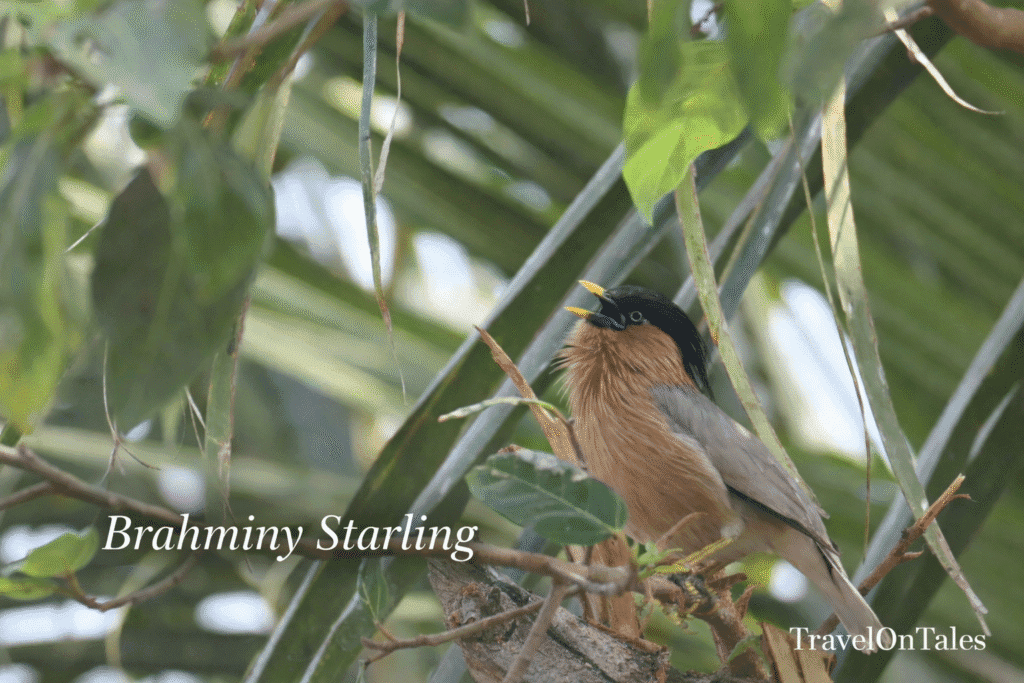
Spotted gracefully perched among dense foliage, this bird carries a subtle charm that grows on you. At first glance, it may seem like just another small passerine, but give it a moment — the black crown, soft buff body, and that striking blue patch near the eye begin to tell a different story.

Meet the Brahminy Starling

The Brahminy Starling (Sturnia pagodarum) is a resident bird of the Indian subcontinent, often seen in open woodlands, farmlands, and urban edges. Unlike its louder cousins, it prefers a more relaxed presence, usually moving in small groups.

What truly sets it apart is its appearance — a glossy black head, a slightly raised crest, and warm brown plumage that blends beautifully with natural surroundings. It’s the kind of bird that doesn’t just sit in the environment, it becomes part of it.

Behavior & Personality

This bird is social but not chaotic. You’ll often find it hopping between branches, occasionally breaking into soft, musical calls. During breeding season, the crest becomes more prominent, giving it a slightly regal look — almost like it knows it’s being watched.

They feed on fruits, insects, and nectar, making them important contributors to the ecosystem. Think of them as quiet gardeners of the wild.

Where You Can Spot Them

If you’re into birding or wildlife photography, places like Bhigwan, Bharatpur, and parts of Maharashtra offer excellent opportunities to spot them. Early mornings are your best bet — when the light is soft and the birds are most active.

Why This Bird Matters

In a world chasing the dramatic — tigers, leopards, and rare sightings — birds like the Brahminy Starling remind us of something important: beauty doesn’t always roar. Sometimes, it just sits quietly on a branch, waiting for you to notice.

Photographer’s Note

This frame captures the Brahminy Starling mid-call, adding life to the stillness. The surrounding foliage creates a natural frame, while the soft background keeps the focus where it belongs — on the bird.

Moments like these are why we step out into the wild.

Fun Facts

  • The Brahminy Starling is also called the “Pagoda Starling” due to its unique crest.
  • It often nests in tree cavities or even old woodpecker holes.
  • Despite being common, it’s often overlooked — a hidden gem for bird lovers.

👉 Click here to explore more wildlife stories

The starling people mistake for a myna

Brahminy Starlings get overlooked because at a glance they look like a pale myna, and in India “myna” absorbs almost every starling-shaped bird. Look again and it is clearly its own thing: creamy buff below, grey above, and a loose black crest that it raises when it is agitated or displaying.

Identification

  • Crest: shaggy black feathers on the crown and nape, often flat and easy to miss until the bird raises them.
  • Underparts: warm buff to rufous-cream, brightest on the breast.
  • Bill: yellow with a blue-grey base.
  • Eye: pale, with bare bluish skin around it.
  • In flight: white tail tips show clearly.
  • Compare Common Myna: browner, bolder, bigger white wing patches, yellow bare face patch, no crest.

Behaviour

They feed on the ground in small parties, walking rather than hopping, and take insects, fruit and nectar. Flowering silk cotton and coral trees pull them in, and they are one of the birds worth watching a flowering tree for in February and March.

The song is a pleasant, varied warbling with a lot of chattering mixed in, delivered from a wire or an exposed branch. It is more musical than any myna and quite unlike the Common Myna’s racket.

Where they live

Widespread across the subcontinent in open dry country — cultivation, thorn scrub, village edges, dry grassland with scattered trees. They avoid dense forest and heavy rainfall zones, so they are far commoner in the Deccan and the north than in the wet Western Ghats.

They are partly nomadic, following flowering and fruiting, which is why a place can hold dozens one month and none the next.

Nesting

Hole nesters. They use natural tree cavities, old woodpecker and barbet holes, and cavities in walls and buildings. That puts them in direct competition with Common Mynas and parakeets for a limited supply of holes, and they usually lose — one reason they are scarcer in built-up areas than their tolerance of dry open country would suggest.

Frequently asked questions

Is the Brahminy Starling a myna?

It is a starling, in the same family as mynas but a different species — Sturnia pagodarum. It is often called Brahminy Myna locally.

How do I tell it from a Common Myna?

The black crest, buff underparts and pale eye. The Common Myna is browner, has a yellow face patch and no crest.

What does it eat?

Insects, fruit and nectar. Flowering trees attract them strongly.

Where is it found?

Dry open country across the subcontinent — cultivation, scrub and village edges. Uncommon in wet forest.


Related: Common vs Jungle Myna.

Scroll to Top