
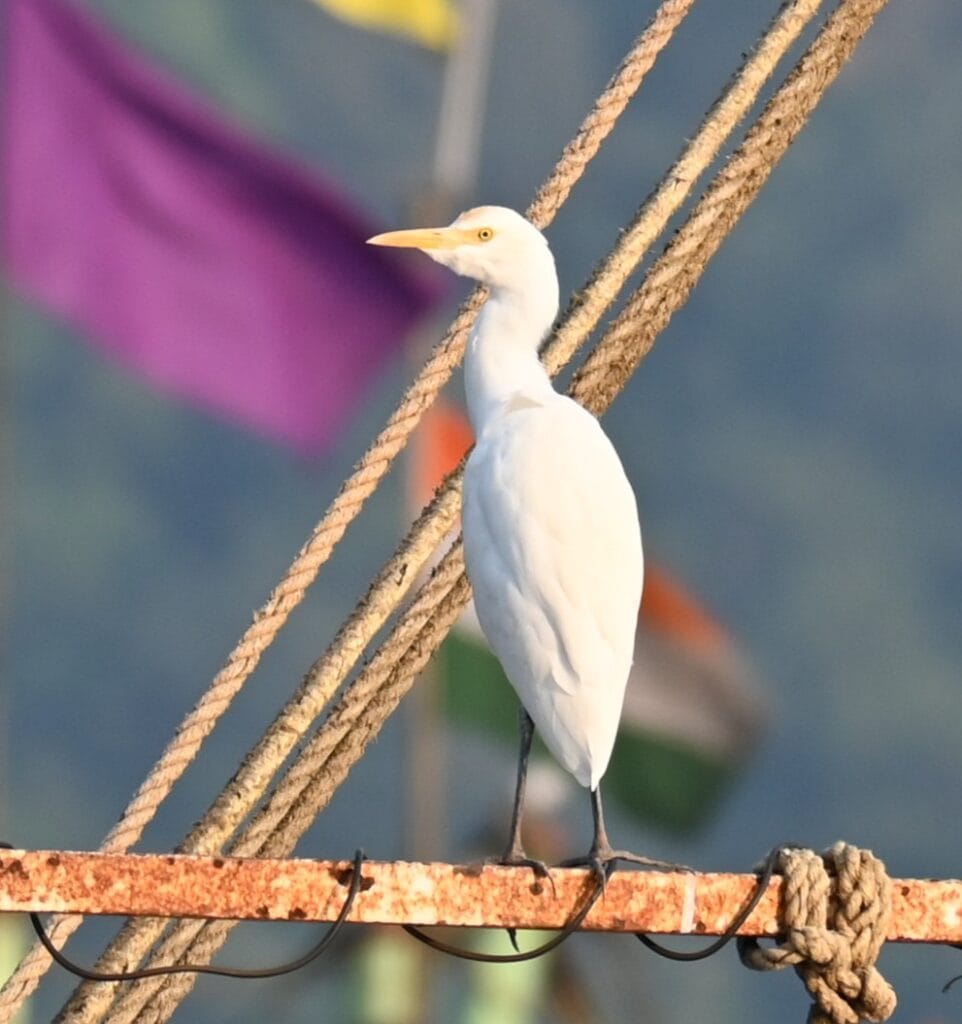
Cattle Egret at Palande Beach, Dapoli
Cattle Egret photography at Palande Beach shows how travel moments don’t always come from dramatic landscapes or action. Sometimes, they come from stillness.
A Quiet Coastal Pause
This Cattle Egret was photographed at Palande Beach in Dapoli, resting calmly on a rope against a soft coastal backdrop. There is no movement, no hunt, no urgency — just a bird standing exactly where it belongs.
About the Cattle Egret
The Bubulcus ibis, commonly known as the Cattle Egret, is widely found across India. It thrives near open fields, wetlands, villages, and coastal areas. Its white plumage, yellow bill, and upright posture make it easy to recognise even from a distance.
Why This Moment Works
What makes this image compelling is not just the bird, but the quiet conversation between nature and human routine. The egret isn’t disturbed by boats or people — it belongs here.
The ropes form gentle leading lines, the background stays soft and uncluttered, and the bird becomes the natural focal point. No drama is forced. The image breathes.
Birds like these don’t demand attention.
They reward observation.
Fun Facts: The Great Egret
While this photograph features a Cattle Egret, its larger cousin, the Great Egret, shares the same quiet elegance along India’s coastlines and wetlands.
- Its bright white feathers once made it a target during the feather trade era.
- Great Egrets are patient hunters and can stand motionless for several minutes.
- Despite their graceful appearance, they can be territorial while feeding.
- They are strong indicators of healthy wetlands and coastal ecosystems.
Click here to explore more bird photography on TravelOnTales
A heron that gave up on water
The Cattle Egret is the odd one out among egrets. The others wade. This one walks around on dry land following large animals, and that single behavioural shift is the most successful thing any heron has ever done.
It evolved following grazing herds — originally wild ungulates, later cattle and buffalo. The animals disturb insects as they move, and the egret walks alongside taking whatever jumps.
Why it is on a beach
Seeing one at Palande, on the Dapoli coast, is less strange than it looks. Cattle Egrets are opportunists that follow disturbance, not water.
On a coast that means beached weed and tideline debris full of sandhoppers and flies, fishing boats being unloaded, drying nets, and cattle grazing on the sand and the scrub above the beach. Anything that turns over ground or concentrates insects works.
The most widespread heron on earth
The Cattle Egret has spread across the world in the last century largely unaided. It reached South America around the 1870s, apparently by flying the Atlantic, then colonised North America, and separately reached Australia.
That expansion tracked the spread of cattle ranching almost exactly. A bird that follows livestock found itself with a food supply being created for it on every continent.
Identifying it
- Bill: yellow and noticeably short and thick, unlike the long dagger of other egrets.
- Shape: stocky, hunched, with a thick jowl. Not elegant.
- Breeding plumage: buff-orange wash on crown, breast and back, and the bill and legs flush red.
- Non-breeding: plain white with yellow bill and dark legs.
The short yellow bill and hunched posture separate it from Little and Intermediate Egrets at any range.
The relationship with cattle
It is genuinely mutual rather than one-sided. The egret gets insects flushed by the animal, and studies have found that cattle accompanied by egrets spend less time flicking and shaking at flies, meaning more time feeding.
Egrets also take ticks and flies directly off the animals, which they tolerate readily.
Photographing them
- Shoot the association. An egret alone is a white bird. An egret on or beside a buffalo is the story.
- Go in breeding season for the buff plumes and red bill, which are far more interesting than plain white.
- Underexpose slightly as with any white bird in strong light.
- On the coast, use the setting — boats, nets and tideline give context you will not get inland.
Frequently asked questions
Why is it called a Cattle Egret?
It follows grazing animals and feeds on the insects they disturb.
What is it doing on a beach?
Following food. Tideline debris, fishing activity and coastal grazing all concentrate insects.
How do I tell it from other egrets?
Short thick yellow bill, stocky hunched shape, and it feeds on dry land rather than wading.
Do cattle benefit from the egrets?
Yes. Egrets remove flies and ticks, and cattle with egrets spend less effort on fly-swatting.
Related: Telling the white egrets apart and Black-hooded Oriole at Dapoli.