
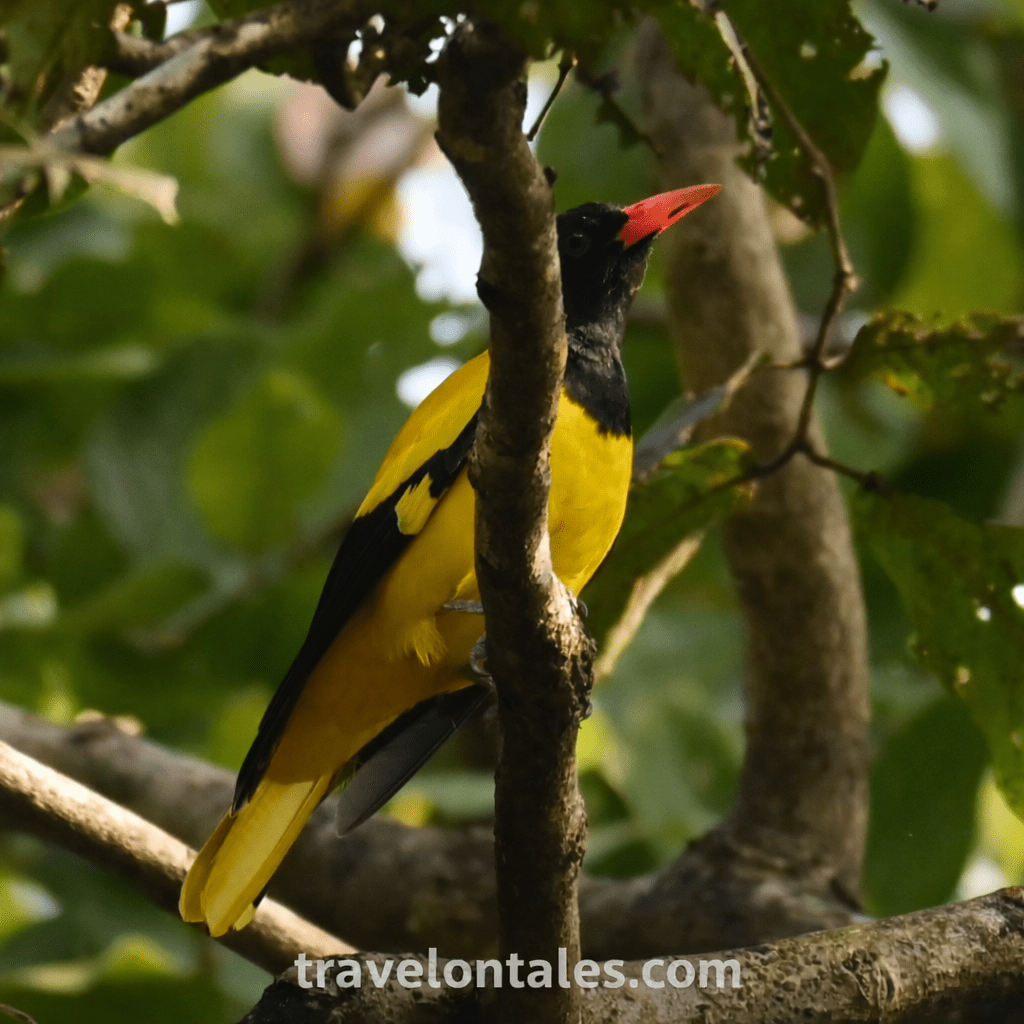
Black-hooded Oriole Black-hooded Oriole at Keshavraj Temple, Dapoli

Black-hooded Oriole perched inside dense forest foliage at Keshavraj Temple, Dapoli

Black-hooded Oriole in the Forests of Keshavraj Temple, Dapoli

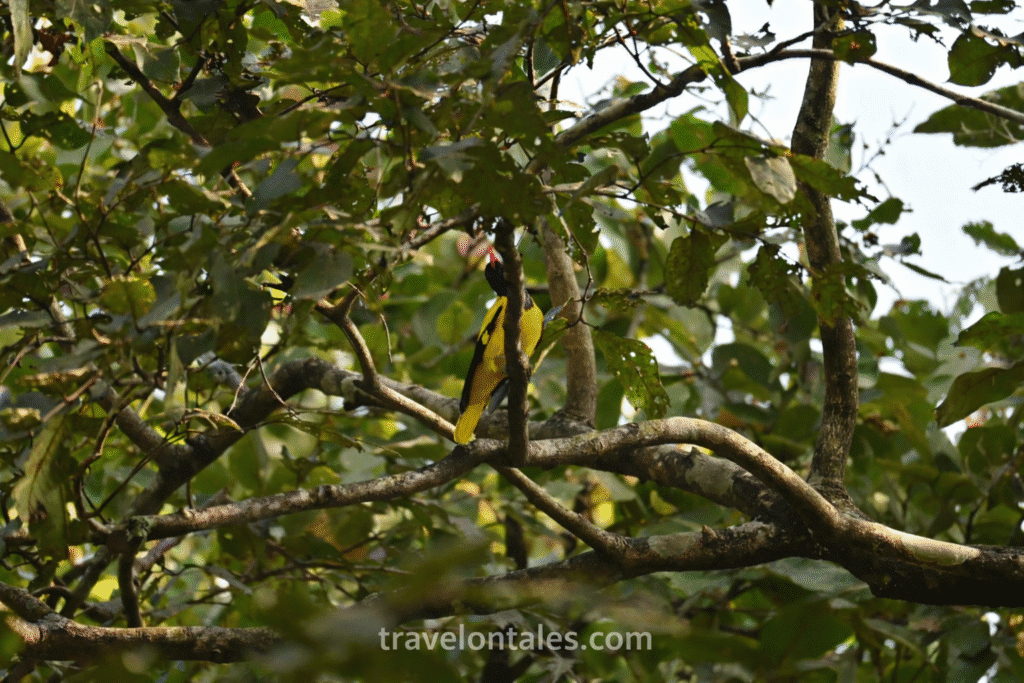
This Black-hooded Oriole was spotted inside the forest near Keshavraj Temple, Dapoli. Surrounded by thick branches and layered foliage, the bird appears almost hidden — revealing itself only through flashes of luminous yellow and a brief hint of red from its beak.

When the Forest Becomes the Frame

The forest here doesn’t offer clean backgrounds or easy compositions. Light filters through leaves unevenly, branches criss-cross without warning, and birds choose concealment over display. You don’t find photo opportunities here — you wait for them.

Every glimpse of colour feels earned. Every quiet moment becomes part of the photograph. In places like this, patience matters more than equipment, and observation matters more than speed.

The Oriole Isn’t Performing

It isn’t posing or calling attention to itself. It’s simply existing — watching, waiting, listening. A quiet presence in a forest that moves at its own pace.

In a world full of staged moments, forest birds like this oriole remind us that wildlife is not about spectacle — it’s about presence.

About the Black-hooded Oriole

The Black-hooded Oriole (Oriolus xanthornus) is commonly found across the Indian subcontinent, especially in wooded areas, groves, and forest edges. Despite its bright colours, it prefers staying within dense foliage and is often detected more by movement than by sight.

A Quiet Takeaway for Birdwatchers

If you’re exploring birdlife around Dapoli or the coastal forests of Maharashtra, slow down. Let your eyes adjust to the layers of green. Listen before you look.

And when the oriole finally reveals itself — even for a few seconds — you understand why moments like these stay with you longer than any perfect frame.

Click here to explore more bird photography on TravelOnTales
Heard long before it is seen

The Black-hooded Oriole is a brilliant yellow bird with a jet-black head, and despite that it is remarkably hard to spot. It stays high in the canopy, moves quietly between fruiting trees, and the yellow reads as dappled sunlight through leaves.

What gives it away is the call — a rich, fluty, liquid whistle, quite unlike anything else in an Indian forest. Learn that sound and you will find the bird.

Identifying it

  • Head: completely black hood covering head, throat and upper breast.
  • Body: deep golden yellow.
  • Bill: pinkish-red, heavy and slightly curved.
  • Eye: deep red.
  • Wings: black with a yellow panel.

The Indian Golden Oriole is the one to separate it from — that bird has a yellow head with only a black stripe through the eye, not a full hood.

What it eats

Mainly fruit, particularly figs, along with nectar and a good proportion of insects, especially when feeding young.

A fruiting fig tree is the single best place to look. When a large fig comes into fruit it draws orioles, barbets, hornbills, green pigeons and bulbuls simultaneously, and sitting under one for an hour will give you more species than a morning of walking.

The nest

Orioles build a neat, deep, hammock-like cup slung between the fork of a thin horizontal branch, bound with fibre and often with cobweb.

It is placed well out towards the end of a branch, which makes it hard for a climbing predator to reach. Both parents build and feed.

An interesting neighbour

Orioles are frequently found nesting near drongos. This is not coincidence. Drongos are exceptionally aggressive towards crows and raptors, and a nest built inside a drongo territory gets that defence for free.

It is a well-documented association across several Asian bird species and a nice thing to watch for — if you find an oriole nest, look for a drongo nearby.

Where to look

Well-wooded gardens, groves, forest edge, plantations and village trees with large fruiting species. It is a canopy bird, so look up rather than into the undergrowth.

Photographing orioles

  • Find the fig tree. Waiting at fruit beats searching, every time.
  • Expose carefully. Brilliant yellow against dark canopy is a difficult range; protect the yellow from blowing out.
  • Shoot upward but not straight up. Find an angle where the bird is against foliage rather than white sky.
  • Listen first. The call locates the bird far more efficiently than scanning does.

Frequently asked questions

How do I tell a Black-hooded Oriole from a Golden Oriole?

The Black-hooded has a complete black hood over the head and throat. The Indian Golden Oriole has a yellow head with just a black eye stripe.

What do orioles eat?

Fruit — especially figs — plus nectar and insects.

Why do orioles nest near drongos?

Drongos aggressively drive off crows and raptors, so an oriole nesting nearby gains protection.

Where is the best place to see one?

At a fruiting fig tree in wooded country. Listen for the fluty whistle.


Related: Sindhudurg Monsoon Birding Guide and Birds of Sindhudurg Field Guide.

Scroll to Top