
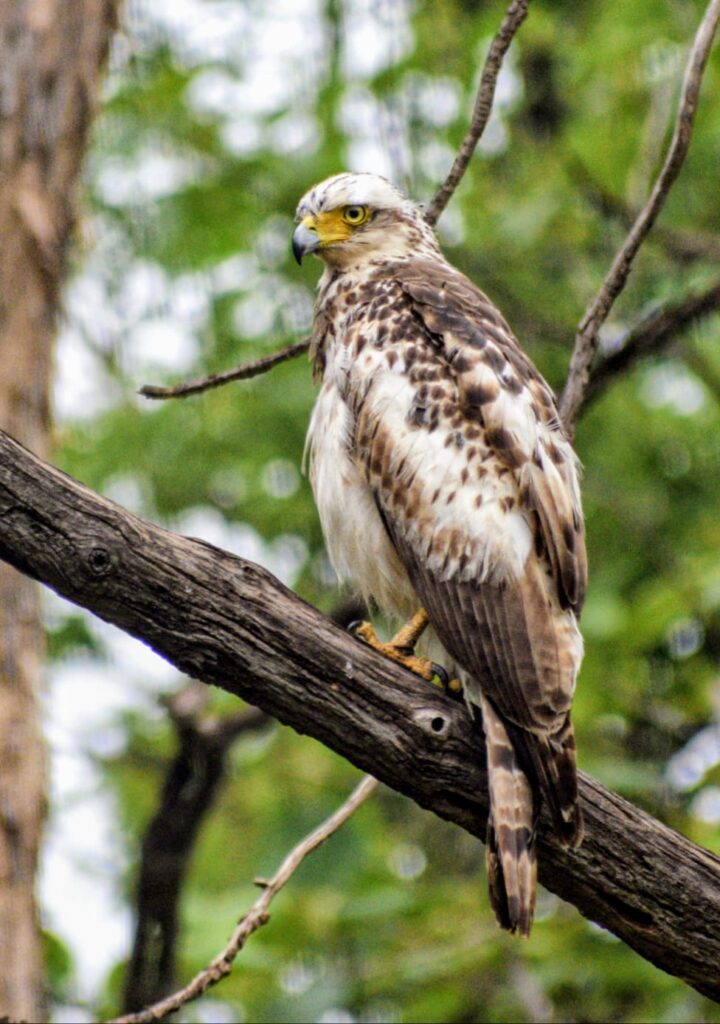
Changeable Hawk-Eagle Spotted at Tadoba National Park

Changeable Hawk-Eagle

Introduction to the Changeable Hawk-Eagle

The Changeable Hawk-Eagle (Nisaetus cirrhatus) is one of India’s most striking raptors. Known for its adaptability and fierce hunting skills, this bird of prey is a powerful symbol of the wild. True to its name, the species shows variation in plumage and appearance, with both crested and crestless morphs. The bird captured here at Tadoba is a crestless morph, distinguished by its strong build, piercing yellow eyes, and mottled brown-and-white feathers.

Changeable Hawk-Eagle in Tadoba

Tadoba Andhari Tiger Reserve, though famed for its tigers, also provides a thriving habitat for raptors like the Hawk-Eagle. They perch silently on high branches, scanning the forest floor for prey. Their presence reflects the richness of Tadoba’s bird diversity, which includes more than 195 avian species.

Distinguishing Features of the Changeable Hawk-Eagle

Plumage Variability

This raptor is called “Changeable” because its plumage varies widely — from heavily streaked morphs to lighter versions. The one in this photo is pale with bold streaks on the chest and belly.

Eyes and Beak

Its sharp yellow eyes and hooked black beak give it a menacing and regal appearance. These features are classic identifiers of the Hawk-Eagle.

Hunting Behavior

Hawk-Eagles are skilled predators, feeding on medium-sized birds, reptiles, and mammals. They swoop down with incredible speed and precision, making them one of the apex aerial hunters of Tadoba.

Ecological Role

As top predators, Hawk-Eagles help maintain ecological balance by controlling populations of smaller birds and mammals. Their presence is a marker of a healthy, functioning forest ecosystem.

Fun Facts About the Changeable Hawk-Eagle

  • The name “Changeable” comes from its diverse plumage patterns.
  • It can hunt prey nearly its own size, including junglefowl and small deer fawns.
  • Unlike kites and buzzards, Hawk-Eagles are solitary and fiercely territorial.
  • They are often mistaken for Crested Serpent Eagles, but their heavier build and hunting style set them apart.

Wildlife Photography in Tadoba

Photographing raptors like the Hawk-Eagle requires patience and luck. They often perch high in dense canopies, scanning for prey. This image captures the raw power and intensity of the eagle, with its sharp gaze locked on the forest below — a perfect frame of Tadoba’s untamed spirit.


Fun Facts

  • Fierce solitary hunter.
  • Plumage varies greatly (hence “Changeable”).
  • Hunts from tall perches with lightning-fast strikes.
  • Apex predator in its range.

The eagle with two versions of itself

The Changeable Hawk-Eagle earns its name. The species occurs in a crested form and a crestless form, and in some regions a dark morph as well — birds that are almost entirely chocolate brown.

These are not different species or different ages. They are colour morphs of the same bird, and they interbreed. It is one of the more confusing raptors in India for exactly this reason.

  • Crested form: long upright crest, pale underparts with heavy dark streaking.
  • Crestless form: no crest at all, otherwise similar. Common in peninsular India.
  • Dark morph: uniformly dark brown, easily mistaken for a different species entirely.

Telling it from other raptors

Hawk-eagles have feathered legs right down to the toes, which distinguishes them from most other large raptors at close range. They are also long-tailed and relatively short-winged compared with true eagles.

That shape is a hunting adaptation. Short broad wings and a long tail give manoeuvrability among trees rather than efficiency in open soaring, which is what a forest predator needs.

How it hunts

From a perch, usually inside or at the edge of forest. It sits still — often for a very long time — and drops onto prey.

It takes a wide range: jungle fowl, pigeons and other birds, hares, squirrels, monitor lizards, snakes and occasionally young langurs. It is powerful enough to take prey heavier than itself.

Because it hunts from a perch rather than soaring, sightings usually come from noticing a large shape sitting motionless rather than from scanning the sky.

Where to look at Tadoba

Along forest roads, at the edges of clearings, and around waterholes where prey concentrates. Look at the larger bare branches in the mid to upper canopy.

Alarm calls help here too. Langurs and jungle fowl mob and call at perched hawk-eagles, which is often what gives the bird away.

Photographing it

  • Look for the shape, not the colour. With three morphs, colour is unreliable. Learn the silhouette — long tail, upright posture, feathered legs.
  • Photograph the legs if you can. Fully feathered tarsi confirm a hawk-eagle.
  • Be patient with a perched bird. It may sit for an hour, then launch without warning.
  • Expose for the underparts when the bird is against sky, or you will get a silhouette.

Frequently asked questions

Why is it called Changeable?

Because it occurs in crested, crestless and dark forms that look substantially different from one another.

Are the crested and crestless birds different species?

No. They are colour morphs of the same species and interbreed.

What does it eat?

Birds including jungle fowl, plus hares, squirrels, lizards and snakes. It can take prey heavier than itself.

How do I know it is a hawk-eagle?

Feathered legs down to the toes, a long tail, short broad wings and an upright perched posture.


Related: Birds of Tadoba National Park, Short-toed Snake Eagle vs Bonelli’s Eagle and Tadoba Safari Guide.

Scroll to Top