
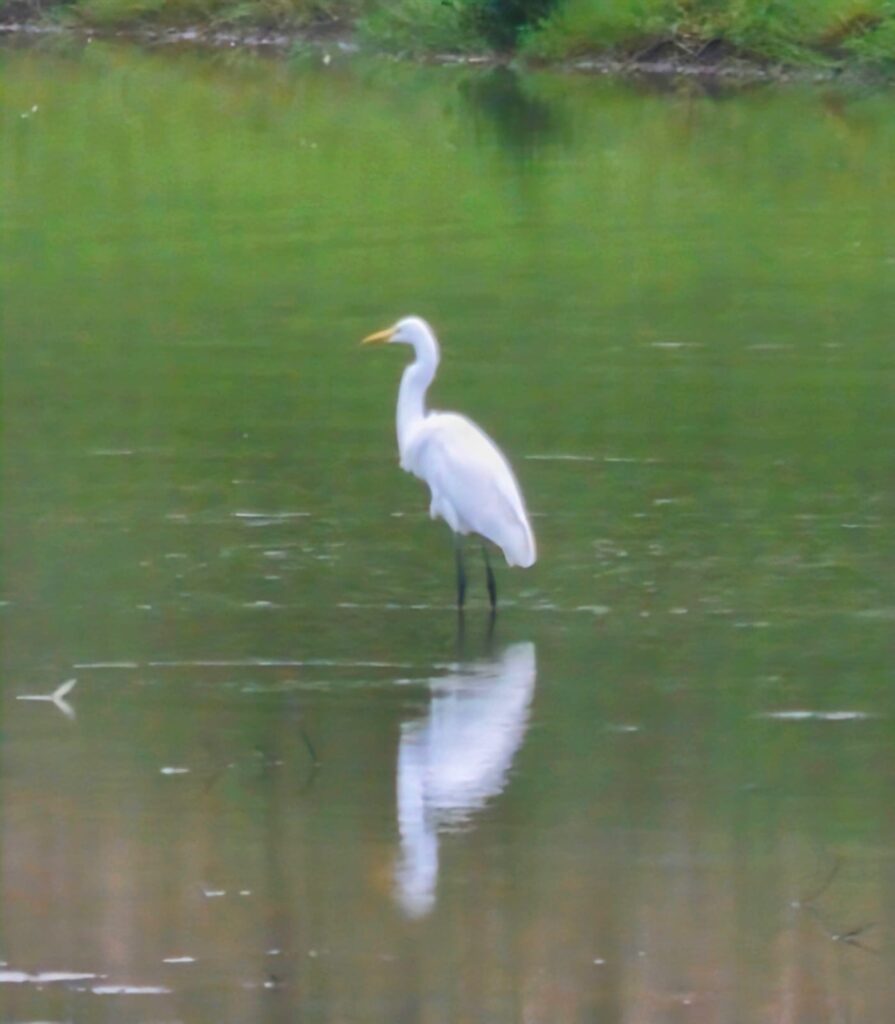
Great Egret of Tadoba
Introduction
While exploring the wetlands of Tadoba, spotting a Great Egret is like watching poetry in motion. With its all-white plumage, tall frame, and calm posture in shallow waters, this bird is a true symbol of grace and patience.
Appearance (Plumage)
The Great Egret has pure snow-white feathers, a long yellow bill, and black legs and feet. Its slim neck forms a beautiful S-curve when resting and stretches out like a spear when hunting.
Habitat & Behavior
- Found in wetlands, lakes, rivers, and marshes.
- Hunts silently by standing still and then quickly striking fish, frogs, or small aquatic creatures.
- Flies slowly with long wings, neck tucked in (unlike cranes which fly with necks outstretched).
Fun Facts
- During the breeding season, the egret grows long, delicate plumes on its back called aigrettes—once heavily hunted for fashion hats.
- Known as a symbol of conservation success: populations recovered after strict protection laws.
- Despite its elegance, it’s a fierce huner, able to catch prey in a split second.
Why You’ll Love Seeing It in Tadoba
The contrast of the egret’s bright white against Tadoba’s lush green wetlands makes it a photographer’s delight. Its reflection in the water adds a mirror-like beauty to any frame.
Telling the white egrets apart
Three white egrets share Indian wetlands and they confuse almost everybody. Size is unreliable at distance. Use the bill and the legs instead.
- Great Egret: largest. Yellow bill outside the breeding season, black in breeding condition. Black legs and black feet. A distinctive kink in the neck.
- Intermediate Egret: mid-sized, shorter bill, and the gape line stops below the eye rather than extending past it.
- Little Egret: smallest. Black bill and black legs but yellow feet — as though wearing socks.
The yellow feet of the Little Egret are the single most useful field mark of the three. If you can see the feet, you have your answer.
The gape line
For separating Great from Intermediate, look at the line of the mouth. On a Great Egret it continues backwards past the eye. On an Intermediate it stops beneath the eye.
It sounds fussy, but it is visible in a decent photograph and it is definitive where size comparison fails.
How it hunts
A Great Egret hunts by standing still. That is the whole technique, and it is far harder than it looks.
It will hold a pose for minutes, neck folded into its S-kink, waiting for a fish to move within range. When it strikes, the neck unfolds like a released spring — the kink stores the energy. The strike is faster than the eye follows.
It also walks slowly through shallows, and sometimes stirs the bottom with a foot to flush prey.
The breeding change
In breeding condition a Great Egret transforms. The yellow bill turns black, the skin between bill and eye flushes green, and long, fine plumes grow from the back.
Those plumes nearly destroyed the species. In the nineteenth and early twentieth centuries they were harvested for the hat trade, and egret populations collapsed across three continents. The campaigns to stop that trade were the beginning of modern bird conservation — the Great Egret is the emblem of the National Audubon Society for precisely this reason.
Where to see them at Tadoba
Tadoba lake, Telia lake and the smaller waterbodies. Egrets are among the easiest birds to find in the reserve and are often ignored by visitors watching for tigers.
The dry months concentrate them, because the remaining water concentrates the fish.
Photographing white birds
- Underexpose slightly. White plumage in sun blows out instantly, and blown highlights cannot be recovered.
- Avoid midday. Early and late light keeps detail in the feathers.
- Wait for the strike. A standing egret is a static photograph. The strike, or the moment after with a fish, is the picture.
- Get low. Water-level perspective separates the bird from a cluttered bank.
Frequently asked questions
How do I tell a Great Egret from a Little Egret?
Look at the feet. The Little Egret has yellow feet on black legs. The Great Egret has black feet, is larger, and usually has a yellow bill.
Why does the Great Egret have a kinked neck?
The kink stores energy. Straightening it drives the strike at high speed.
Does its bill change colour?
Yes. Yellow normally, black in breeding condition, along with green facial skin and long back plumes.
Where can I see Great Egrets at Tadoba?
Tadoba and Telia lakes and the smaller waterbodies, particularly in the dry months.
Why were egrets hunted?
For their breeding plumes, used in the hat trade. The resulting collapse in numbers helped launch modern bird conservation.
Related: Birds of Tadoba National Park and Asian Openbill Stork at Tadoba.
