
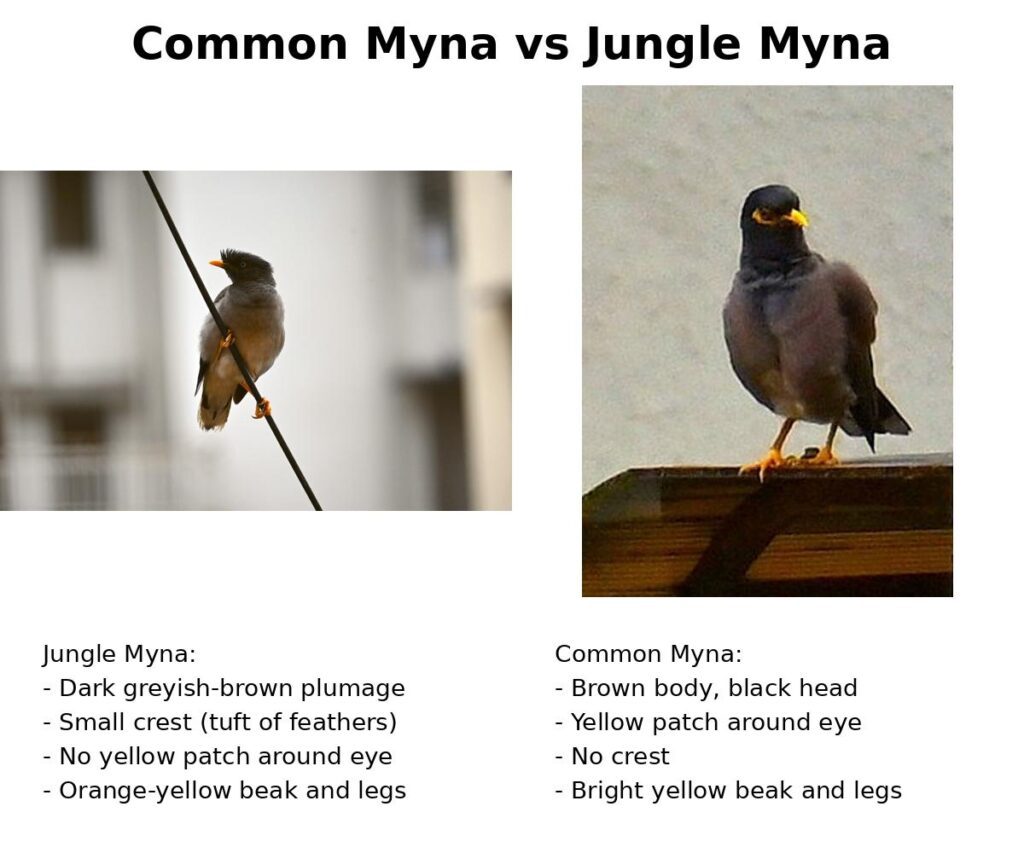
If you live in India or Southeast Asia, chances are you’ve spotted a noisy, chatty bird perched on wires or rooftops. That’s most likely a Myna. But did you know there are two similar-looking species often confused with each other — the Common Myna (Acridotheres tristis) and the Jungle Myna (Acridotheres fuscus)?
Both belong to the starling family, are smart mimics, and thrive around humans. However, a closer look reveals some striking differences. Let’s break it down.
1. Appearance
Common Myna:
- Has a glossy brown body with a black head.
- Distinctive yellow patch (wattle) around the eyes.
- Bright yellow beak and legs.
- Sleek, no crest on its head.
Jungle Myna:
- Slightly darker greyish-brown plumage.
- No yellow patch around the eye.
- Has a small tuft of feathers (crest) at the forehead, giving it a spiky look.
- Orange-yellow beak, sometimes with a bluish base.
2. Habitat
- Common Myna: Loves urban life — you’ll find it in cities, towns, markets, and near human settlements.
- Jungle Myna: Prefers rural areas, open fields, and forest edges, but occasionally visits towns.
3. Behavior
- Common Myna: Very bold, noisy, and often seen scavenging in groups. Known for competing with other birds for nesting spaces.
- Jungle Myna: Comparatively shy, often seen in pairs or small flocks. Their calls are softer compared to the Common Myna’s loud chatter.
4. Distribution
- Common Myna: Found widely across India, Southeast Asia, and introduced to countries like Australia and New Zealand.
- Jungle Myna: Found mainly in the Indian subcontinent and Southeast Asia, particularly in countryside regions.
Quick Identification Tip
If you spot a Myna in a crowded city with yellow skin around its eyes, it’s the Common Myna.
If you see one with a little crest on the head and no yellow patch, that’s the Jungle Myna
Both Common Myna and Jungle Myna are fascinating species that have adapted well to their environments. The next time you see one perched on a wire or rooftop, look closer — is it the city-loving Common Myna, or the crest-wearing Jungle Myna from the countryside?
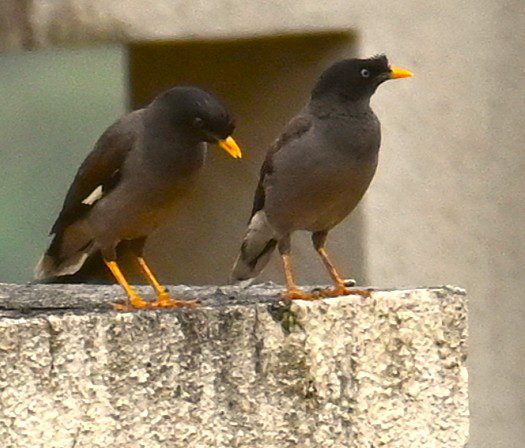
Side by side
These two share the same fields, roadsides and villages across much of India, and most people never separate them. It takes one look at the face.
- Common Myna: bare yellow skin patch behind the eye. Warm brown body, black head, yellow bill and legs.
- Jungle Myna: no bare skin — the face is feathered. A small tuft of feathers at the base of the bill, a pale bluish or whitish eye, and greyer, plainer plumage.
The yellow eye patch is the whole test. Present means Common; absent means Jungle.
Where they differ in habits
The Common Myna is the more urban of the two and will live in the middle of a city, nesting in air-conditioner housings, roof cavities and signage.
The Jungle Myna prefers the edges — cultivation next to woodland, tea and coffee estates, grazing land, village margins. It is less willing to live in dense settlement.
Where both occur they mix in feeding flocks and at roosts, which is precisely why learning to separate them is worth the trouble.
The most invasive bird in the world
The Common Myna has been introduced far beyond its native range — Australia, New Zealand, South Africa, Hawaii, the Middle East and many island groups — and it is listed among the world’s worst invasive species.
The problem is that it is an aggressive cavity nester. It evicts native hole-nesting birds and small mammals, and in island ecosystems with vulnerable endemic species the damage has been serious.
In India it is native and part of the landscape. The invasiveness is a story about where humans have taken it, not about the bird itself.
Behaviour worth noticing
Both species walk rather than hop, which separates mynas from most small birds instantly. Both are highly social and roost communally in large noisy gatherings at dusk.
Common Mynas are also capable mimics and pair for life, with pairs remaining together year-round and defending a territory jointly.
Photographing mynas
- Get the face sharp. With these two the identification lives in a small patch of skin behind the eye.
- Shoot both together if the chance comes — a comparison frame is far more useful than two portraits.
- Use the cattle. Birds following grazers are relaxed and give you behaviour.
- Low light helps. Brown and grey plumage looks dull at midday.
Frequently asked questions
How do I tell a Common Myna from a Jungle Myna?
The Common Myna has a bare yellow patch of skin behind the eye. The Jungle Myna has a feathered face, a small tuft above the bill and a pale eye.
Which one lives in cities?
The Common Myna is far more urban. The Jungle Myna prefers cultivation and woodland edges.
Why is the Common Myna considered invasive?
Where introduced outside its native range it aggressively takes over nest cavities from native species. In India it is native.
Do mynas mimic?
Yes, particularly the Common Myna, though not as impressively as the Hill Myna.
Related: Jungle Myna in detail and Birds of Bhigwan.
