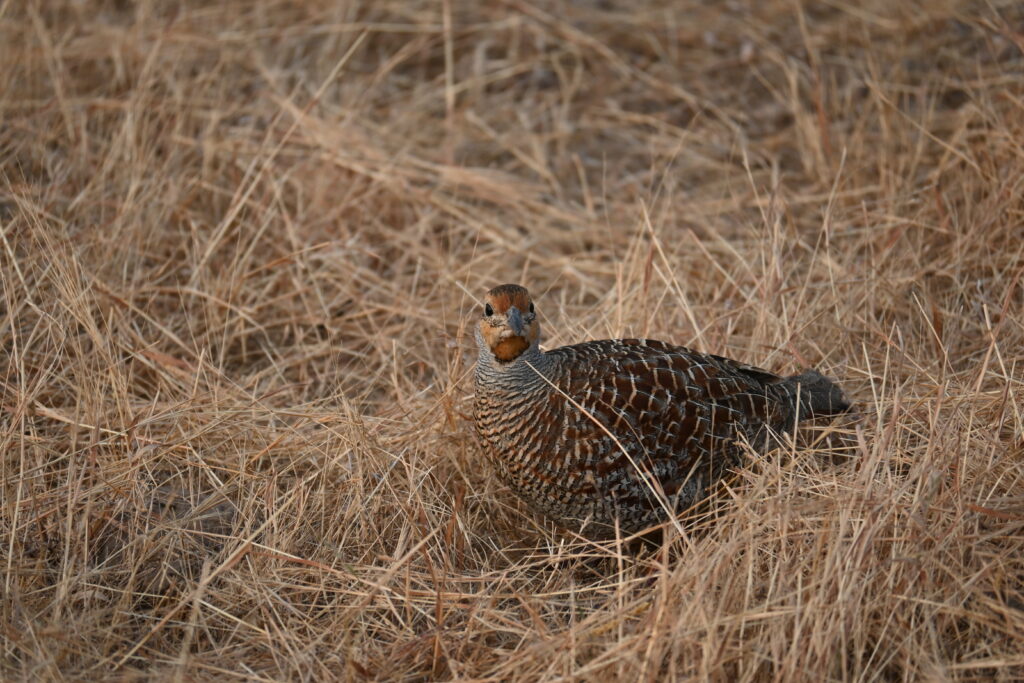
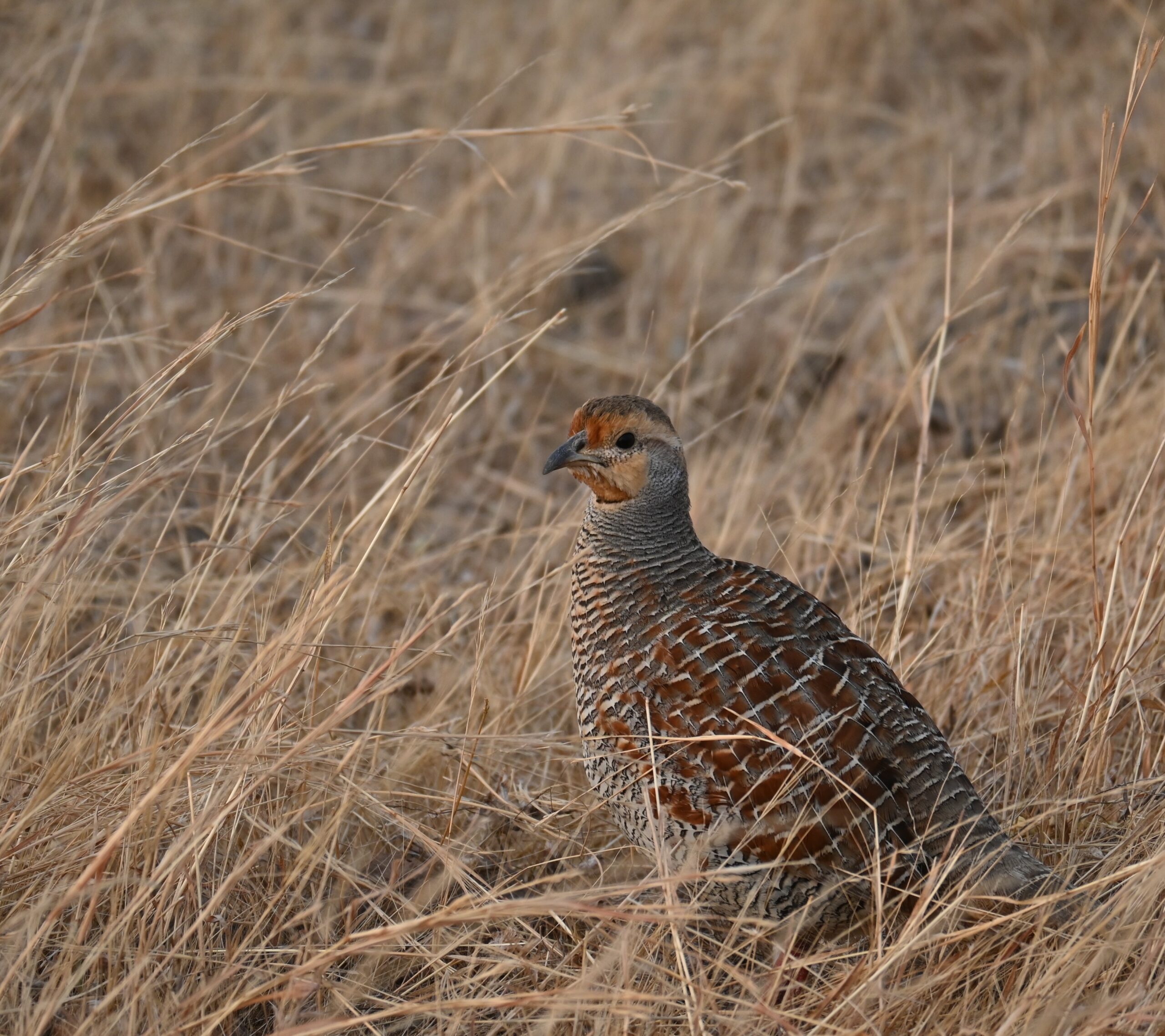
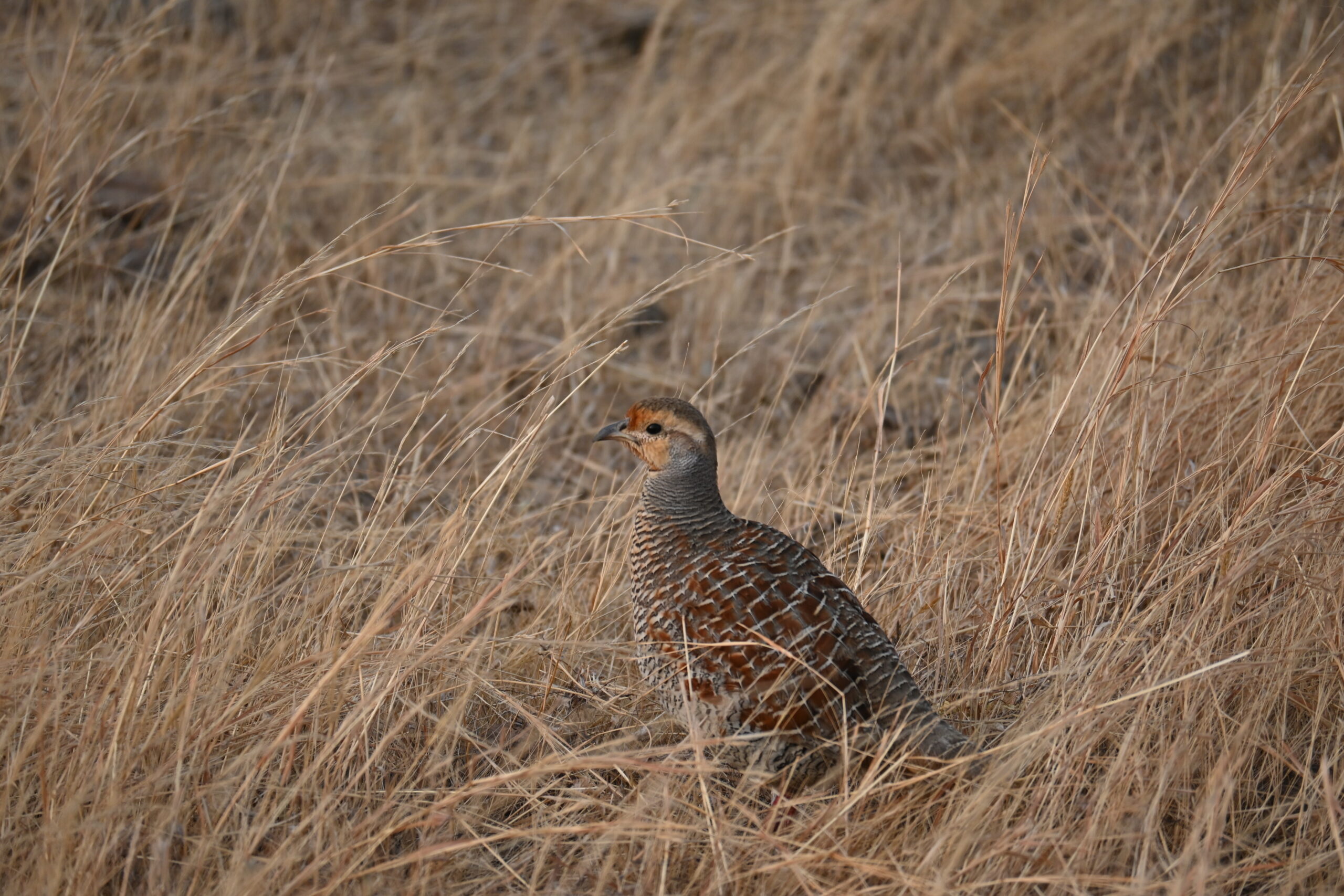
Grey Francolin (Francolinus pondicerianus) — alert posture, Kadbanwadi Grasslands, Bhigwan · © Prashant S. Gupta / TravelOnTales
The Grey Francolin at Bhigwan is one of those quietly brilliant sightings that rewards patient birders who look past the flamingos and raptors. Perfectly camouflaged in the dry tawny grasslands of Kadbanwadi, Francolinus pondicerianus blends almost invisibly into the straw — until it stands tall, fixes you with that bold russet eye, and you realise you’ve been watching something extraordinary all along.
Bhigwan Bird Sanctuary, spread across the backwaters of Ujani Dam on the Bhima River in Pune district, Maharashtra, is rightly famous for its wintering flamingos and harriers. But the Kadbanwadi Grasslands section — a broad expanse of dry scrub and golden grass adjoining the wetland — holds its own remarkable community of ground-dwelling birds. The Grey Francolin is one of its most characteristic and photogenic residents.
These four photographs were taken during an April morning session at Kadbanwadi — low light, still air, and a family group of Grey Francolins foraging slowly through the dry grass, completely unconcerned by the presence of the vehicle. Shot on Nikon Z50 without any supplementary lighting or editing beyond basic raw conversion.
| Common Name | Grey Francolin |
| Scientific Name | Francolinus pondicerianus |
| Family | Phasianidae (Pheasants & Partridges) |
| Size | 33–36 cm · stocky, ground-dwelling |
| Key Field Marks | Russet-orange crown, finely barred brown-grey plumage, pale throat with fine dark necklace, dark eye with pale supercilium |
| Voice | Loud, carrying ka-tee-tar, ka-tee-tar — most vocal at dawn and dusk |
| Status in India | Common resident · widespread across dry open country |
| IUCN Status | Least Concern |
| At Bhigwan | Year-round resident · Kadbanwadi Grasslands, scrub edges |
| Best Time | Early morning · October to March for clearest light |
Identifying the Grey Francolin — What to Look For
The Grey Francolin is a medium-sized, plump ground bird — roughly pigeon-sized but considerably more robust, with the hunched posture characteristic of francolins and partridges. In the Kadbanwadi grasslands, the species typically holds very still when alarmed, relying on its superb camouflage before deciding to run or flush.
The most distinctive feature — visible clearly in these photographs — is the rich russet-orange crown and nape, contrasting sharply with the finely barred grey-brown of the neck, breast and flanks. Look closely at the plumage and you’ll see an intricate pattern of dark chevrons and pale streaks on the body feathers, a pattern so finely detailed it looks almost woven. The throat is paler, with a thin dark collar. The eye is dark and alert, set in a plain face with a pale supercilium.
Males and females are broadly similar in plumage, though males carry a small spur on the tarsus. The call is far more often heard than the bird is seen — a loud, repetitive ka-tee-tar, ka-tee-tar that carries across the grassland, especially in the first hour of light. Once you know the call, you begin to appreciate just how abundant Grey Francolins are at Bhigwan.
“It held perfectly still for nearly four minutes — watching me watch it — before turning and walking slowly back into the grass. No drama. Just complete composure.”
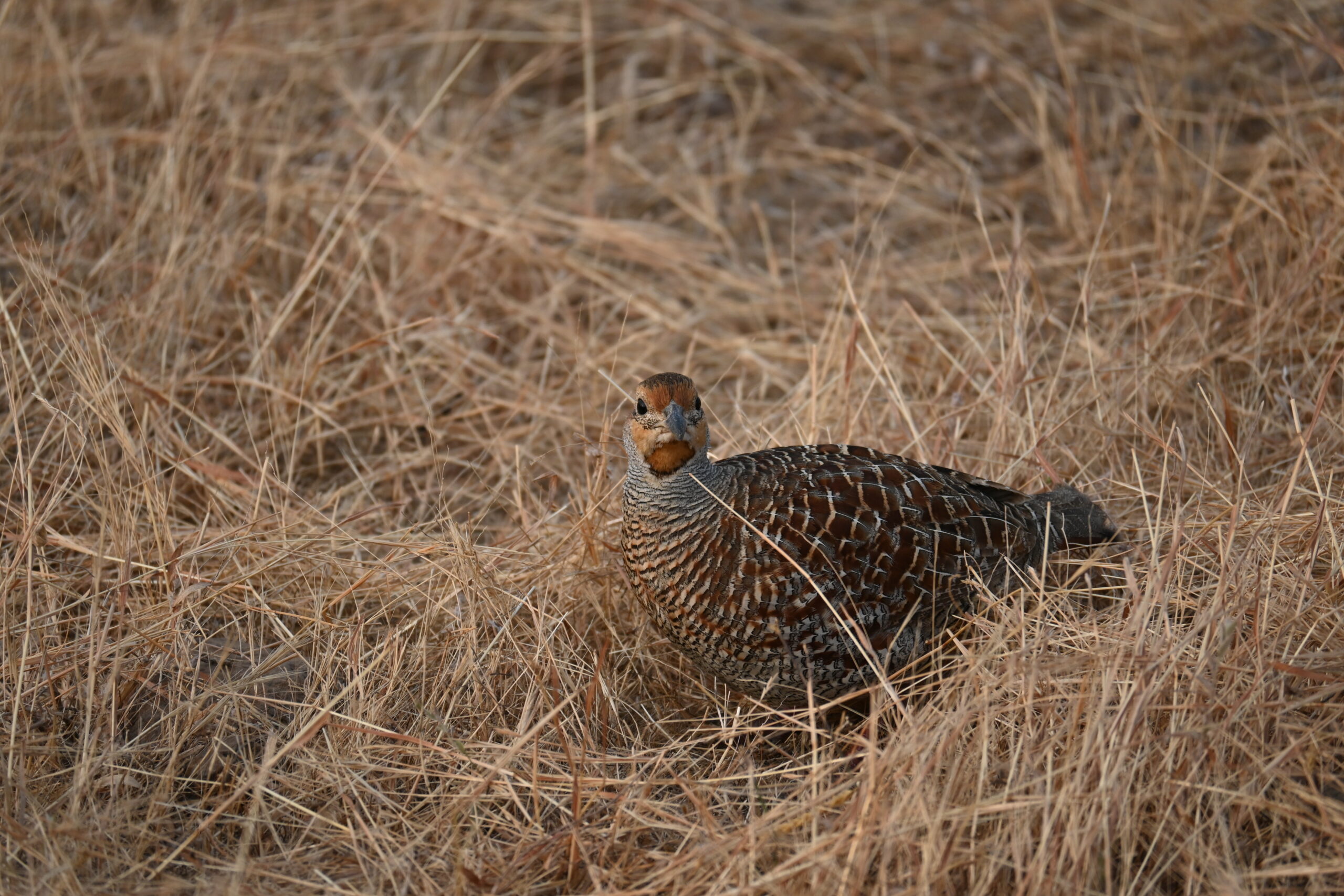
Standing alert — side profile showing the full body, russet crown and intricately barred flanks · Kadbanwadi Grasslands · © Prashant S. Gupta / TravelOnTales
Habitat, Behaviour and What Makes Kadbanwadi Special
Grey Francolins favour dry open country — scrubby grasslands, agricultural margins, thorn scrub and fallow fields. At Bhigwan, the Kadbanwadi Grasslands represent ideal habitat: broad, open, with patches of dry grass, scattered low scrub and bare earth between tussocks. The species occurs here as a year-round resident, breeding in the area and present even through the hot summer months when most migratory visitors have long departed.
Behaviour is typically ground-level — the Grey Francolin forages by walking slowly and deliberately, picking seeds, insects and small invertebrates from the soil surface and between grass stems. When disturbed, the first response is to freeze, then walk quickly away on foot. Flight is taken only as a last resort — a sudden burst of rapid wingbeats followed by a long glide back to cover.
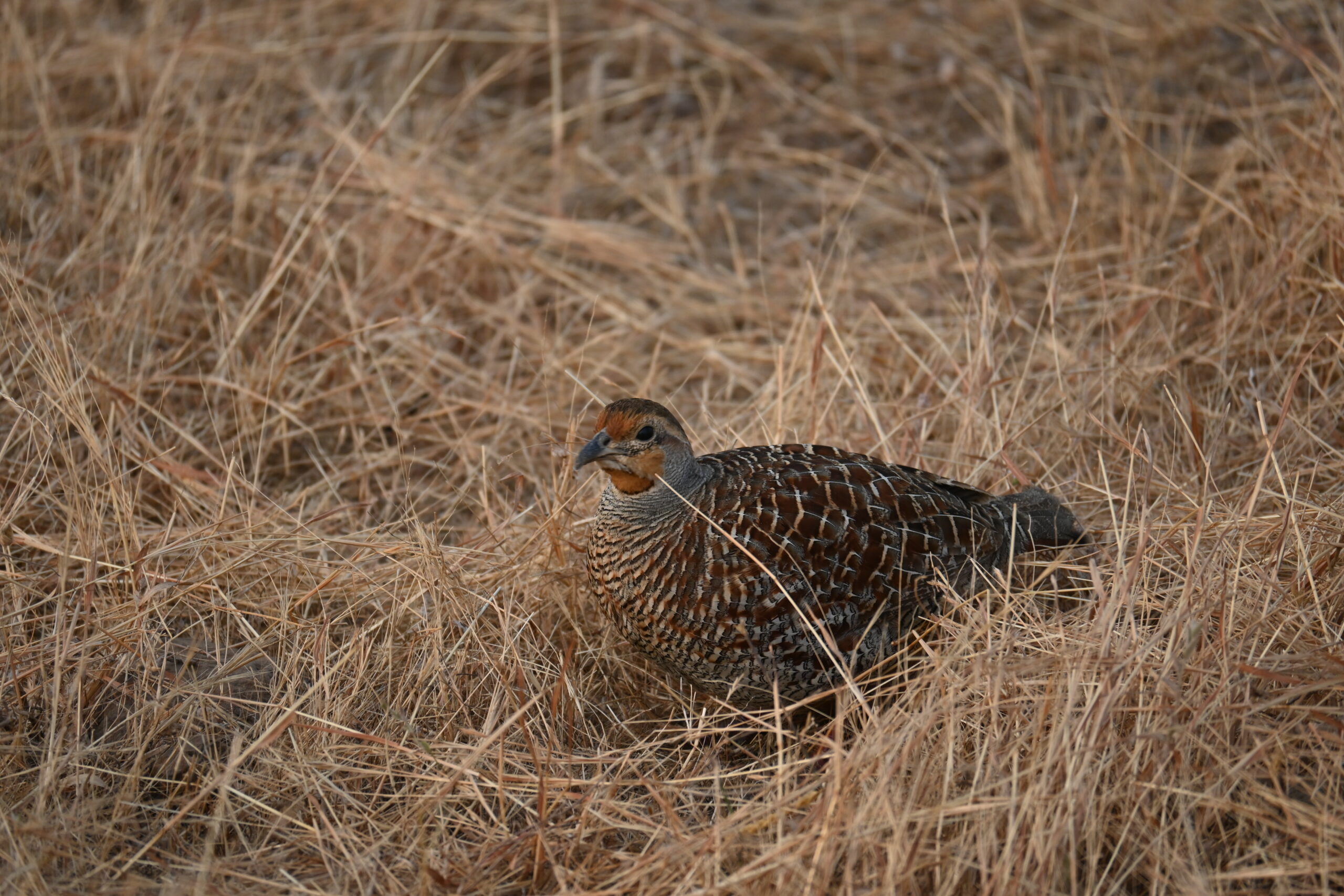
Group size is typically pairs or small family groups of 3–6 birds. During the breeding season (March to June in Maharashtra) the male becomes conspicuously vocal, calling repeatedly from an exposed vantage — a low mound, a boulder or a fence post — before descending to forage with the female. Chicks are precocial and follow the adults almost immediately after hatching.
- Time of observation: 06:45 – 07:30 IST (first hour after sunrise)
- Group size: 3 birds — likely a pair with one juvenile
- Behaviour: Active foraging, moving slowly through dry grass; one individual stood alert for extended periods
- Habitat: Open dry grassland with sparse low scrub, dry grass 30–60 cm height
- Light: Golden side-light, clear sky, no wind — ideal conditions
- Distance: Approximately 8–12 metres from vehicle; birds showed no alarm at vehicle presence
- Camera: Nikon Z50 · no supplementary lighting · minimal post-processing
Photography Tips — Grey Francolin at Kadbanwadi
-
🌅
First Light is Everything Arrive at Kadbanwadi by 06:30 at the latest. Grey Francolins are most active and most visible in the first 90 minutes after sunrise. The golden side-light also transforms the dry grassland into something truly beautiful.
-
🚗
Stay in the Vehicle Grey Francolins at Kadbanwadi are remarkably tolerant of vehicles but will flush instantly if you step out. All four of these images were taken from a seated position inside a safari jeep.
-
🔇
Patience Over Movement If you spot a francolin, stop completely and wait. Within minutes the bird will typically return to normal foraging behaviour, often moving closer. Rushing or panning noisily will flush it immediately.
-
📷
Lens Choice A 300–500mm equivalent gives comfortable working distance without disturbing the bird. The Nikon Z50 with the 70-300mm kit lens works well here — the close approach distance at Kadbanwadi means you don’t always need extreme reach.
-
🌿
Embrace the Grass Don’t try to avoid the foreground grass. The natural framing of dry tussocks in front of and around the bird creates the authentic grassland feel — it’s what makes these images feel like Bhigwan, not a park.
Where to Find Grey Francolin at Bhigwan
The best area for Grey Francolin at Bhigwan is the Kadbanwadi Grasslands — the dry scrubby zone that borders the wetland on the landward side, accessed by the main dirt track from Bhigwan village toward the Ujani backwater viewpoints. The species is also present along the roadside verges between Bhigwan and Shirsufal, and in the agricultural margins around Baramati Road.
On any morning visit to Kadbanwadi that includes a slow drive along the track, you should expect at least 2–3 Grey Francolin encounters. The species is significantly easier to observe here than in many other Maharashtra grassland sites because the open terrain gives clear sightlines and the birds are accustomed to vehicle traffic.
Other ground birds sharing this habitat include Indian Bush Lark, Ashy-crowned Sparrow-Lark, Paddyfield Pipit and — in winter — Montagu’s Harrier and Short-toed Snake Eagle quartering low overhead. A morning at Kadbanwadi frequently produces 25–35 species without moving more than two kilometres.
Plan Your Visit · Bhigwan
Book a Bhigwan Bird Sanctuary Tour
Guided birding and boat safaris at Bhigwan — flamingos, harriers, francolins and 300+ species on Ujani backwaters. Verified operators, real field experiences. Book on Viator.
Best Time to Visit Bhigwan for Grassland Birds
While Bhigwan’s flamingos and migratory raptors peak between November and March, the Grey Francolin is a year-round resident and can be encountered on any visit. For the combination of grassland birds, waterbirds and migratory raptors, the period from November through February offers the richest overall experience.
Bhigwan is located approximately 105 km southeast of Pune (around 2 hours by road) and 45 km from Baramati. The grassland areas at Kadbanwadi are easily accessible by private vehicle or auto-rickshaw from Bhigwan village. Early morning arrival — before 07:00 — is strongly recommended for ground bird activity.
More from Bhigwan Bird Sanctuary