
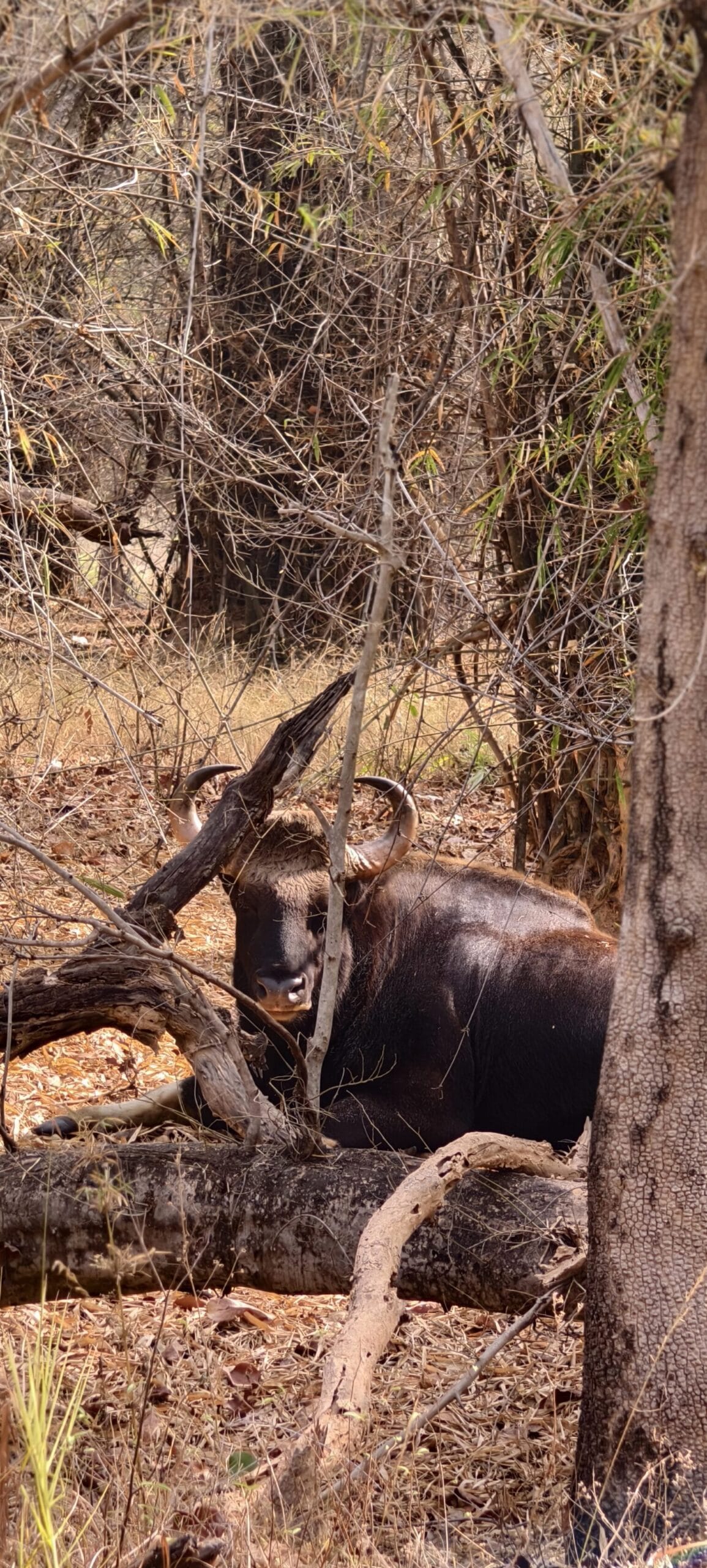
The Indian Gaur – Nature’s Titan of the Indian Jungles
The Indian Gaur (Bos gaurus), often casually called the “Indian Bison,” is one of the most commanding animals to ever walk the forests of Asia. With its towering physique, glossy dark coat, and a calm but commanding presence, the gaur stands as the largest wild bovine on Earth — a silent heavyweight built by evolution to dominate the landscape.
If you’ve ever seen a gaur in the wild, you know the feeling — the forest suddenly feels smaller, quieter, almost respectful. This isn’t an animal you “spot.” This is an animal that “arrives.”
What Exactly Is the Indian Gaur?
The gaur belongs to the cattle family but is far from your average grassland grazer. Its massive head, muscular shoulders, and signature dorsal ridge make it instantly recognizable. While often confused with the American bison, the gaur is a distantly different species — more muscular, taller, and far more imposing.
Scientific Name: Bos gaurus
Common Names: Indian Gaur, Seladang (Malaysia), Gaur Bull
Family: Bovidae
Conservation Status: Vulnerable (IUCN)
Appearance – Built Like a Living Fortress
The Indian Gaur looks like nature decided to combine elegance with raw power:
- Height: Up to 220 cm at the shoulder — taller than most SUVs.
- Weight: 600–1,000 kg; large bulls can cross 1,200 kg.
- Coat: Dark brown to jet black, with iconic white “stocking” legs.
- Musculature: A pronounced ridge of muscle on the shoulders, visible even at a distance.
- Horns: Majestic, curved, and incredibly strong — used for dominance and defense.
Bulls are noticeably larger and darker, while females have slightly slimmer builds and lighter coats.
Where Do Gaurs Live? (Habitat & Distribution)
The gaur is a forest specialist, thriving in regions that offer dense vegetation and open grass patches:
- India – The largest population. Sightings are common in Tadoba, Bandhavgarh, Kanha, Pench, Nagarhole, Wayanad, and Mudumalai.
- Nepal – Found in Chitwan and other forest belts.
- Bhutan – Healthy, stable numbers.
- Southeast Asia – Thailand, Vietnam, Cambodia.
In India, their presence often signals a healthy, well-protected forest ecosystem.
Behaviour & Social Life – Silent Giants with Gentle Rules
Despite their intimidating appearance, gaurs are surprisingly calm. They follow simple but powerful social rules:
- Social Structure: Herds of 8–20 individuals, led by a matriarch.
- Diet: Grasses, leaves, fruits, bamboo shoots, and shrubs.
- Daily Rhythm: Early morning and late evening grazers; rest in deep shade during hot hours.
- Temperament: Quiet, gentle, and non-aggressive unless threatened.
A herd of gaurs can silently melt into thick forest, disappearing faster than you’d expect from such massive animals.
Tiger vs Gaur – A Rivalry Written in the Jungle
Gaurs have only one natural predator — the tiger. But even the tiger, king of stealth and strength, chooses its battles wisely.
Adult bulls are almost never hunted. Tigers focus on calves or lone females. Even then, it’s a risky hunt — there are recorded cases where the gaur has fatally injured big cats in self-defense.
Why Is the Gaur Vulnerable? (Conservation Issues)
Although populations are stable in many protected reserves, gaurs still face threats:
- Loss of forest corridors
- Encroachment near villages
- Diseases from domestic cattle
- Occasional poaching
Thankfully, strong protection in Indian reserves has helped them recover significantly over the last decade.
Where to Spot the Indian Gaur in India
If you want guaranteed sightings, these locations are top-tier:
- Tadoba Andhari Tiger Reserve – Frequent encounters near meadows.
- Bandhavgarh Tiger Reserve – Seen in mixed forest patches.
- Kanha Tiger Reserve – One of the best gaur habitats.
- Nagarhole & Kabini – Herds often graze near backwaters.
- Wayanad & Mudumalai – Excellent chances in early mornings.
Ideal time for sightings: November to March
Photography Tips – Capturing a Giant
Photographing a gaur isn’t difficult, but capturing a *great* gaur shot is:
- Use mornings for the best light on the glossy coat.
- Stay downwind — they have an excellent sense of smell.
- Keep distance — never block a gaur’s path, especially mothers with calves.
- Focus on eyes — the tranquillity creates beautiful portraits.
Fun Facts About the Indian Gaur
- The gaur is the largest bovine in the world.
- Its neck muscles are so strong the head rarely droops.
- The white “stockings” on their legs act like visual markers in the forest.
- Gaurs can run at speeds up to 35–40 km/h.
- They can jump surprisingly well for their size.