

By Prashant S. Gupta · April 4, 2026 · Tadoba, Bandhavgarh & Panna
The Indian Gaur (Bos gaurus) — also called the wild Indian bison — is the largest wild cattle species on earth. It lives in Indian forests, weighs up to 1,500 kilograms, and is immediately recognisable by its massive dark body and distinctive white legs. It is not a bison. It is not a buffalo. It is something else entirely.
Wild Indian Gaur (Bos gaurus) — The Animal That Makes You Rethink the Word Large
You see a shape at the treeline and think: buffalo. Something big and dark, half-hidden in the sal trees. Then it steps out fully onto the track — and everything you thought you knew about large animals quietly rearranges itself.
The Indian Gaur does not announce itself. It simply appears, takes up more space than seems reasonable, and stands there with the unhurried confidence of something that has genuinely nothing to prove.
I have been on safaris where the gaur sighting was more memorable than the tiger. Not because the tiger wasn’t there — but because nothing quite prepares you for the moment a thousand-kilogram animal walks out of the jungle and looks straight at your jeep.
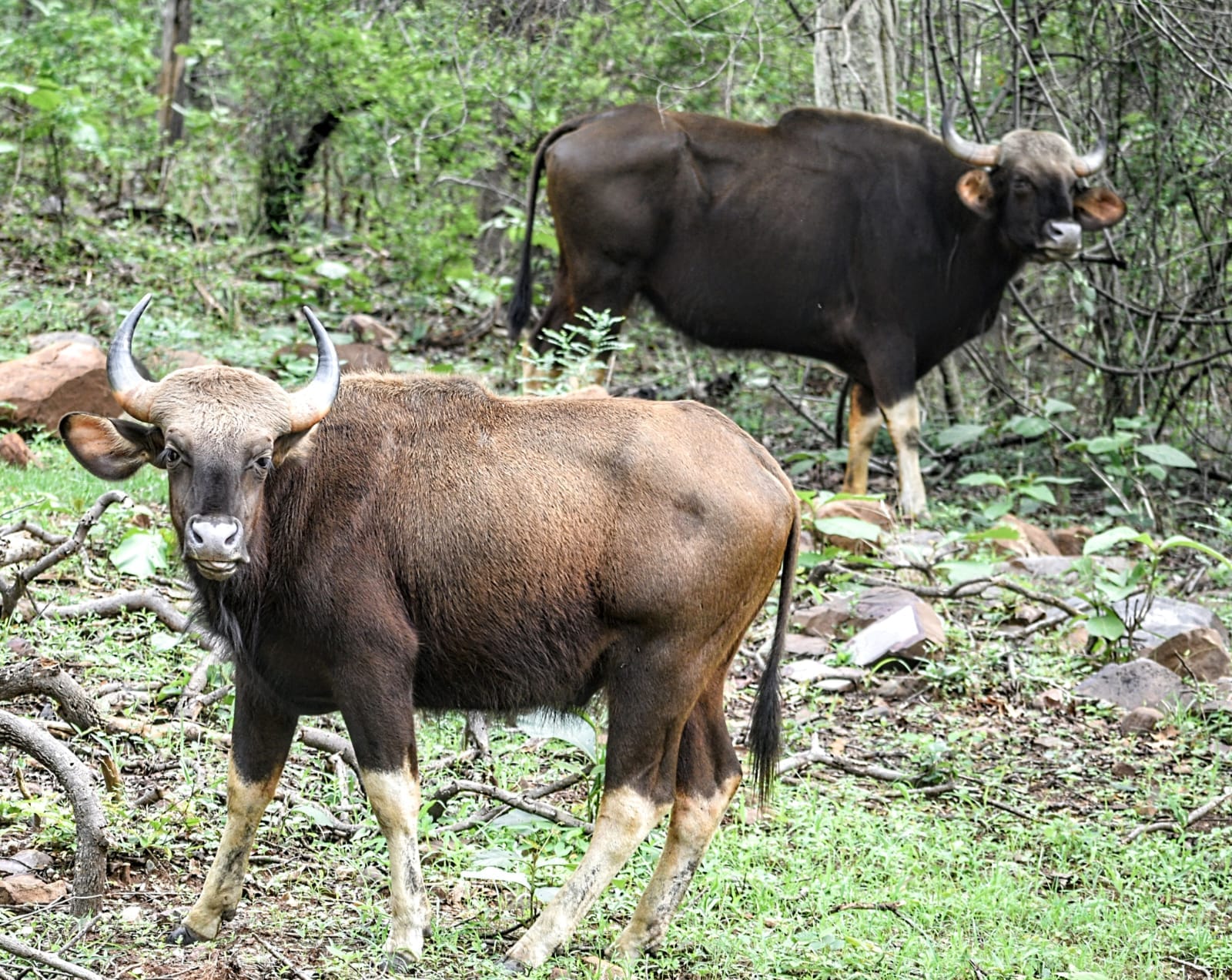
A dominant bull gaur at the forest edge — note the massive build, curved horns, and the white legs that distinguish it from every other large animal in Indian forests.
What Exactly is the Indian Gaur?
The Indian Gaur (Bos gaurus) is the largest wild cattle species in the world. Not the largest in India — the largest anywhere on earth. It is native to India and Southeast Asia, and it belongs to the cattle family, which is why people searching for “wild indian bison” or “gaur animal” sometimes end up confused.
It is not a bison. It is not a buffalo. The scientific name Bos gaurus places it firmly in the cattle genus — the same family as domestic cows, only evolved over millions of years into something the size of a small car.
- Scientific Name: Bos gaurus
- Common Names: Indian Gaur, Wild Indian Bison, Gaur
- Weight: Up to 1,500 kg (a large bull)
- Shoulder Height: Around 6 feet — nearly two metres
- Diet: Herbivore — grass, leaves, bark, fruit
- Conservation Status: Vulnerable (IUCN)
The one feature that identifies a gaur from a distance, even in low light, even through forest cover: the white legs. Every other large dark animal in the Indian jungle has dark legs. The gaur has white ones from the knee down — as if someone dipped it in paint. Once you know this, you never misidentify one again.
Indian Gaur vs Bison vs Buffalo — The Confusion Explained
This is the most searched question about the gaur, and the confusion is understandable. Three large, dark, horned animals — but they are entirely different species from entirely different parts of the world.
| Feature | Indian Gaur | Bison | Buffalo |
|---|---|---|---|
| Where Found | India & Southeast Asia | USA & Europe | Asia & Africa |
| Habitat | Dense forest | Open grasslands | Wetlands & grasslands |
| Leg Colour | White (below knee) | Dark throughout | Dark throughout |
| Body Build | Massive, smooth, muscular | Large shoulder hump, thick fur | Wide body, spreading horns |
| Genus | Bos | Bison | Bubalus / Syncerus |
The simplest field rule: white legs = gaur. If the large dark animal at the treeline has white from the knee down, you are looking at a gaur. Nothing else in the Indian forest has that marking.
Gaur vs Bison
The gaur is often called the Indian bison, but true bison — the American and European species — are a completely different genus. Bison live in cold open grasslands, have thick shaggy fur and a pronounced shoulder hump, and have never been native to India. The gaur lives in warm tropical forests. The similarity is visual and superficial. Scientifically, they are not related beyond being bovids.
Gaur vs Buffalo
The Indian buffalo — both wild and domestic — has wide, sideways-spreading horns and prefers wetlands and open grassland. The gaur has upward-curving horns, lives deep in forest, and has those unmistakable white legs. Up close, there is no confusion. At distance in low light, the white legs are your identifier.
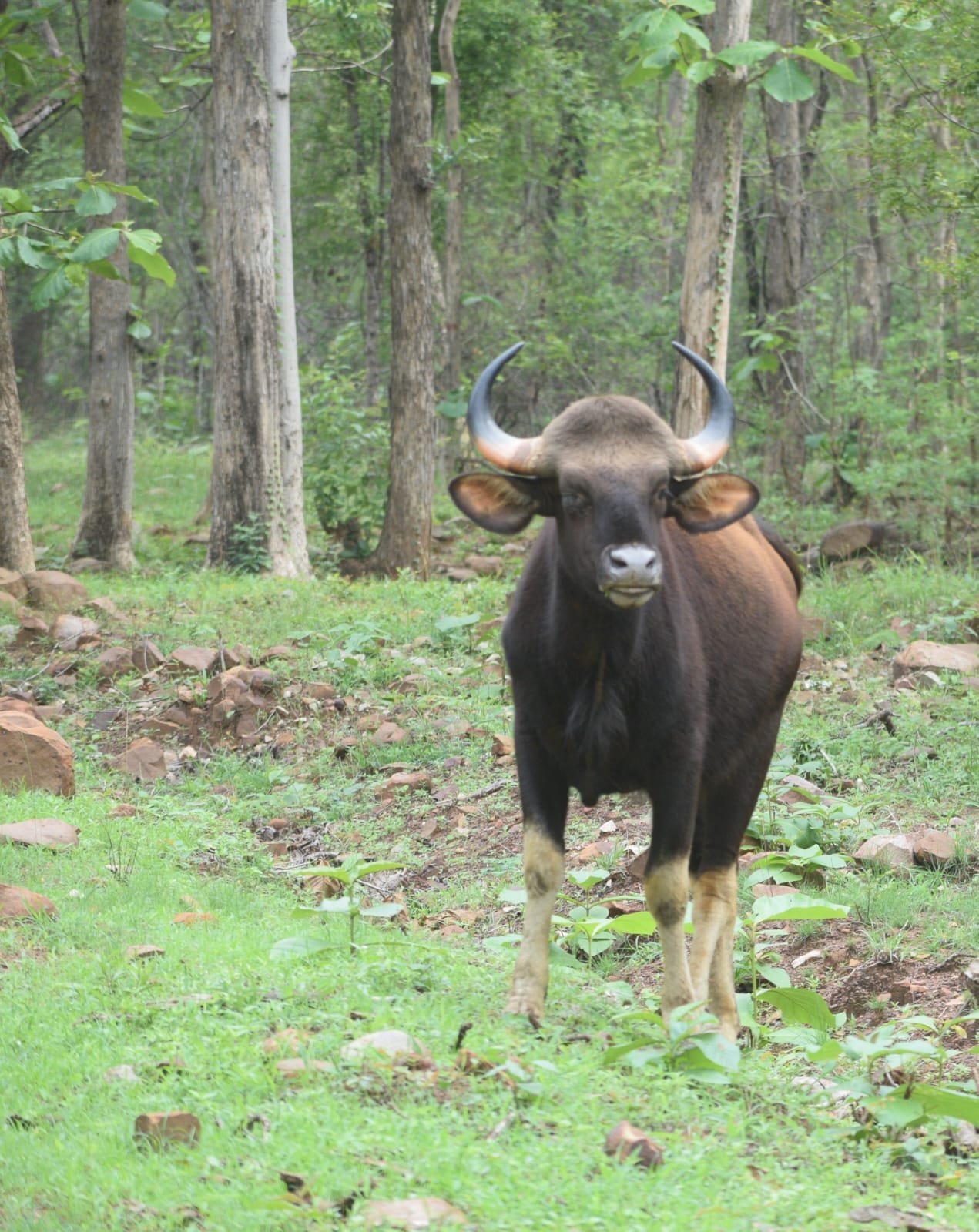
The curved horns and white legs — the two features that make the Indian Gaur unmistakable in the field, even from a moving jeep.
The Gaur Up Close — What the Field Notes Say
A bull gaur in his prime is one of the most physically impressive animals you will ever sit beside in a jeep. The ridge along his back, the massive shoulder muscles, the way he carries himself — utterly unhurried, taking up as much space as he wants. He is not aggressive. He simply does not need to be.
Adult gaur are largely tiger-proof. A full-grown bull is too large and too powerful for a tiger to take alone. Even a tigress with cubs will redirect her path rather than challenge a healthy gaur. Watching one move slowly across a forest road, in no particular hurry, is watching an animal at the absolute top of its size class — and it knows it.
The herd structure is led by females. A dominant cow leads the group, chooses the grazing ground, and decides when to move. The big solitary bulls you see at forest edges are mature males who live largely alone, joining herds only during the breeding season. These are the ones most likely to cross your safari track.
Where to See Gaur in India
The gaur is found across central and southern India wherever dense forest and water are available together. These are the most reliable locations for sightings:
- Tadoba National Park, Maharashtra — one of the highest gaur densities in India. Regular sightings near grassland edges and waterholes, especially in the dry season.
- Bandhavgarh National Park, Madhya Pradesh — gaur are frequently seen in the Tala and Magadhi zones, often near bamboo forest.
- Panna National Park, Madhya Pradesh — smaller population but sightings are relatively easy given the open terrain near the Ken river.
- Kanha National Park, Madhya Pradesh — large gaur herds in the meadow sections, excellent for photography.
Best Time to See Gaur on Safari
The best window is February to June. As the dry season progresses and water sources shrink, gaur concentrate near remaining waterholes and become easier to spot. The dry forest also means less cover — sightings are longer and clearer.
Early morning drives are most productive. Gaur are active feeders at dawn and dusk, resting through the hot midday hours in deep shade. An early morning jeep entering Tadoba’s Moharli gate has a high chance of finding a herd at the first waterhole within the first thirty minutes.
Gaur Behaviour — What to Watch For on Safari
Gaur are not dangerous animals in normal circumstances, but they are large enough that any sign of agitation should be taken seriously. A gaur that stops, raises its head fully, and fixes its gaze on your vehicle is reading you. The naturalist will cut the engine. Nobody speaks. After a few seconds the gaur usually decides you are not interesting and continues grazing.
Watch for these behaviours:
- Tail raised — alert, possibly sensing a predator nearby
- Stamping foot — mild agitation, maintain distance
- Herd bunching together — something has alarmed them, scan for predator
- Calf hiding behind mother — normal when vehicle is close
Why Gaur Matter for Indian Forests
The gaur is a keystone grazer. By moving through forest and grassland, consuming vegetation, and redistributing nutrients, large herds shape the structure of the forest itself. Where gaur graze regularly, clearings stay open — and those clearings become critical habitat for dozens of other species including deer, birds, and smaller mammals.
The gaur is listed as Vulnerable on the IUCN Red List. The main threats are habitat fragmentation, disease transmission from domestic cattle, and human encroachment on forest edges. India’s tiger reserves — which protect large, connected forest blocks — are currently the most effective protection the gaur has.
Indian Gaur Facts Worth Knowing
- Largest wild cattle species on earth — heavier than a domestic water buffalo by a significant margin
- Despite their size, gaur can move very quickly through dense forest when they choose to
- The white legs are present from birth and become more pronounced in adults
- A dominant bull can be over thirty years old
- Gaur and tigers share the same forest and the same waterholes — they are fully aware of each other at all times
The Moment That Changes How You See Safaris
Most people come to Indian wildlife reserves looking for the tiger. The gaur is rarely on the wish list. And then one walks out of the bamboo, ten metres from the jeep, and fills the entire frame of every camera in the vehicle.
Nobody expected it. Nobody was ready. And it becomes, for several people on that jeep, the photograph they keep coming back to.
The tiger is extraordinary. But the gaur reminds you that the forest was never only about the tiger. It was always about everything else as well.
Planning a safari to see gaur and tigers in central India? Explore more wildlife field notes on TravelOnTales →