
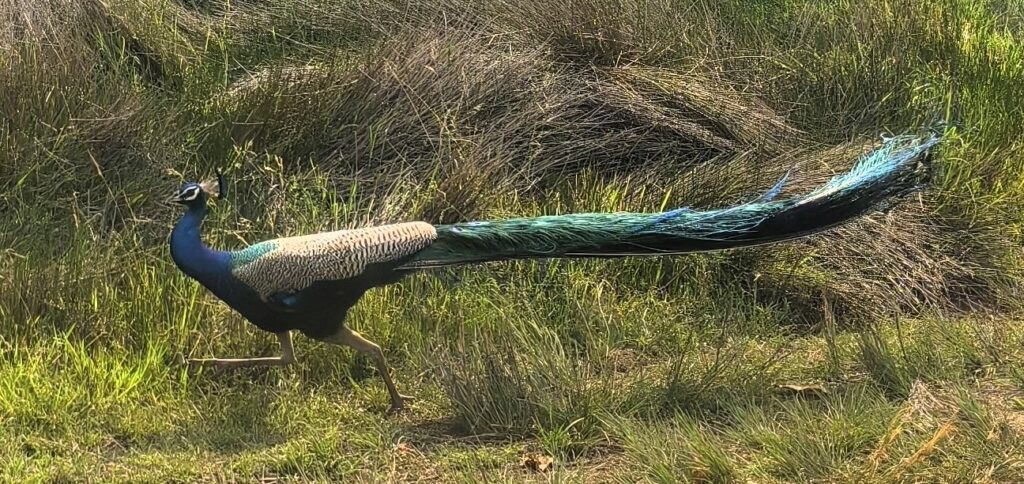
Indian Peacock in Bandhavgarh National Park | Stunning Wildlife Photography

 Indian Peafowl (Pavo cristatus)
Peacock in natural habitat

The Indian Peafowl (Pavo cristatus), often simply called the peacock, is one of the most majestic birds found in the Indian subcontinent. The image beautifully captures a male peafowl gracefully walking with its long iridescent train trailing behind. Known for their shimmering feathers and extravagant displays, peafowls hold cultural, spiritual, and ecological significance.

In the wild, these birds prefer open forests, grasslands, and agricultural lands where they forage for seeds, insects, and small reptiles. The long train, though stunning, is not just ornamental—it plays a key role in attracting mates during the breeding season. When fanned out, the “eyes” on the feathers create a dazzling display that is nearly impossible to ignore.

Beyond their beauty, Indian Peafowls are also celebrated in Indian mythology, art, and folklore. Declared the national bird of India, they symbolize grace, pride, and spirituality. Capturing such a moment in the wild highlights not just the bird’s elegance, but also the importance of conserving its natural habitat.


Fun Facts

  • Only the male is called a “peacock”; females are “peahens.” Together they are called peafowls.
  • Their loud call often warns other animals of approaching predators.
  • The peacock’s train can be longer than its actual body length.
  • They can fly short distances despite their heavy feathers.

The tail is not a tail

The peacock’s train is not made of tail feathers. The actual tail is short, stiff and brown, hidden underneath — its job is to prop the train up.

The train itself grows from the back, above the tail, and consists of around 200 elongated upper tail-covert feathers. Roughly 150 of them carry the eyespots.

It is shed and regrown every year

The whole train drops after the breeding season and grows back before the next one. A peacock in August can look like a large, drab, ordinary bird.

This also means that a train is an honest signal. A male that can grow and carry two metres of feathers, and still escape predators, is demonstrably in good condition. That is the point of it.

The eyespots matter

Research on peafowl has found that peahens attend to the number and quality of the eyespots. Males with damaged or fewer eyespots do less well.

The display itself is not just visual. When the train is fanned, the male vibrates it rapidly — the rattling you can hear at close range — and this shaking produces infrasound below human hearing that peahens can detect.

Where the peacock stands in the forest

For a safari visitor the peacock is worth more attention than its familiarity suggests, because it is an alarm bird.

The loud, ringing may-awe call is given at the sight of a predator as well as before rain. Guides listen for peacock alarms alongside chital and langur calls when tracking tigers and leopards. A peacock calling repeatedly from one spot is worth stopping for.

Identifying males, females and young

  • Male: iridescent blue neck and breast, fanned crest, the train in season.
  • Female: brown with a white face and a green-glossed neck. No train.
  • Juvenile male: resembles the female at first, then gradually acquires blue on the neck. The full train takes about three years.

Photographing peafowl

  • Do not chase the fan. Displaying males are unpredictable. Position yourself and wait.
  • Shoot from behind occasionally. The rear of a fanned train, backlit, is a picture most people never take.
  • Soft light for iridescence. Harsh sun kills the blue-green sheen; overcast brings it out.
  • Watch for the shake. The rattling display makes far better images than a static fan.

Frequently asked questions

Is the peacock’s train its tail?

No. It is made of upper tail-coverts growing from the back. The real tail is short, brown and hidden beneath.

Do peacocks lose their feathers?

Yes, the entire train is shed after the breeding season and regrown before the next one.

Why do peacocks call before rain?

They call at many stimuli including approaching weather and predators. The link with rain is real but the call is not exclusive to it.

How do I tell a male from a female?

Males are iridescent blue with a train in season. Females are brown with a white face and no train.

Why is it India’s national bird?

It was designated in 1963, chosen for its distribution across the country and its long presence in Indian art, myth and religion.


Related: Bandhavgarh Tiger Safari Guide and How Tigers Mark Territory.

Scroll to Top