
Montagu’s Harrier at Bhigwan: The Grassland Raptor That Travels the World to Be Here
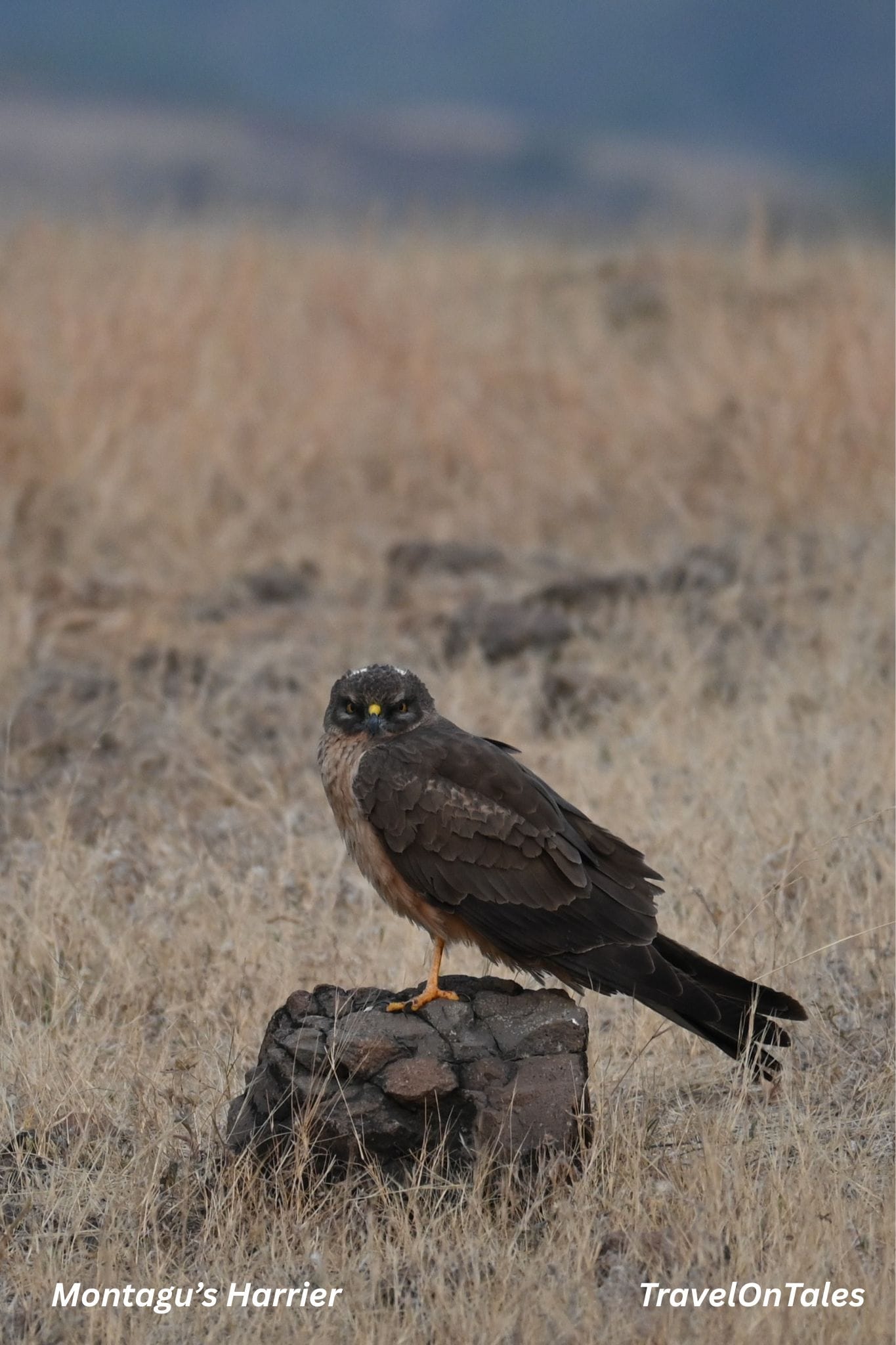
Not every great bird sighting involves a rare bird. Sometimes the most striking moment of a trip is a common winter visitor doing something simple — and doing it with complete authority. That is what happened the morning this Montagu’s Harrier landed on a flat rock in the middle of the Kadbanwadi Grasslands and turned to stare directly at my jeep.
There was no alarm in that stare. Just a long, steady, yellow-eyed look that said clearly: I have flown four thousand kilometres to be in this grassland, and nothing here concerns me. Then it looked away, scanned the dry grass for movement, and went about its business.
The Montagu’s Harrier (Circus pygargus) is one of India’s most important winter raptors. Each year, large numbers fly from their breeding grounds in Europe and Central Asia to spend the cold months on the open grasslands and farmland of the Indian subcontinent. Bhigwan, in particular, is one of the best places in Maharashtra to see them — and the Kadbanwadi Grasslands near Indapur deliver reliable sightings from November right through to March.
What You Are Looking At: Female Montagu’s Harrier
The bird in this photograph is a female or immature Montagu’s Harrier. This is important to understand because female and young Montagu’s Harriers look very different from the clean grey-and-black adult male that usually appears in field guides. Many birders see this brown bird and pass it off as a generic harrier without a second look. That is a mistake — this bird repays attention.
Key Features Visible in This Shot
Look at the photograph closely. Several field marks are clear even at this distance. The yellow cere at the base of the bill stands out sharply against the dark brown head. The orange-yellow legs are fully visible below the compact body. The overall plumage is dark brown with pale streaking on the chest — typical of a female or first-year bird. The long tail and relatively slim body are also clear, and they separate this from the bulkier Marsh Harrier that shares the same wintering grounds.
Moreover, the facial expression here is worth noting. The slightly rounded, owl-like face — visible in the forward-facing stare — is a feature that sets Montagu’s apart from other harriers. It has a more defined facial disc than the Pallid Harrier, giving it that intense, focused look even when perched and resting.
| Scientific Name | Circus pygargus |
|---|---|
| Common Names | Montagu’s Harrier, Grassland Hawk |
| Family | Accipitridae (Hawks & Eagles) |
| Size | 43–47 cm; wingspan 97–115 cm |
| Adult male | Pale grey with black wingtips and one black wing bar; red-streaked underparts |
| Female / immature | Brown above; pale buff-white below with brown streaks; yellow cere; orange-yellow legs |
| Key ID marks | Slim build; long tail; two black bars on upper wing (male); white rump patch |
| Flight style | Low, buoyant glide over open ground — wings held in shallow V shape |
| Diet | Rodents, lizards, large insects, small birds; hunts on the wing close to the ground |
| Breeding range | Europe, Central Asia, Russia — nests in open farmland and grassland |
| Wintering range | Sub-Saharan Africa and South Asia — India, Pakistan, Sri Lanka |
| In India | November to March; Deccan grasslands, farmland, wetland edges |
| IUCN Status | Least Concern; declining in Europe due to agricultural change |
| eBird code | monhar1 |
Telling Montagu’s from Other Harriers at Bhigwan
Bhigwan hosts three harrier species in winter — Montagu’s, Pallid, and Western Marsh. All three can appear in the same grassland on the same morning. Learning to separate female and young birds of each is one of the real skills of Bhigwan birding. Here is a quick guide based on what you are most likely to see perched or in low flight.
🔍 Quick ID Comparison — Female/Immature Harriers at Bhigwan
Why Kadbanwadi is India’s Best Harrier Ground
The Kadbanwadi Grasslands, roughly 8 km from Bhigwan village towards Indapur, are among the finest open grassland birding sites in peninsular India. The terrain is classic Deccan plateau — flat, dry, open, with a mix of short grass and rocky scrub that perfectly matches what harriers need for hunting. In winter, the dried golden grass holds rodents, lizards, and large insects. Above it, harriers quarter back and forth in long, low passes, covering the ground with the kind of patient efficiency that makes them one of the most watchable raptors anywhere.
The numbers here can be remarkable. On a good morning in December or January, it is not unusual to count fifteen or more harriers of multiple species working the same stretch of grassland. Montagu’s tends to fly lower and lighter than the Marsh Harrier, its narrow wings barely seeming to work as it drifts over the grass on the wind. Seeing one drop suddenly from its glide and hit the ground is one of those moments that makes the early start worthwhile.
The Perching Behaviour
What made this particular sighting special was the perch. Harriers are not known as birds that sit for long. Most of the time they are in the air, hunting low. When they do come down, they usually choose a spot in the middle of the grass where they become very hard to find. This bird chose a flat basalt rock — raised just enough above the grass to give a clear view in every direction. It stayed for several minutes, scanning slowly, before dropping back into the air. That kind of perched opportunity is rare, and it explains why this photograph worked as well as it did.
Best Time to See Montagu’s Harrier at Bhigwan
Fortunately, this matches perfectly with Bhigwan’s main birding window. The same November-to-March trip that gives you flamingos on the Ujani backwaters also delivers harriers at Kadbanwadi. You do not need a separate visit — the two habitats are covered in the same three-day circuit.
Photographing Harriers at Bhigwan: What Works
Harriers in flight are challenging to photograph well — fast, low, and constantly changing direction. However, a perched bird like this one is a different situation entirely. When a harrier lands on an open rock in good morning light, you have a genuine portrait opportunity. The key is not to rush it.
In-Flight Tips
For flight shots, the early morning offers the best light angle as harriers quarter low over the grass directly towards the rising sun. Use continuous AF with subject tracking — the Z50’s bird-detection AF locks reliably onto flying raptors against a plain sky background. Set a fast shutter of at least 1/1600s to freeze wing beats, and open the aperture to f/5.6 to keep the background as clean as possible.
Perched Bird Settings
Mode: Aperture Priority with -0.3 to 0 EV — open grassland light is bright; avoid blowing the pale chest
Aperture: f/5.6 to f/7.1 — enough depth to keep the full bird sharp, background stays pleasantly soft
Shutter speed: 1/400s to 1/800s — perched bird but use faster shutter in case it lifts suddenly
ISO: Auto ISO capped at 1600 — open grassland in morning light is bright; base ISO often stays at 400–800
Focus: Subject tracking with bird eye AF — even on a perched bird, this locks on the eye and holds it if the bird turns its head
White Balance: Auto or Daylight — the warm golden grass tones are part of the image; do not cool them down
Framing: Portrait orientation for a perched bird on a vertical post or rock — it gives room for the tail below and sky or grass above
The golden dry grass background at Kadbanwadi is one of the great natural backdrops for raptor photography in India. Work with it. A wide aperture at the right distance turns it into a clean warm blur that makes the bird pop. Expose for the face and cere — that yellow stands out against dark brown feathers and is the sharpest colour note in the frame.
The Journey: What This Bird Has Done to Be Here
Before it landed on that rock, this Montagu’s Harrier had flown from somewhere in Europe or Central Asia — possibly Russia, Ukraine, or Kazakhstan. The round trip covers roughly 8,000 to 10,000 kilometres each year. Most of that flight happens over open country, often at night, navigating by the stars and Earth’s magnetic field.
By the time it reaches the Deccan plateau in November, it has already crossed the Himalayas or the Arabian Sea. It arrives lean and hungry and sets about hunting the grasslands with the kind of single-minded focus that only a bird fuelled by pure survival instinct can manage. Then in March, when the days grow longer and an ancient signal fires in its body, it turns north again and disappears from Indian skies until the following winter.
Knowing this makes the perched moment in the photograph feel different. That bird on the rock is not just a harrier. It is a thread connecting two continents, a grassland in Maharashtra and a meadow somewhere in the steppes of Central Asia. Standing in a jeep in Kadbanwadi watching it stare back at you, that is not a small thing to think about.
Harriers in a Bhigwan Birding Trip
The Montagu’s Harrier is one of the main reasons serious birders make the Bhigwan trip in winter. It is never the only reason, but it is often the most rewarding one. The species sits at the heart of what Kadbanwadi offers — a wide, open Deccan grassland with enough prey to support dozens of raptors through the cold months.
In a three-day Bhigwan circuit, harrier watching happens on the first afternoon safari and the second pre-dawn session at Kadbanwadi. That early morning slot is particularly good — birds are active right through from before sunrise, and the light on the golden grass is at its best. On the same outing, Short-toed Snake Eagles work the thermals above, and Changeable Hawk-Eagles use raised perches along the field edges. Together, the Kadbanwadi raptor list on a single winter morning can reach eight to ten species without much effort.
Other Harrier Species to Watch For
While Montagu’s is the star, do not overlook the Pallid Harrier — it is actually less common in India and a higher quality tick for most birder lists. The Western Marsh Harrier is the most likely to be seen over the Ujani backwaters on the afternoon boat safari. All three may appear together over the Kadbanwadi plain on a single morning. That kind of comparison opportunity, seeing all three side by side in the same habitat, is rare anywhere in Asia, and Bhigwan delivers it reliably in the peak months.
📌 Planning a Bhigwan winter birding trip?
The complete field guide covers the three-day itinerary, all habitats, boat safari booking, and harrier-watching tips for Kadbanwadi.
Read the Complete Bhigwan Bird Sanctuary Guide →
Also read: Rock Eagle-Owl at Bhigwan | Spotted Owlet at Bhigwan | More from Birdsong →