
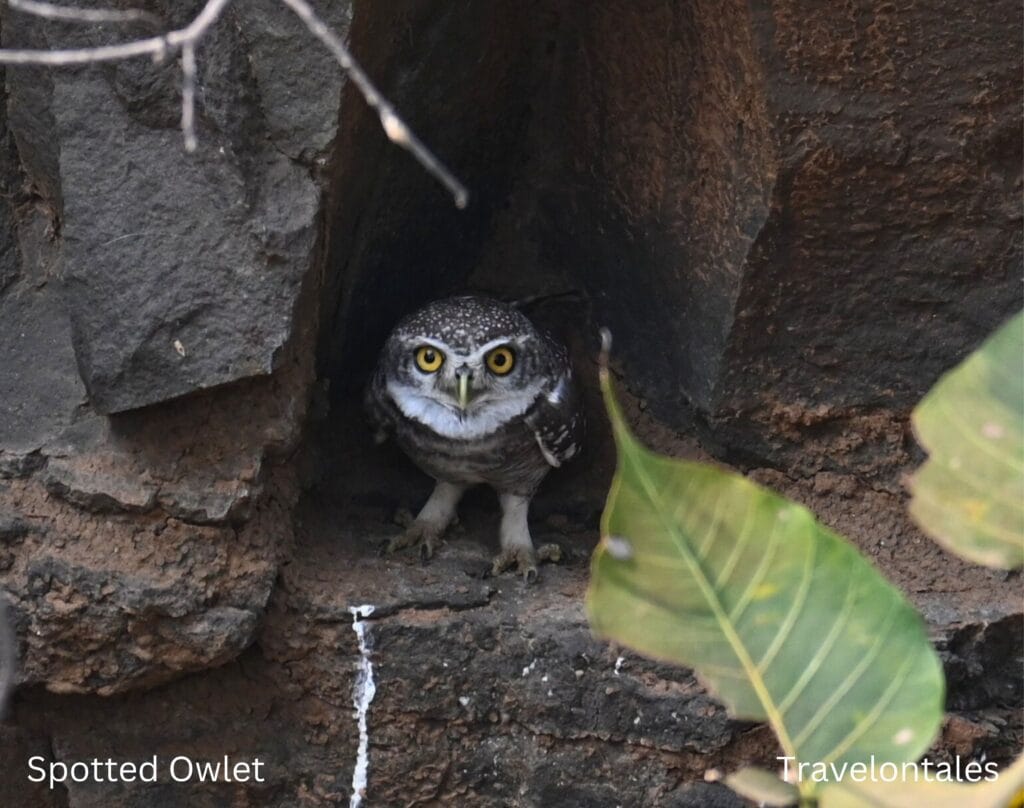
Spotted Owlet of Bhigwan: The Tiny Guardian of the Rocks
Some wildlife moments don’t come with noise… they come with a stare.
Tucked inside a rugged basalt crevice, a Spotted Owlet (Athene brama) Those bright yellow eyes didn’t just look… they assessed. And for a brief moment, it felt like the wild was watching back.
Bhigwan, often called Maharashtra’s flamingo paradise, hides a quieter secret. Beyond the wetlands lies a rugged world of rocks and scrub—perfect for owls, raptors, and birds that don’t crave attention.
Meet the Spotted Owlet
Small in size, massive in personality—this owl is one of India’s most adaptable birds.
- Size: Around 21 cm
- Eyes: Bright yellow, forward-facing
- Habitat: Rocks, ruins, trees, even cities
- Diet: Insects, rodents, lizards
- Behavior: Bold, curious, often active in daylight
That Unforgettable Gaze
Owls don’t move their eyes—they rotate their heads. So when one locks onto you, it’s not casual… it’s deliberate.
Photography Insight
- Natural rock framing creates a cinematic tunnel effect
- Eye-level shot builds a powerful connection
- Foreground leaf adds depth and realism
- Low light enhances contrast and drama
This isn’t just a photograph—it’s a portrait with attitude.
Responsible Wildlife Photography
A roosting owl is in its safe zone. Respect matters.
- Maintain distance
- Avoid flash
- Keep noise minimal
- Limit time near the subject
Final Thought
This tiny bird, hidden in silence, carries a presence that stays longer than any roar.
✨ Fun Facts
- Spotted Owlets often live near humans—even in cities
- They bob their heads when curious (or confused)
- They can rotate their heads up to 270°
- Their call sounds like soft chuckling
Want to explore more wildlife stories?
👉 Click HereAn owl that is awake when you are
Most owls are a matter of luck and torchlight. The Spotted Owlet is not. It is small, common, and frequently sitting in plain view in the middle of the afternoon, blinking at you from a tree hole or a ledge.
At Bhigwan they turn up on the drive in as much as inside the reserve — in babul trees, on old buildings, in the gaps in village walls. If you have never photographed an owl, this is the one to start with.
Identification
- Size: tiny, about 20 cm. Smaller than a myna.
- Plumage: greyish brown with white spotting above, whitish below with brown bars.
- Face: pale, with a dark ring and staring yellow eyes.
- No ear tufts, which separates it immediately from the scops owls.
- Compare Jungle Owlet: more finely barred all over, forest rather than open country.
The head-bobbing
Owls cannot move their eyes in their sockets. The Spotted Owlet compensates by bobbing and rotating its head, sometimes almost upside down, which looks comic and is actually rangefinding — shifting the head gives it the parallax it needs to judge distance.
When it does this at you, it is working out how far away you are.
Behaviour
They are usually in pairs and often with grown young nearby, and they call a lot — a harsh, chattering, scolding series that carries at dusk and at first light. It sounds less like an owl than a small argument.
They hunt from a perch, dropping onto insects, small rodents, lizards and frogs. Beetles and moths around village lights are taken freely, which is why they do so well near people.
Photographing them at Bhigwan
- Look for them in the hour after sunrise, when they sit out at the mouth of a roost hole to warm up.
- Approach in a straight line and stop moving before they do. They tolerate a still watcher and dislike being circled.
- Expose for the pale face, not the tree. The bird is brighter than its background.
- Never use flash on a roosting owl.
Frequently asked questions
Is the Spotted Owlet nocturnal?
Mostly, but it is regularly active and visible in daylight, especially early morning and late afternoon.
Why does an owlet bob its head?
To judge distance. Owls cannot move their eyes, so shifting the head gives them depth perception.
Where do Spotted Owlets nest?
Tree holes, wall cavities and old buildings. They are very comfortable around human structures.
Are they common at Bhigwan?
Yes, in the babul scrub and around village buildings on the way to the water.
Related: Bhigwan Birding Guide and Kadbanwadi Grassland.