
 Painted Stork – India’s Living Canvas on the Water
Mycteria leucocephala at Bhigwan Bird Sanctuary
There are birds you photograph, and then there are birds that photograph themselves — arriving with such effortless theatre that all you have to do is press the shutter. The Painted Stork is firmly the latter. Standing knee-deep in the early-morning shallows of Bhigwan, its pink-flushed wings catching the grey pre-dawn light, it is one of the most visually arresting sights Indian wetlands have to offer.
The Painted Stork (Mycteria leucocephala) is a large wading bird belonging to the family Ciconiidae — the same family as the White Stork that decorates European folklore. But where its European cousin is monochrome and sombre, the Painted Stork is, quite literally, painted. Pink tertial plumes cascade over its back and rump, a bold black breast band cuts across its white chest like a brushstroke, and that heavy yellow bill — down-curved at the tip like an ibis — gives the bird an instantly recognisable silhouette even at distance.
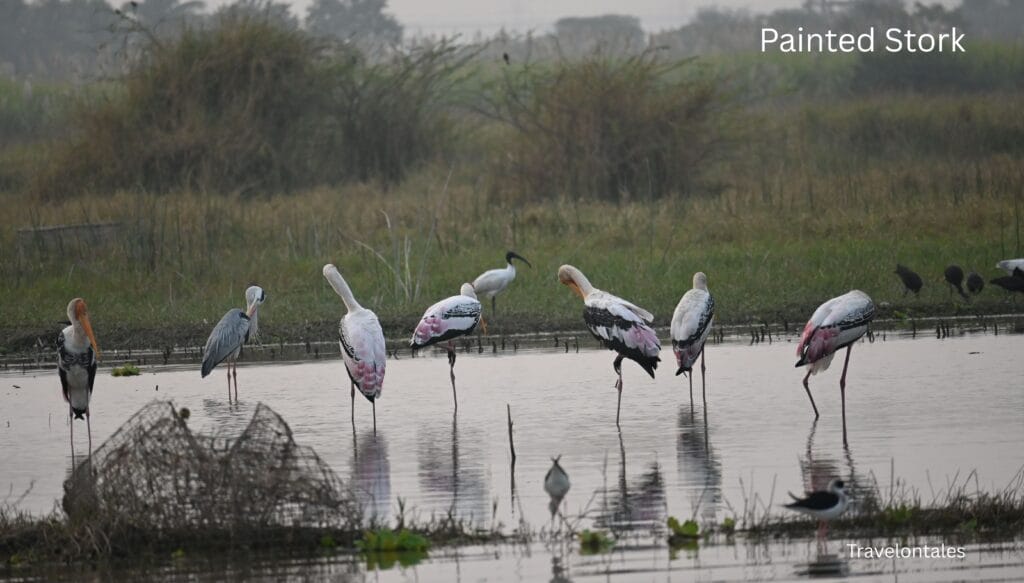
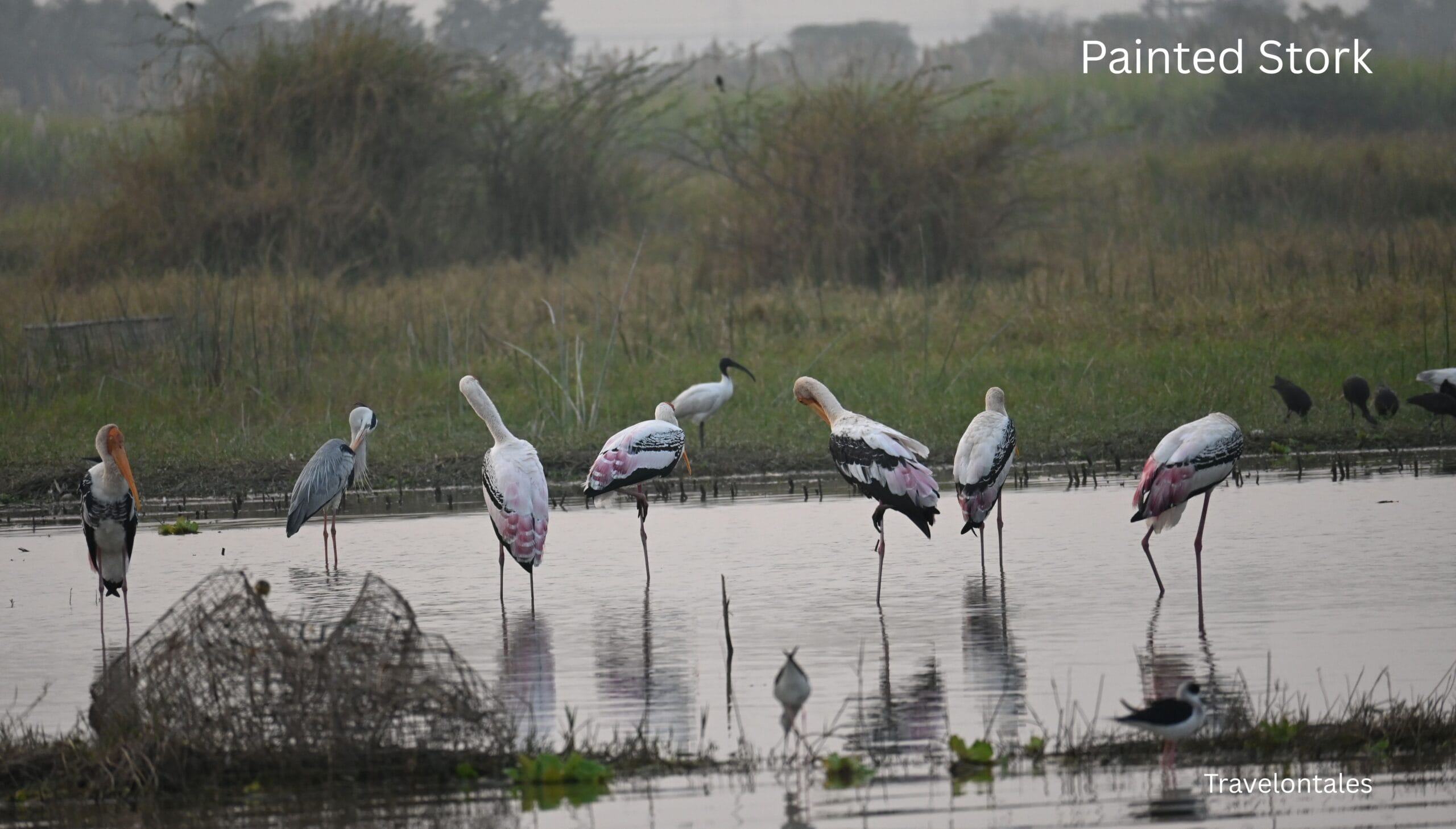
On a recent birding morning at Bhigwan Bird Sanctuary in Maharashtra, I watched a loose congregation of Painted Storks standing in the backwaters of the Ujani reservoir, side by side with a Grey Heron and a Black-headed Ibis. Nobody moved in any hurry. The mist hadn’t fully lifted. It was, as these moments tend to be, quietly perfect.
Quick Facts — Painted Stork
| Scientific Name | Mycteria leucocephala |
| Family | Ciconiidae (Storks) |
| Height | 95–100 cm |
| Wingspan | 150–160 cm |
| Weight | 2–3.5 kg |
| IUCN Status | Least Concern (some regional populations Near Threatened) |
| Diet | Primarily fish; frogs, crustaceans, occasional snakes |
| Lifespan | Up to 28 years (captivity) |
| Best Season at Bhigwan | October – March (peak: November – February) |
Identification: How to Recognise a Painted Stork
At first glance the Painted Stork can seem predominantly white — but look closer and the details are startling. The adult carries a bare orange-red face, a heavy yellow bill that droops slightly at the tip, and those celebrated pink tertials that drape over the lower back and rump when the bird is at rest. A bold black breast band adorned with small white scallop-marks runs across the chest and continues into the under-wing coverts, creating a striking pattern visible even in flight.
The legs are pink to reddish — a tone that deepens during the breeding season. Primaries and secondaries are black with a faint greenish gloss. The tail is short and black. In flight, the bird adopts a characteristic posture with the neck held so that the head droops below the level of the body — almost as though the stork is looking for something it has just dropped.
Immatures lack the vivid colours of adults. They are duller overall, with a brownish wash and without the defined black breast band — easily mistaken for a juvenile Asian Openbill at distance. Reproductive maturity is typically reached at around four years of age, which means that a wetland like Bhigwan often hosts birds at several different stages of plumage development.
Habitat and Distribution in India
The Painted Stork is a bird of the Asian plains — widely distributed across the Indian subcontinent south of the Himalayan ranges and extending eastward into Southeast Asia. In India it is a common resident across the lowland wetlands of the peninsula and the Gangetic plains, absent only from dense forest, the higher hills, and the driest desert zones.
It gravitates toward freshwater wetlands in all seasons — lakes, reservoirs, river backwaters, and marshes. During the monsoon months it also makes use of flooded paddy fields and irrigation canals, where temporarily high fish density makes foraging highly productive. The Ujani reservoir backwaters that form the core of Bhigwan Bird Sanctuary are textbook Painted Stork habitat: shallow, still, open, and rich in small fish.
India holds the largest stable population of the species globally, with major breeding colonies at Keoladeo Ghana National Park (Bharatpur), Kokrebellur in Karnataka, Telineelapuram in Andhra Pradesh, and Ranganathittu in Karnataka. For Maharashtra birders, Bhigwan is the most accessible and reliable site — and the low, flat boats that take you across the Ujani backwaters put you at eye level with birds standing in shallow water, which is exactly how you want to photograph a Painted Stork.
Behaviour: The Tactile Forager
Few feeding strategies in the bird world are as elegant as the Painted Stork’s. Rather than relying on sight like a heron, it feeds primarily by touch — a technique called tactile foraging. The bird wades slowly into water that is typically no more than 7–10 cm deep, partially opens its bill, and then sweeps it from side to side just below the surface. When a small fish nudges the bill, the stork snaps shut in a reflex that takes milliseconds. They also stir the shallow bottom with their feet to flush hiding fish out of the mud.
Watching a Painted Stork forage is watching a master craftsman at work — methodical, unhurried, and almost always successful. — Prashant Gupta, TravelOnTales
They are intensely social feeders. Flock sizes at Bhigwan regularly reach 20–50 birds, and occasionally much more. After a successful feeding session they often stand motionless on the shore or on partially submerged vegetation for long stretches — an almost meditative stillness that makes for striking photography against a softly lit sky.
Despite being a large bird with a presence that commands any wetland, the Painted Stork is essentially voiceless. Adults produce only low, weak moans or rhythmic bill-clattering at the nest during courtship and incubation. Young birds produce a hoarse call that gradually fades as they mature — by 18 months, communication shifts entirely to physical displays: bowing, bill-clattering, wing-spreading, and neck-stretching postures.
Breeding and Nesting
The Painted Stork is a colonial nester, and its breeding colonies — called heronries or rookeries — are among the most spectacular wildlife spectacles in India. Colonies range from a few dozen nests to several thousand pairs, and are typically established in large trees close to water, often shared with other waterbirds such as herons, cormorants, and spoonbills.
When does breeding begin?
The timing varies by geography. In northern India — including Keoladeo in Rajasthan — the breeding season begins in mid-August, shortly after the monsoon peaks. In peninsular India and Maharashtra the season typically starts from October and may continue into February or even April. This post-monsoon timing is adaptive: it reduces the risk of nest failure due to storm flooding and coincides with the period of peak fish abundance in receding wetlands.
Nesting and chick-rearing
Both parents share nest construction, egg incubation, and chick-rearing equally — an unusually egalitarian arrangement. The typical clutch is three to five eggs, with larger clutches in birds that begin nesting early in the season. Incubation lasts approximately 30 days. Chicks are born naked and with eyes closed, entirely dependent on their parents. They fledge at around 60 days in a pale whitish-brown juvenile plumage and are fully capable of independent life, though reproductive maturity only arrives at around four years.
Seeing the Painted Stork at Bhigwan
Bhigwan — often called the Bharatpur of Maharashtra — sits around 110 km southeast of Pune on the banks of the Ujani reservoir. The backwaters here create an extensive, shallow wetland that draws hundreds of waterbird species from October onward. The Painted Stork is present throughout this season but numbers typically peak between November and February, when wintering birds swell the resident population.
The image at the top of this article was clicked on exactly one such morning — a loose group of Painted Storks in various resting and preening postures, flanked by a Grey Heron (visibly smaller, but holding its ground) and a single Black-headed Ibis in the middle distance. A pair of Black-winged Stilts added a vertical note in the foreground shallows. Shot with the Nikon Z50, natural light, no flash. The mist had not yet fully lifted.
What else you will see alongside Painted Storks at Bhigwan
- Grey Heron — almost always present in the same shallows
- Black-headed Ibis — frequently foraging alongside stork flocks
- Asian Openbill — similar silhouette; look for the gap in the bill
- Black-winged Stilt — elegant wader often feeding at the stork’s feet
- Flamingos — can appear in large numbers depending on the season
- Eurasian Spoonbill — another tactile forager sharing the shallows
- River Tern — often diving close by
Conservation Status
Globally, the Painted Stork is classified as Least Concern by the IUCN — a reassuring status that largely reflects the strong, stable population in India. Estimates suggest around 15,000 individuals in South Asia. However, the species faces serious pressure outside the subcontinent: populations in China have declined dramatically, with the bird now possibly locally extinct in southern China. In Pakistan, along the Indus River system, the population is considered endangered, and chicks at nests are still taken for the illegal bird trade.
The primary threats everywhere are consistent: habitat loss through wetland drainage and agricultural expansion, contamination of water bodies with pesticides and heavy metals that deplete fish populations, and disturbance to breeding colonies. In India, many of the best-known colonies — Kokrebellur in Karnataka being the most famous example — survive partly because local communities have developed a cultural and economic stake in protecting the birds. At Kokrebellur, the storks nest within the village itself, and residents actively guard the trees during the breeding season.
Wetlands like Bhigwan serve a critical function as feeding and roosting grounds outside the breeding season, providing the energy reserves that allow birds to successfully breed in colonies elsewhere. Protecting these backwater habitats from encroachment and pollution is as important as protecting the breeding trees.
Final Thoughts
The Painted Stork is not a bird that demands effort to appreciate — it does the work for you. It arrives large, colourful, and unhurried, and it stays long enough to be properly observed. But there is something beyond the visual spectacle that stays with you after a morning at Bhigwan. It is the sheer composure of the bird — the way it wades slowly through uncertain water, opens its bill to the current, and simply trusts that the world will provide. There is a quiet confidence in that which, on a cold foggy morning with a camera in your hands, feels quietly instructive.
If you have not yet seen the Painted Stork in the wild, put Bhigwan on your list. October to February is the window. A good guide, a flat boat, and the first hour of morning light is all you need.