
Panna Tiger Reserve is not India’s most talked-about wildlife destination. It is quietly becoming one of its best.
This guide covers everything you need to plan a Panna Tiger Reserve safari — how to get there, which gate to use, exact safari timings and ticket costs, the best season to visit, where to stay, what wildlife to expect, and what the forest actually feels and looks and smells like across three days on the ground. All photographs in this article were taken by me, Prashant S. Gupta, on a personal visit in April 2024.
Watch the full Panna forest video — three days, multiple tiger sightings, Ken River and more.
What Is Panna Tiger Reserve? The Reserve That Came Back from Zero
Panna Tiger Reserve (PTR) sits in the Panna and Chhatarpur districts of northern Madhya Pradesh, on the Vindhyan plateau — the same geological range that holds Bandhavgarh to its south-east. Declared a wildlife sanctuary in 1981 and a tiger reserve in 1994, it covers 542.67 sq km of dry deciduous teak and mahua forest divided by the Ken River, which flows north through the reserve cutting gorges through pale Vindhyan sandstone.
What makes Panna’s story genuinely different from every other Indian tiger reserve is what happened in 2009. The park was officially declared tiger-free — a devastating conservation failure caused by years of poaching and weak enforcement. Rather than close the chapter, the Madhya Pradesh forest department launched one of India’s most ambitious tiger reintroduction programmes. Two tigresses were brought from Bandhavgarh and Kanha, one male from Pench. These founders — T1, T2, T3 — and a hand-raised tigress T4 became the parents of a population that by 2024 had grown to over 70 tigers. Panna is a UNESCO Biosphere Reserve and the world’s most closely watched large-carnivore recovery story.
The Atmosphere of Panna: What This Forest Actually Feels Like
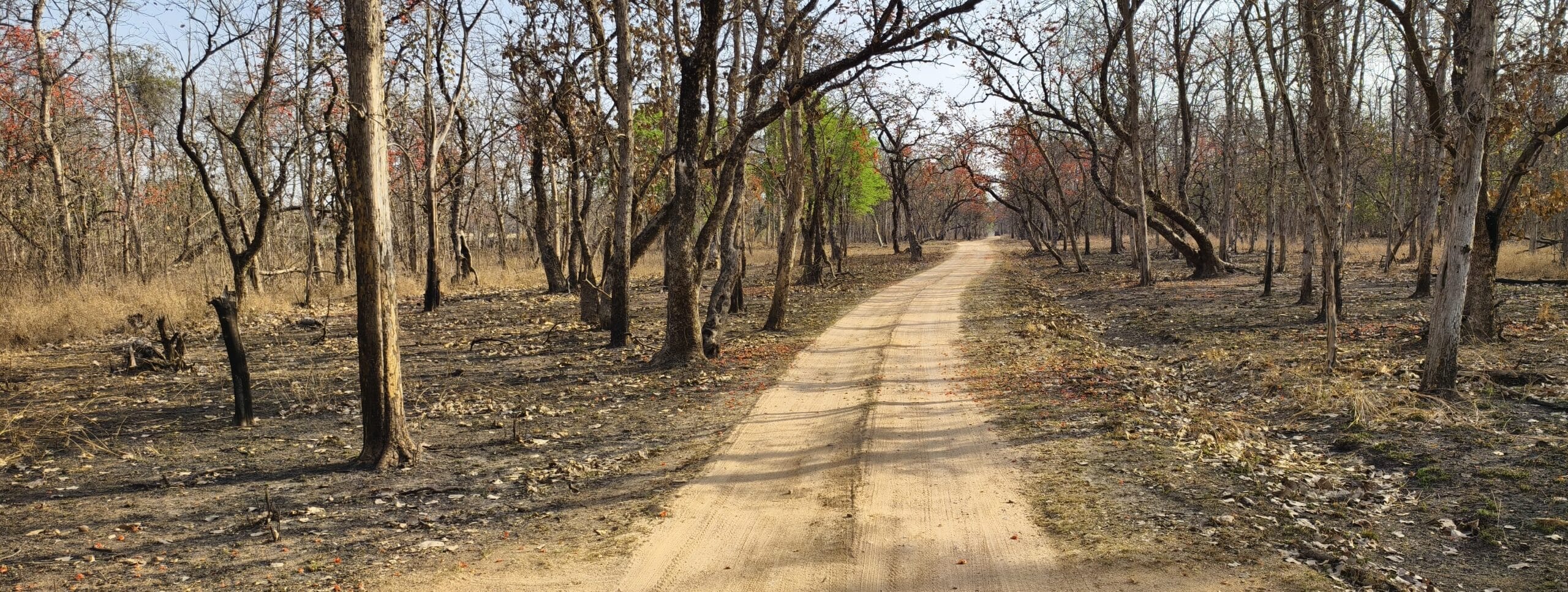
Panna does not feel like Kanha or Tadoba. There are no tall sal forests, no dense moist undergrowth, no tourist queues at Zone A. What you find instead is a landscape of dry teak, mahua, arjuna, and tendu trees on a sandstone plateau, intersected by rocky gorges and the Ken River’s wide sandy channel. In the dry season the forest opens up completely — the teak drops every leaf and the floor becomes orange and pale grey, ash and stone and last year’s leaves. Visibility in every direction. Silence that feels deliberate.
Through this skeletal woodland in March and April, the Butea monosperma — Flame of the Forest — erupts in coral-red blossom clusters that look wrong against the stripped landscape, like someone left fireworks in the trees. The contrast is one of the most striking seasonal visual experiences in any Indian national park.
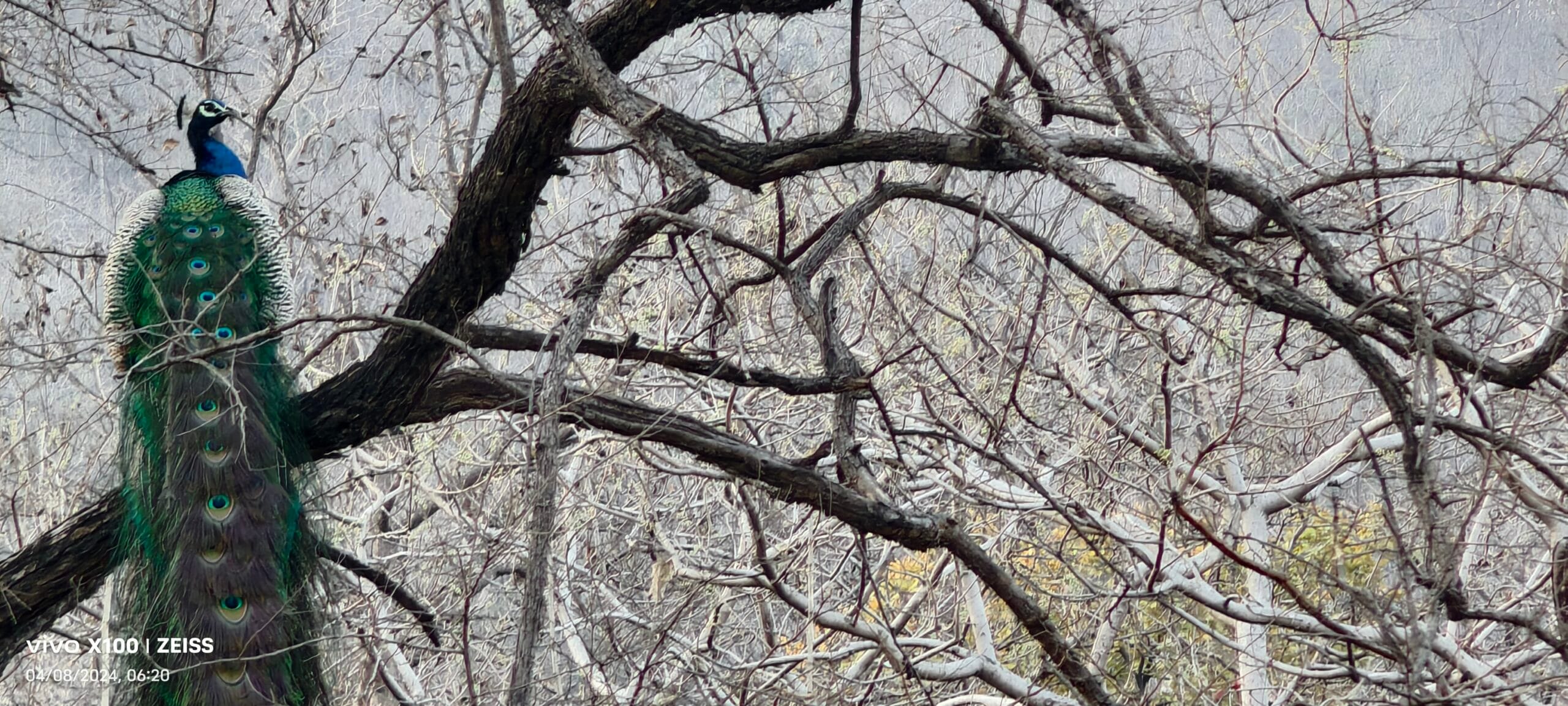
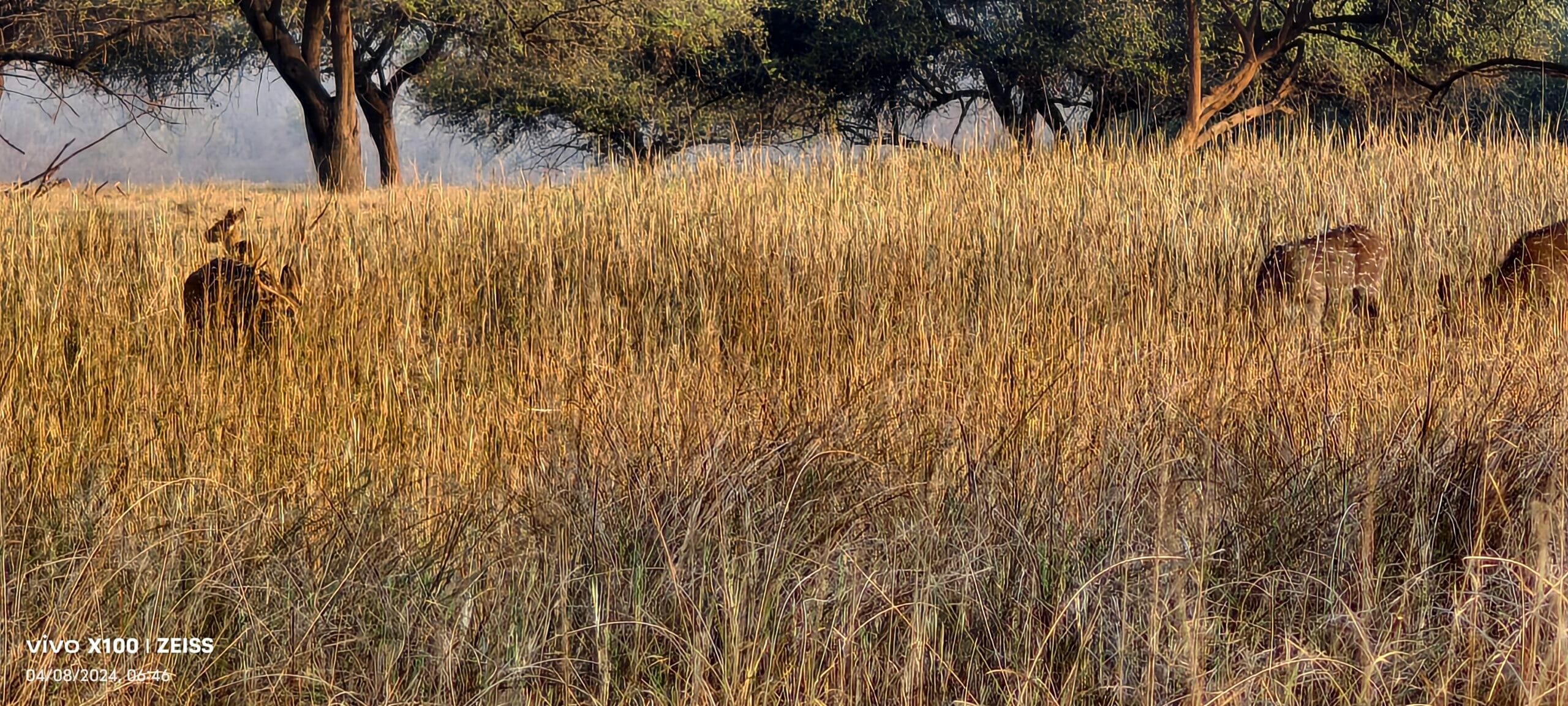
The early morning atmosphere is something visitors consistently underestimate. At 5:30 AM when the gate opens, the forest is cold, completely still, and dark under the teak. The jeep moves slowly on chalk-white tracks. Then the light comes — and for about forty minutes, everything in the forest turns amber and gold. The spotted deer glow. The tree bark catches fire. And somewhere in this light, a tiger is moving.
Sunrise at Panna Tiger Reserve: Why You Must Be at the Gate Before Dawn
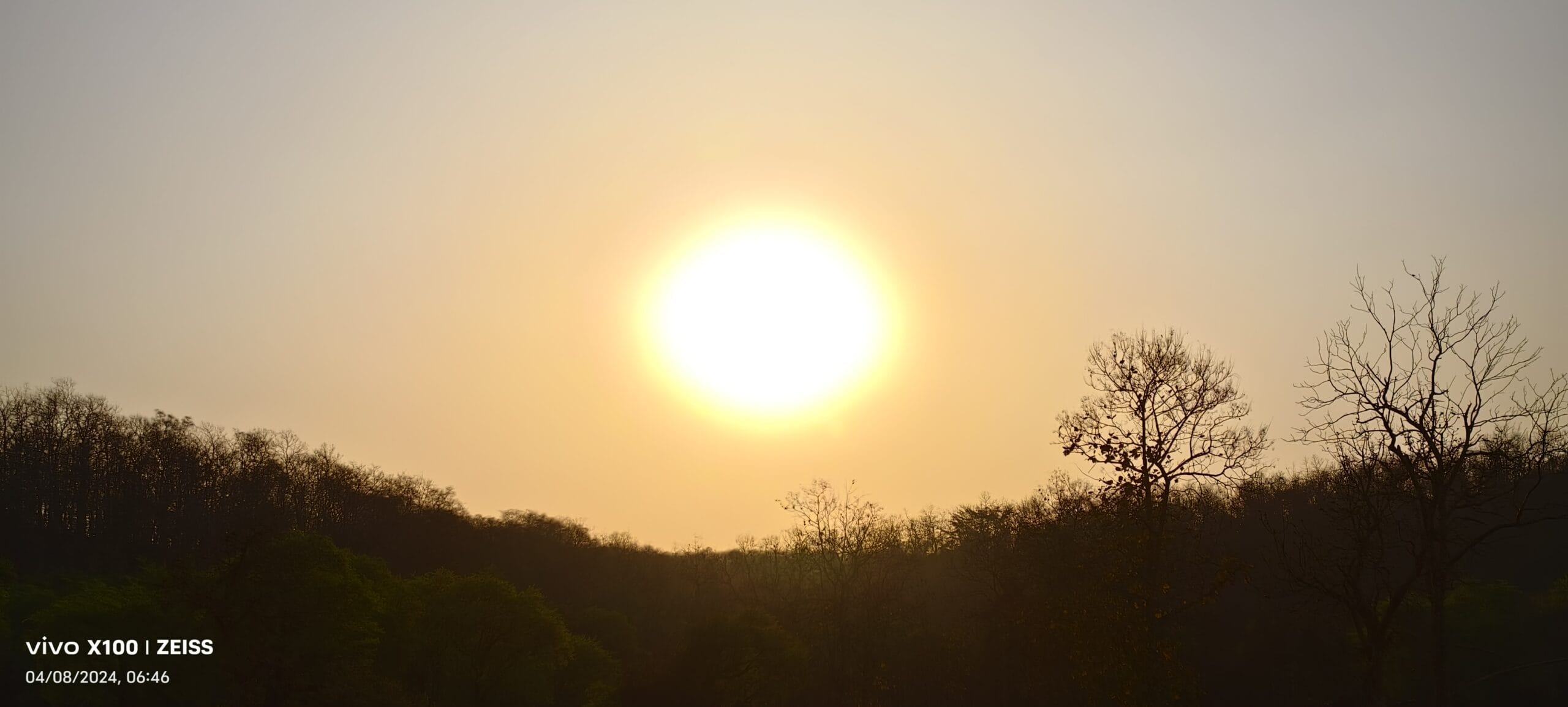
On the second morning of our visit, just before gate entry, the sun broke through a dust-haze horizon in a way that stopped the entire vehicle. Everyone reached for a camera — and then put it down again, because no frame was going to do this justice. It had to be witnessed. There is something about a forest sunrise in the dry season that a green park cannot replicate. The silhouettes are harder, the light more directional, the shadows longer. Plan your arrival at Madla Gate at least 30 minutes before opening time. The queue position you secure determines which part of the core zone you reach first — and whether you find fresh pugmarks or cold tracks.
Tiger Sightings in Panna: What Our Three Days Delivered
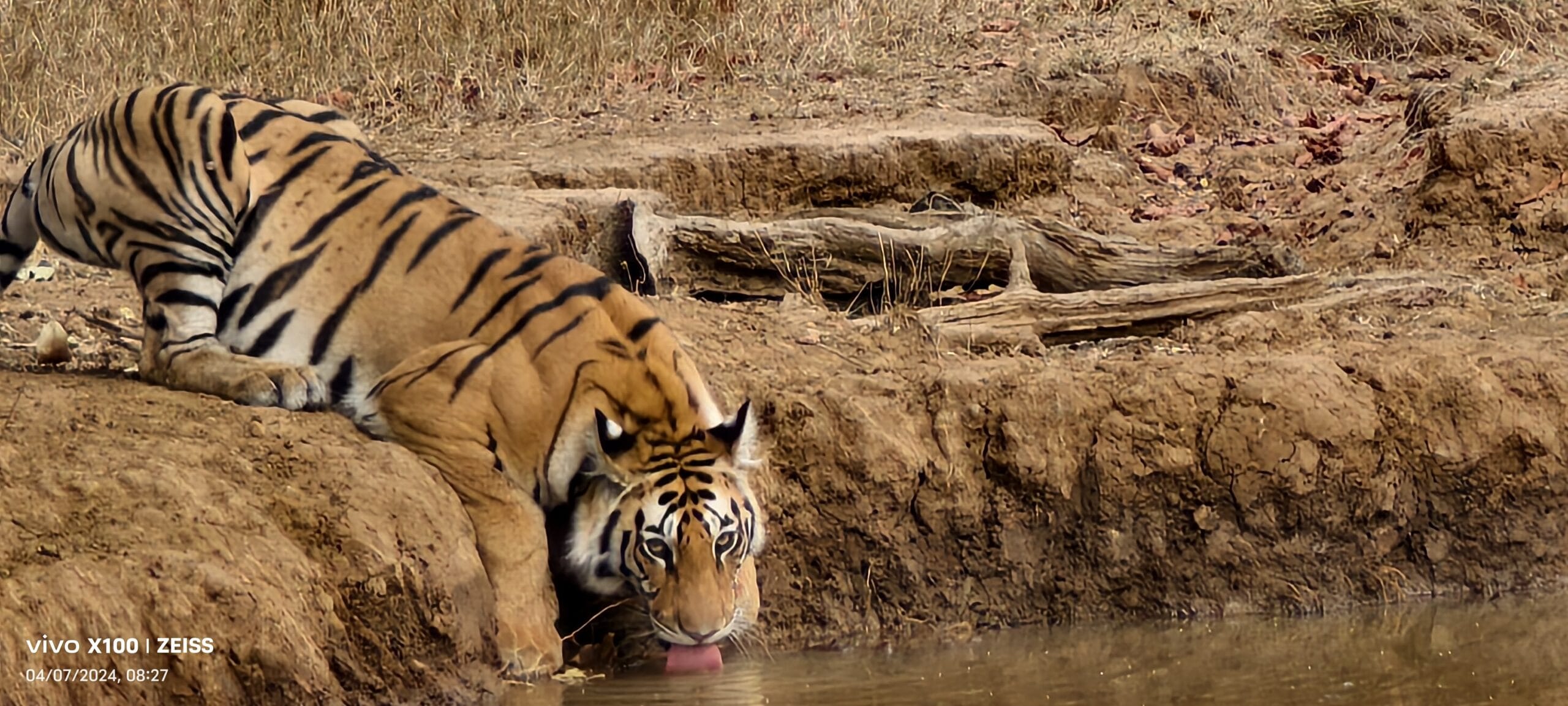
We entered through Madla Gate on the morning of April 7th. Within the first hour, near the Ken River’s edge, our naturalist cut the engine. Twenty metres from the bank, a full-grown Bengal tiger lay flat against the clay, leaning forward to drink from the shallow channel. The striped body curved forward, the head dropped low, the reflection breaking and reforming in the water with each lap of the tongue.
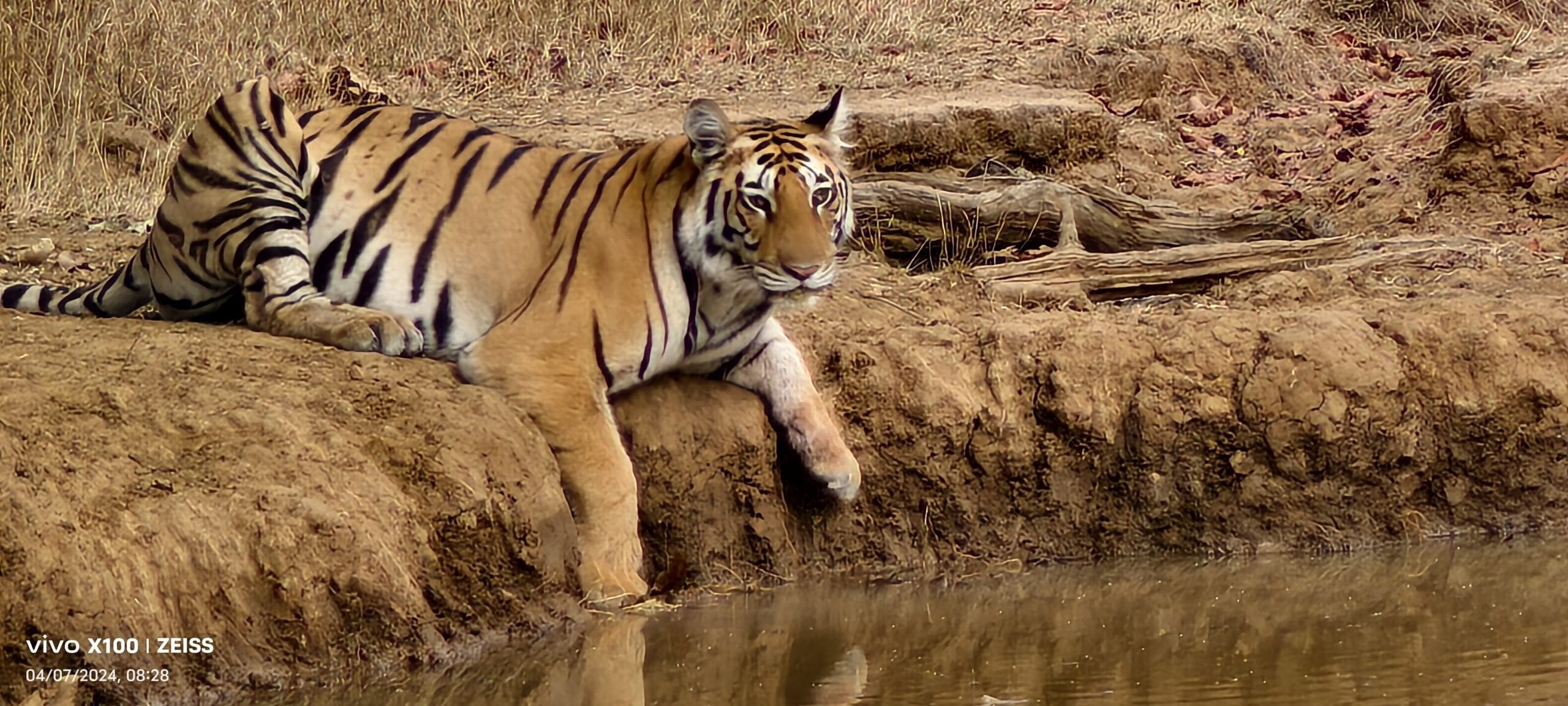
Watch the actual tiger sighting at the Ken River — April 2024, Panna Tiger Reserve.
A second tiger appeared from the grass ridge above shortly after and descended to rest beside the first. Both settled close together, watching the vehicles with calm indifference. We had two tigers in clear view before 9 AM on the very first morning.
The tiger stretches and wakes at the forest pool — Panna, April 2024.
On the morning of Day Three, a tiger crossed the track directly in front of our vehicle — walking across the white dust road with complete ownership, pausing once to look back before disappearing into the teak. Three safaris, five tiger sightings across the trip. Panna delivered every session.
Tiger road crossing — Panna Tiger Reserve, April 2024.
The Ken River: Panna’s the Secret Behind Its Tiger Sightings
The Ken River flows north through the heart of the reserve, carving pale sandstone gorges, pooling into broad sandy reaches, and sustaining every animal in the forest through the dry months. In March–June, as the forest pools shrink, the Ken becomes the single reliable water source. Spotted deer, sambar, nilgai, chinkara, and wild boar all converge on its banks daily. The tiger follows. This concentration mechanism is why Panna’s dry-season sighting rates consistently outperform parks with far larger populations.
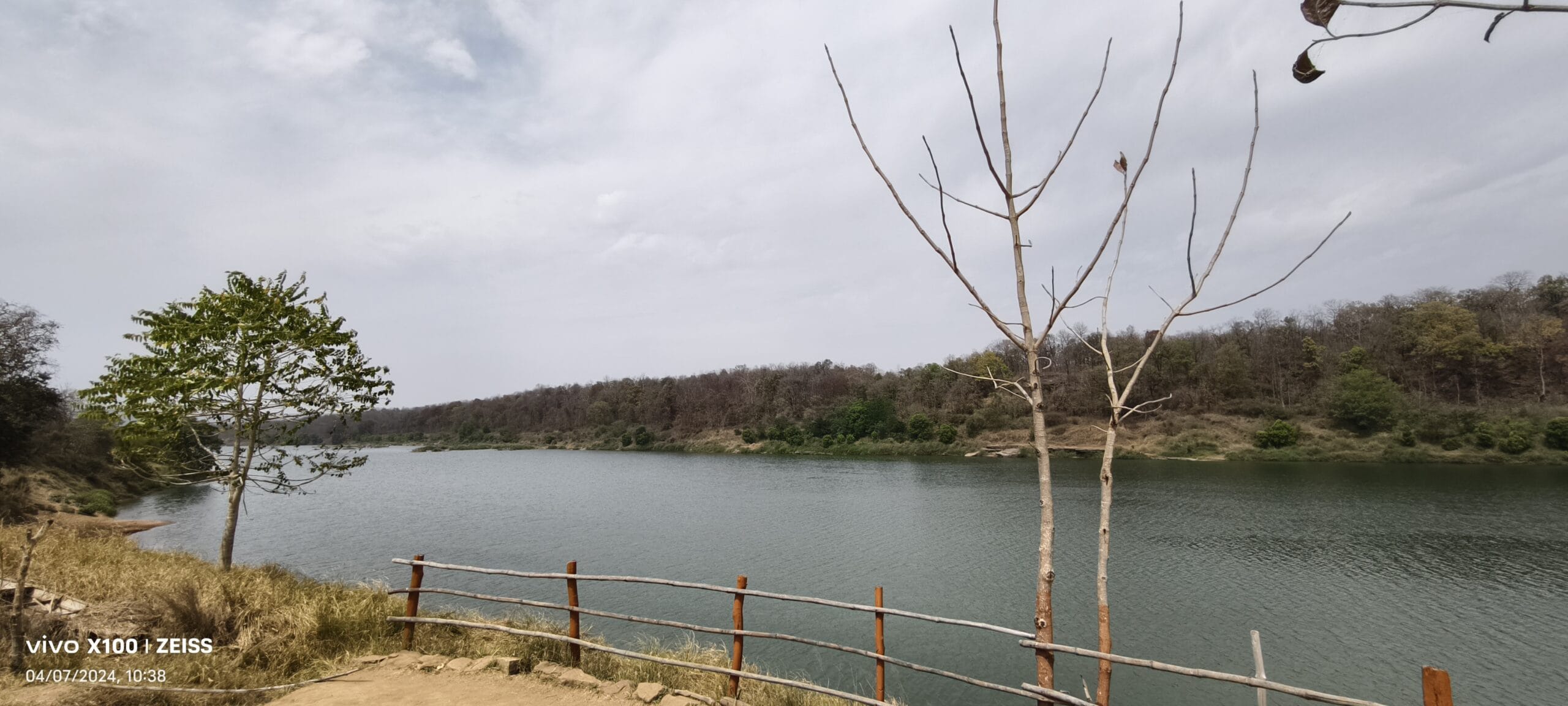
The Ken also holds one of India’s last self-sustaining gharial populations — the critically endangered, fish-eating crocodilian that disappeared from most Indian rivers through the twentieth century. Seeing a gharial basking on the Ken’s sandbars is a wildlife sighting that goes largely unreported in Panna coverage but is genuinely extraordinary. The river also supports smooth-coated otters, mugger crocodiles, Indian skimmers, and a dense population of kingfisher species.
A separate Ken River boat safari is available as an add-on activity — a one-hour motorised ride through the gorge focusing on aquatic and riverbank species. Arrange this in advance through your accommodation or the forest department. It is entirely different from the jeep safari experience and worth the additional half-day.
The Drive to Panna: What You Pass on the Way
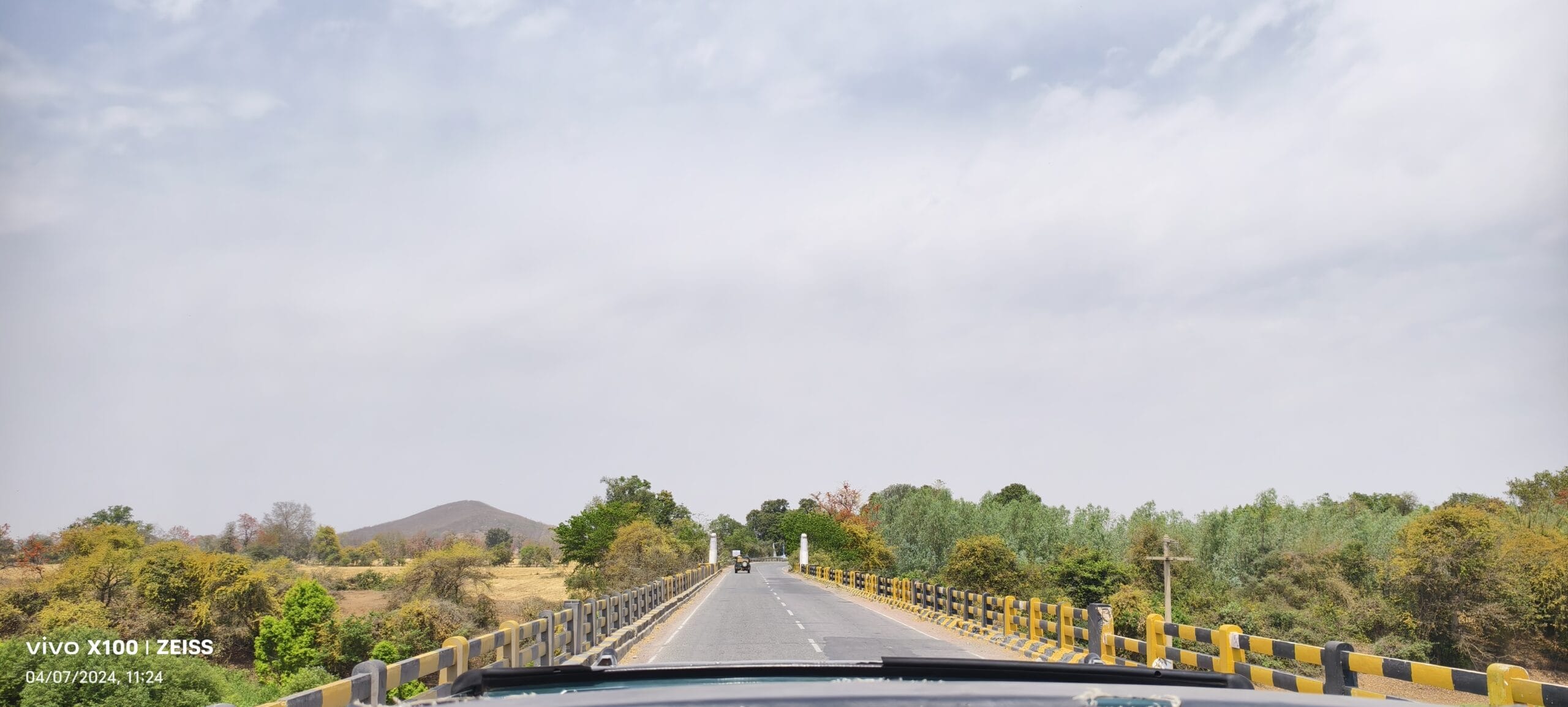
The approach from Khajuraho on NH75 crosses the Ken River on a long bridge with viewpoints on both sides. Below, the river spreads wide through the gorge — pale sandstone, rocky mid-channel islands, and the forested slopes of the reserve rising on the far bank. This is your first real view of Panna’s landscape, and it sets the scene for everything that follows inside the gate.
Panna Tiger Reserve Entry Gates, Safari Timings and Ticket Prices
Which Gate: Madla or Hinauta?
Madla Gate (on NH75, 25 km from Khajuraho airport) is the primary entry point and the correct choice for tiger-focused visitors. It gives access to the Ken River core zone where tiger activity concentrates in the dry season. Most premium accommodation is clustered within 2–3 km of this gate.
Hinauta Gate is 30 km from Madla on the opposite side of the reserve, giving access to rockier, hillier terrain — better suited for leopard, sloth bear, and birding. The Pandav Falls approach is also easier from the Hinauta side. For a first visit focused on tigers, Madla is the clear choice.
A third option — Jhinna Zone in the buffer — is where the night safari operates. This must be booked offline at the ticket counter on the day of the safari.
Safari Timings
| Season | 🌅 Morning Safari | 🌇 Evening Safari | Note |
|---|---|---|---|
| Summer (Mar–Jun) | 5:30 AM – 9:00 AM | 4:00 PM – 7:00 PM | No evening on Wed |
| Winter (Oct–Feb) | 6:00 AM – 9:30 AM | 2:30 PM – 5:30 PM | No evening on Wed |
| Night Safari (Buffer) | Available on request | Offline booking only, same day | |
Max 6 passengers per jeep (excluding guide and driver). Arrive at gate 30–45 min before opening for best queue position.
Safari Ticket Prices
Safari charges include entry permit, guide fee, and vehicle hire. Weekday and weekend (Saturday/Sunday/public holiday) rates differ, as do Indian and foreign national rates. Prices are revised annually by the Madhya Pradesh Forest Department — always check current rates before booking at forestmponline.gov.in.
Advance online booking is strongly recommended for March–June peak season, especially for weekends.
📍 Book Panna Tiger Reserve Jeep Safari from Khajuraho
Skip the permit queue and logistics. This guided jeep safari from Khajuraho includes entry permits, experienced local naturalist, safari vehicle, and morning core zone access. Everything handled — you arrive and go straight into the forest.
Check Availability & Book Safari →Affiliate link — we earn a small commission at no extra cost to you.
Wildlife Beyond the Tiger: What Else Lives in Panna Tiger Reserve
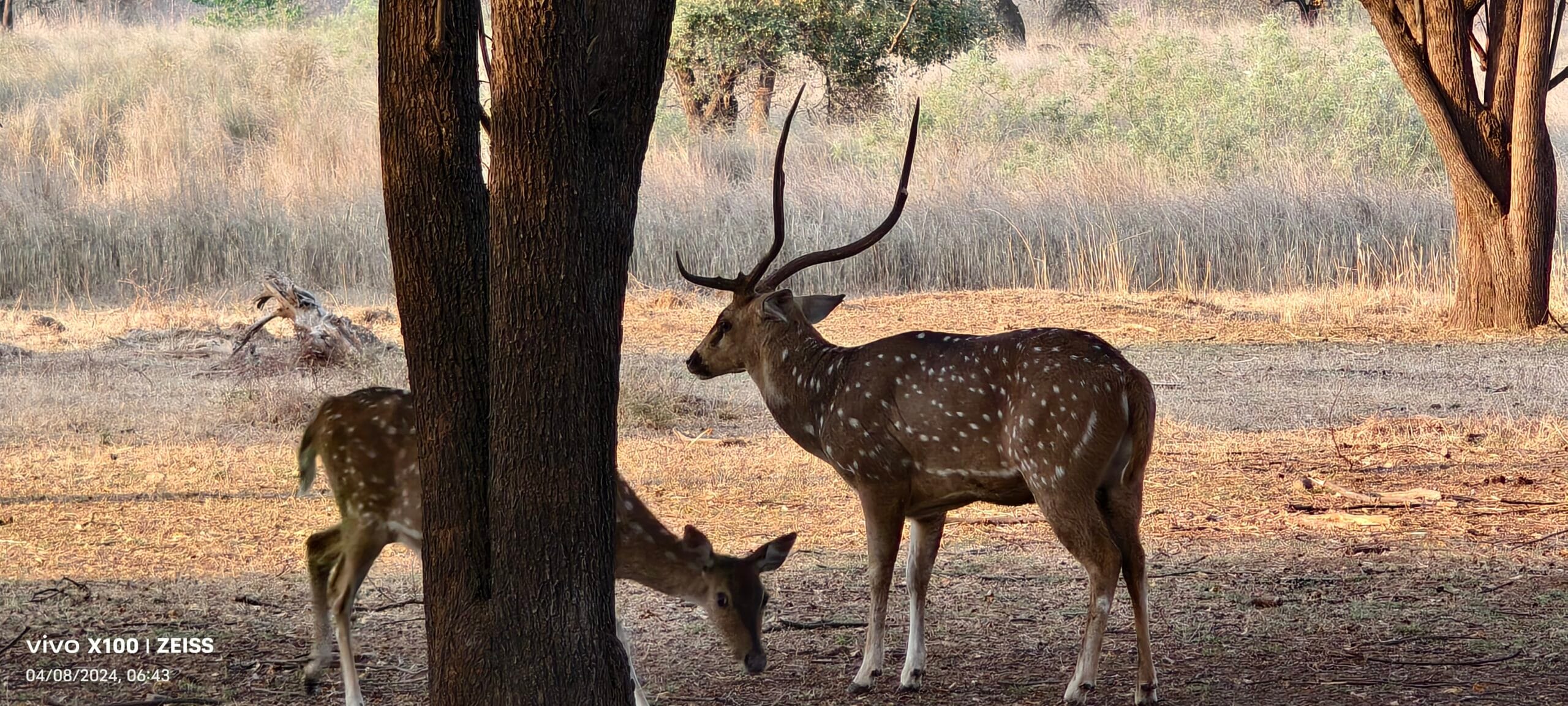
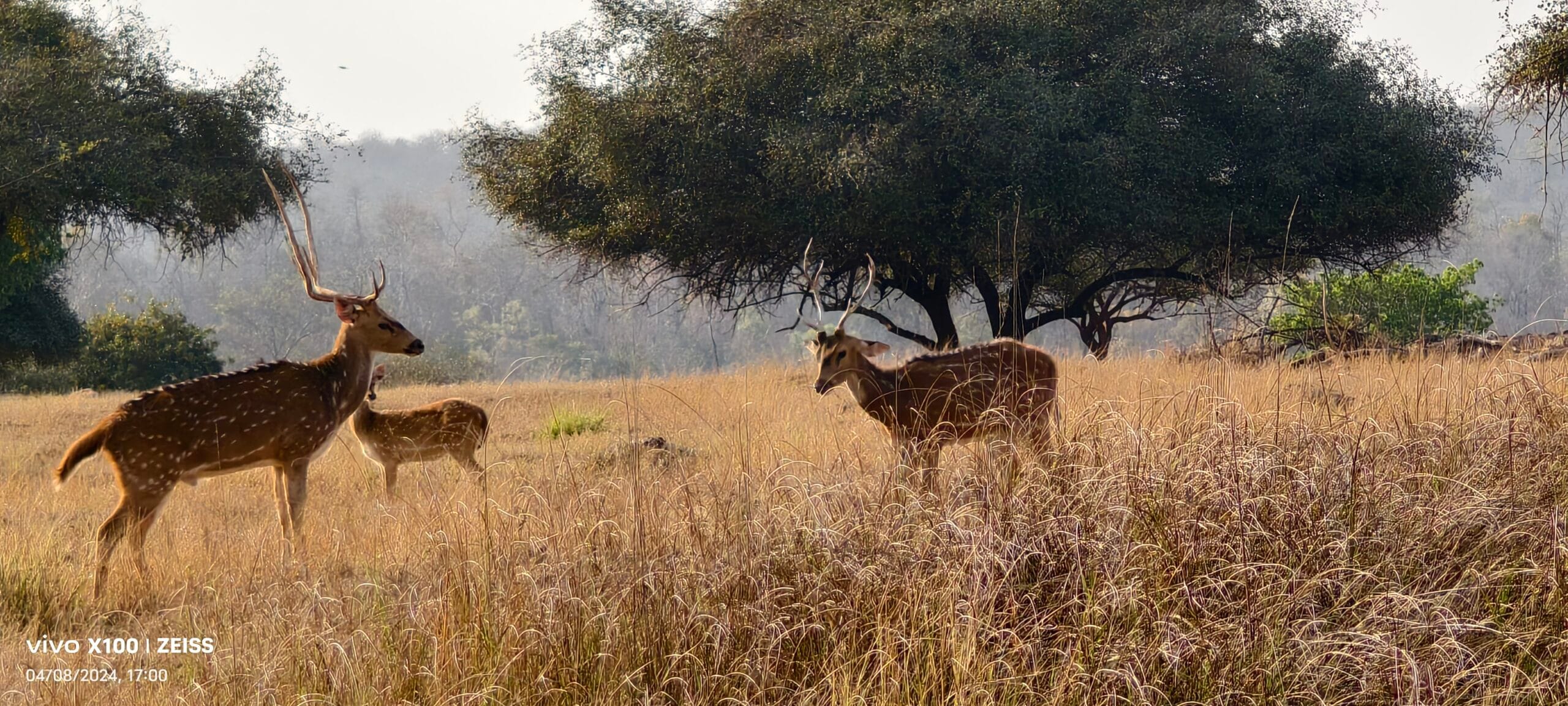
Panna’s prey base is abundant and highly visible thanks to the open dry forest and active habitat management through controlled burning. Chital (spotted deer) appear in herds of 20–40 along the Ken River banks on every safari. Stags with full antlers are common through the dry months.
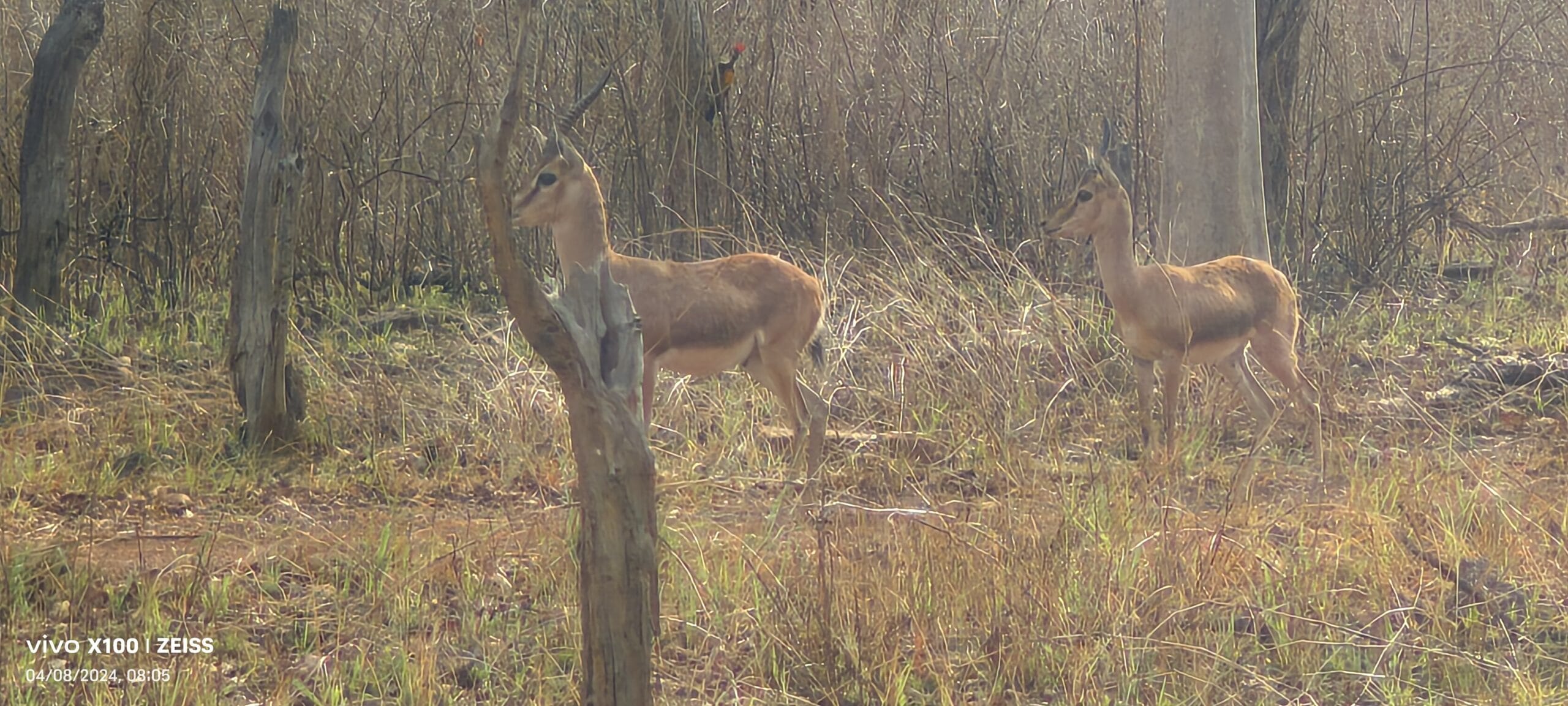
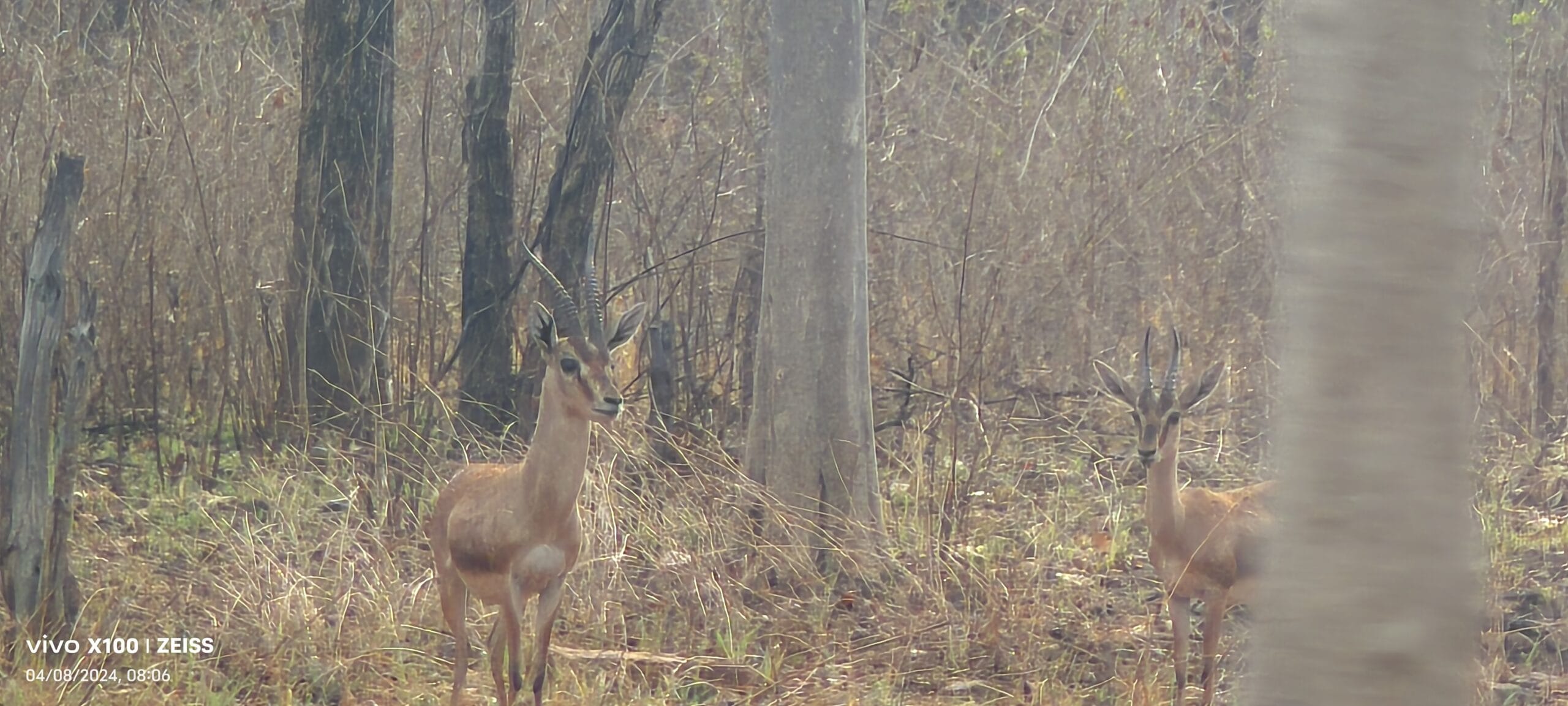
The four-horned antelope (chowsingha) — India’s smallest and rarest bovid, endemic to the subcontinent — is one of Panna’s quiet specialities. These shy animals blend almost perfectly into the dry leaf litter. Panna’s open teak woodland is among their most reliable habitats in central India.
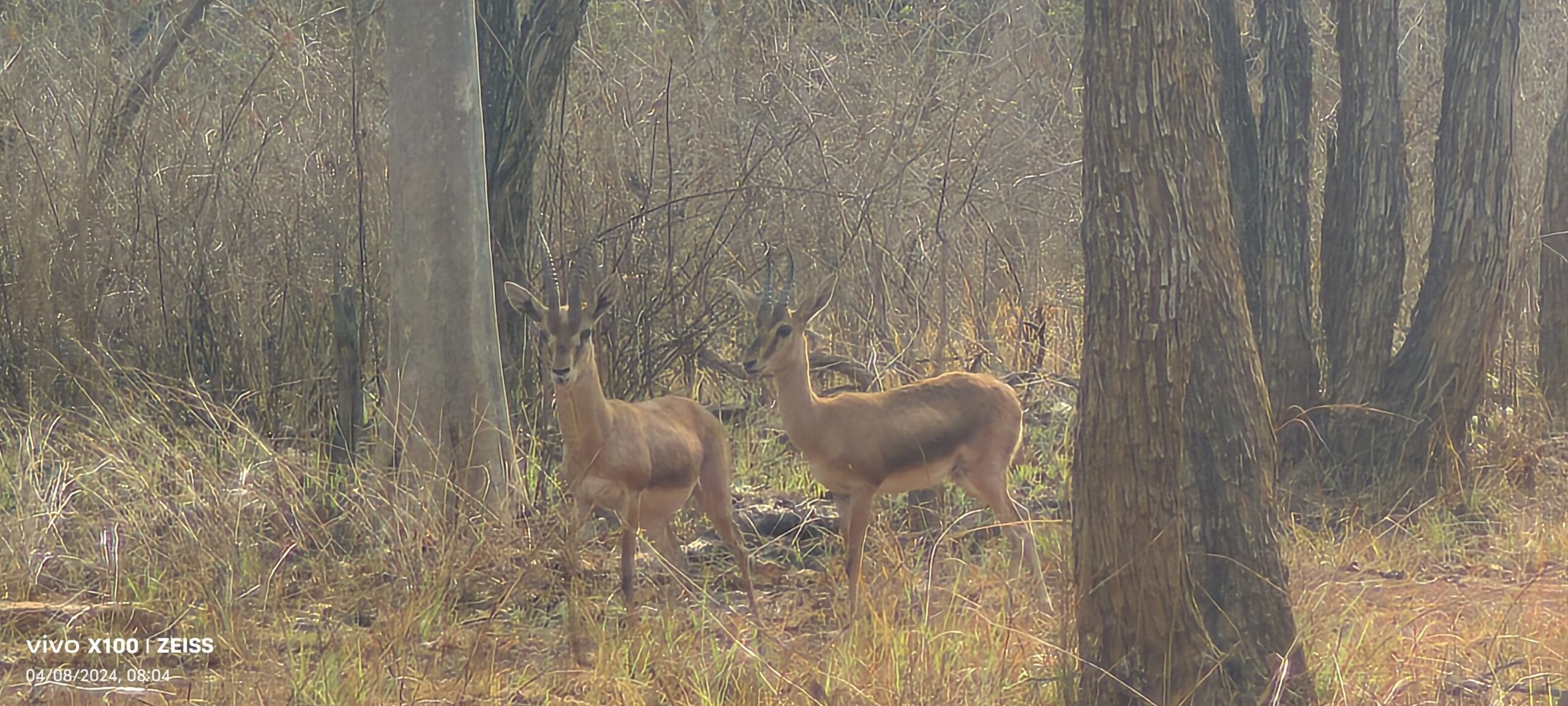
Other notable mammals include leopard (present throughout, rarely seen in the core zone — Hinauta zone is better), sloth bear (active and visible March–May when mahua flowers), Indian wild dog/dhole (occasional pack sightings), striped hyena, Indian wolf, nilgai, sambar, and jungle cat. For birds, Panna is significantly underrated — six vulture species nest in the reserve (Indian, white-rumped, long-billed, slender-billed, red-headed, Egyptian), and Indian skimmer nests on the Ken’s sandbars. Over 200 species have been recorded.
The Forest in Detail: What Panna Looks Like Beyond the Tiger Tracks
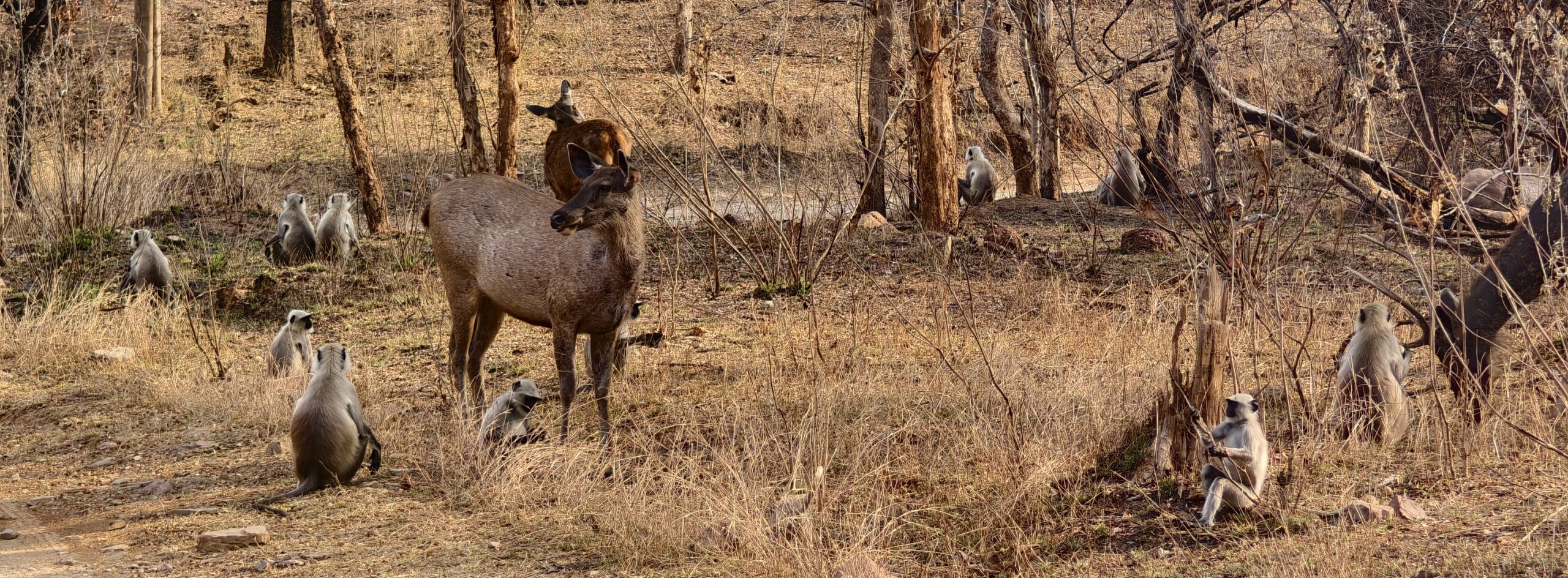
The dry forest floor in the peak season is a mosaic of pale sandstone fragments, ash-dark soil from the controlled burns, and deep amber leaf litter. The burns — managed by the forest department — are deliberate. They open the understorey, reduce the tick burden on prey animals, regenerate grass cover, and improve nesting conditions for ground birds. The scorched sections you drive through on safari are not damage. They are management in progress.
Best Time to Visit Panna Tiger Reserve: Season by Season
Panna Tiger Reserve is open from October 1 to June 30 each year, closing entirely during the monsoon (July–September). Three distinct windows offer genuinely different experiences — choose based on what matters most to you.
How to Reach Panna Tiger Reserve: Complete Route Guide
Panna Tiger Reserve is one of the most accessible tiger reserves in central India — the nearest airport is just 25 km away, and a good highway connects it directly to Khajuraho, Satna, and Jhansi. Here are all your options.
By Air
Khajuraho Airport (HJR) — 25 km from Madla Gate
🕐 45 min by taxi | ₹1,000–1,200
Direct daily flights from Delhi (IndiGo, Air India ~1h 20m) and Varanasi. Mumbai / Chennai need Delhi transit.
✔ Fastest option from Delhi
By Train
Satna Jn — 90 km / 2.5 hrs Best for Delhi / Varanasi
Katni Jn — 115 km / 3 hrs Mumbai / Chennai
Jhansi Jn — 180 km / 4.5 hrs Agra / Delhi
Pre-book a cab from station to Panna resort — all operators know the route.
By Road
Khajuraho → 25 km, 45 min (NH75)
Delhi → ~600 km, 8–9 hrs (NH44 + NH75)
Bhopal → ~400 km, 6–7 hrs (NH46 + NH75)
Varanasi → ~370 km, ~6 hrs (NH35 + NH75)
Jabalpur → ~240 km, ~4.5 hrs
NH75 excellent quality throughout
📍 Distance from Panna Tiger Reserve (Madla Gate)
Perfect Combination
🏛️ Khajuraho Temples + 🐯 Panna Safari
The UNESCO World Heritage temples at Khajuraho — 25 surviving structures built between 950 and 1050 CE — are just 25 km from Madla Gate. This is one of India’s most efficient wildlife-heritage combinations.
📅 Suggested 4-Day Itinerary
Day 1 — Arrive Khajuraho. Visit Western Group temples (3–4 hrs). Evening Light & Sound show.
Day 2 — Transfer to Panna resort. Afternoon safari (Madla zone).
Day 3 — Morning safari + Evening safari. Ken River boat safari optional.
Day 4 — Final morning safari. Depart by afternoon.
Where to Stay Near Panna Tiger Reserve
The best base is the Madla village area, 2–3 km from Madla Gate. Staying here puts you at the gate queue first, eliminates predawn driving, and keeps you within the buffer zone atmosphere rather than Panna town’s more urban surroundings.
Ken River Lodge (IHCL SeleQtions) is the most established premium property — river-facing cottages, resident naturalists, and a location directly overlooking the Ken valley. Pashan Garh (Taj Safaris) is the luxury benchmark with architecturally distinctive cottages and exceptional naturalist-led safaris. For mid-range, Nature Shack Jungle Camp and Jungle Resort Panna both deliver clean, functional accommodation with knowledgeable local guides at significantly lower price points. The Forest Department also maintains basic accommodation near Raneh Falls, allocated through the Field Director’s office on availability.
Beyond the Jeep Safari: Other Things to Do at Panna
Ken River Boat Safari: One-hour motorised ride through the gorge — the primary activity for gharial, otter, skimmer, and kingfisher sightings. Must be arranged separately through your resort or the forest department with one day’s advance notice. Best combined with an afternoon when the evening safari slot is already used.
Night Safari (Jhinna Buffer Zone): A unique offering in Panna’s buffer zone — nocturnal species including rusty-spotted cat, civets, Indian bush cat, striped hyena, and honey badger are the targets. Permits must be purchased offline at the ticket counter on the same day. This is only available in the buffer zone, not the core.
Pandav Falls: Inside the buffer zone, this waterfall drops approximately 30 metres into the Ken below — one of the more dramatic falls in Madhya Pradesh. Best visited October–February when the river flow is at its peak. The Pandav Caves nearby carry mythological association with the Mahabharata.
Raneh Falls: A series of waterfalls on the Ken River set in gorges of dark basalt, pink granite, and rose quartz — the geological combination is extraordinary and unlike anything else in the region. Quieter than Pandav Falls and often skipped by tourists, making it a better experience for those who find it.
Diamond Mines, Panna: The Panna district is historically one of India’s primary diamond-producing regions. The Majhgawan diamond mine and the traditional alluvial mining operations near Panna town are a genuinely unusual half-day activity for travellers with an extra day in the area.
Khajuraho Temples: Already covered above but worth repeating — 25 km away, UNESCO World Heritage, and one of the finest medieval temple complexes in Asia. Do not leave this region without spending at least one morning there.
Panna Tiger Reserve Safari Tips: How to Get the Most from Your Visit
Book permits 2–3 weeks in advance for the March–June peak window, especially for weekends. Arrive at Madla Gate 30–45 minutes before opening time — queue position determines which part of the core zone you reach first after entry. Plan a minimum of three safaris (two morning, one evening) across two nights; one-safari visits rarely capture what Panna offers. Tell your naturalist your specific priority — tiger, gharial, chowsingha, birds — before the engine starts. A clear brief produces a more targeted drive. Carry a reusable water bottle (the forest department restricts single-use plastic at some gates). Dress in muted earth tones; avoid white or bright colours inside the forest. Keep your voice low and your phone on silent once inside — it makes a genuine difference to what approaches the vehicle.
🐯 Ready to Book Your Panna Tiger Reserve Safari?
This guided jeep safari package from Khajuraho handles everything — entry permits, a vetted local naturalist, safari vehicle, and morning core zone access. No permit queue, no vehicle logistics. Just the forest and the tiger.
Book Panna Jeep Safari from Khajuraho →Affiliate link — we earn a small commission at no extra cost to you.
Frequently Asked Questions: Panna Tiger Reserve
How many tigers are in Panna Tiger Reserve in 2024?
Panna Tiger Reserve’s population had recovered to approximately 70 Bengal tigers by 2024 — around 45–50 adults and 20–25 cubs under one year, with an additional 30–35 individuals having dispersed outward into adjacent forests. This recovery from complete local extinction in 2009 through a translocation programme using tigers from Bandhavgarh, Kanha, and Pench is one of the most closely studied large carnivore conservation successes in Asia.
What is the best time to visit Panna Tiger Reserve for tiger sightings?
March to June is the peak tiger sighting window. The dry season opens the forest completely — the teak drops its leaves and visibility extends to 150+ metres. As the Ken River’s water level falls through May and June, animals concentrate along its banks and tiger activity near the remaining forest pools is at its annual maximum. March–April offers the best combination of sighting probability and manageable temperature.
Is Panna Tiger Reserve better than Bandhavgarh for a first tiger safari?
Bandhavgarh has India’s highest tiger density per square kilometre and the highest guaranteed-sighting probability. Panna offers a far less crowded experience, excellent dry-season sighting rates, the unique Ken River boat safari, a resident gharial population, and proximity to Khajuraho’s UNESCO temples — making it a more layered destination overall. For a first visit specifically focused on tiger photography, Bandhavgarh edges ahead. For a richer, more immersive wildlife experience, Panna is increasingly the better answer.
Which gate is best for tiger sightings in Panna Tiger Reserve?
Madla Gate gives access to the Ken River core zone — the area with the highest tiger activity through the dry season. It is the correct choice for tiger-focused visitors. Hinauta Gate suits travellers interested in leopard, sloth bear, and birding in rockier terrain.
How far is Panna Tiger Reserve from Khajuraho?
Madla Gate is approximately 25 km from Khajuraho Airport — about 45 minutes by taxi. Khajuraho town is slightly further along NH75 at approximately 57 km. The road is NH75 standard throughout — good quality and well-signed.
Can I do a night safari in Panna Tiger Reserve?
Yes — night safaris are available in the Jhinna Buffer Zone and must be booked offline at the ticket counter on the same day. They are not available in the core zone. The buffer zone night safari targets nocturnal species including rusty-spotted cat, civets, striped hyena, and honey badger.
What should I pack for a Panna Tiger Reserve safari?
Earth-tone clothing (avoid white and bright colours). Light layers for predawn starts in cool season (October–February: a fleece; summer: light long-sleeve). Wide-brim hat and sunscreen for summer morning safaris. Binoculars (8×42 minimum). Fully charged camera or phone. Reusable water bottle. Cash — ATMs are scarce near the reserve and most local vendors and lodges near Madla Gate prefer cash or UPI.