
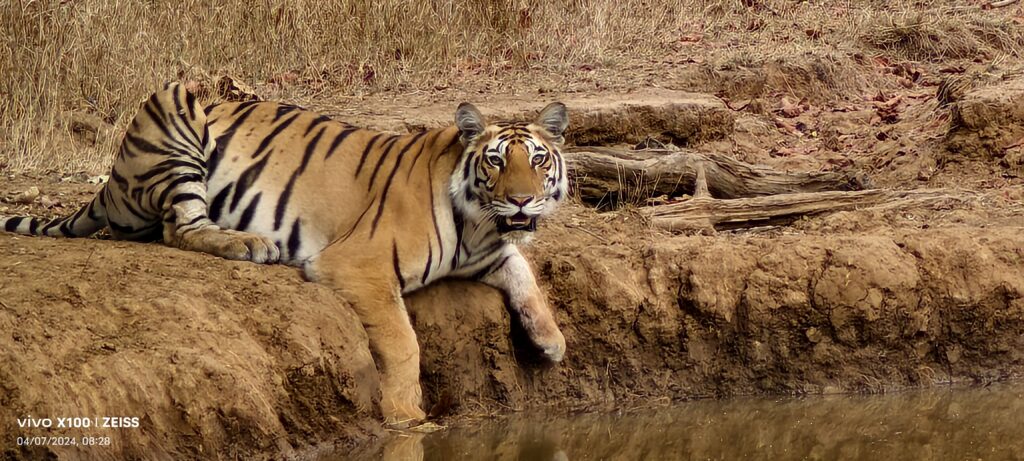
Tiger in Panna Forest – Photo of Tiger

Each tiger has a unique stripe pattern, just like human fingerprints. No two tigers are ever the same!

Panna Tiger Reserve was once declared tiger-less in 2009, but thanks to conservation efforts, it now boasts a growing tiger population.

Tigers are solitary animals — spotting one sitting calmly in the open is both rare and magical!

Stripes are an identity document

Every tiger carries a pattern that belongs to it alone. No two are the same, the two flanks of a single animal do not match each other, and the pattern does not change over the animal’s life.

This is not a curiosity. It is the basis of how India counts its tigers.

How stripe patterns are used to count tigers

Camera traps are set in pairs facing each other across a trail, so both flanks of any animal walking between them are photographed at once.

Those images are matched against a reference database. Because the pattern is unique and stable, a tiger recorded at one location can be positively identified when it appears somewhere else months later. That is how researchers separate individuals instead of counting the same animal twice.

It is also how a reserve can state that a particular tigress has three cubs, or that a young male has dispersed forty kilometres to set up territory of his own.

What the stripes are actually for

The pattern breaks up the animal’s outline. In dry grass and dappled shade, vertical dark bars on an orange body dissolve the shape of a very large predator remarkably well.

Deer and most other prey species do not see colour the way we do. To a chital, that vivid orange does not read as orange at all, and a tiger against dry grass is far harder to pick out than it looks in a photograph. The colour that seems so obvious to us is doing exactly the job it evolved to do.

Panna: the reserve that lost every tiger

In 2009 Panna Tiger Reserve was confirmed to have no tigers left. Poaching had emptied it.

What followed was one of the more determined recoveries in Indian conservation. Tigers were moved in from other reserves, females first, then males, and monitored closely while they settled and began to breed.

The population re-established. A reserve written off inside a decade now produces its own wild-born generations. It is worth holding that in mind while you are sitting in a jeep there, because the animal in front of you exists as the result of a deliberate decision to rebuild.

Seeing tigers at Panna

  • Best season: February to June. It gets hot from March, but sightings improve as water grows scarce.
  • The Ken River runs through the reserve, so there is more permanent water here than in many central Indian parks.
  • Nearest airport: Khajuraho, roughly an hour away, which makes Panna one of the easier reserves to reach.
  • Worth combining with the Khajuraho temples if you want a trip that is not only safaris.

Frequently asked questions

Are tiger stripes really unique?

Yes, like a fingerprint, and stable for life. The two sides of the same tiger differ from one another as well.

How do researchers identify individual tigers?

By photographing both flanks with paired camera traps and matching the stripe pattern against a database.

Why did Panna lose its tigers?

Poaching. By 2009 the reserve was confirmed to have none left.

Does Panna have tigers now?

Yes. Tigers were reintroduced from other reserves and the population re-established through wild breeding.

What are stripes for?

Camouflage. They break up the outline in grass and dappled light, and prey species do not perceive the orange as we do.


Related: Panna National Park Safari Guide, Tiger drinking at a Panna waterhole and How Tigers Mark Territory.

Scroll to Top