
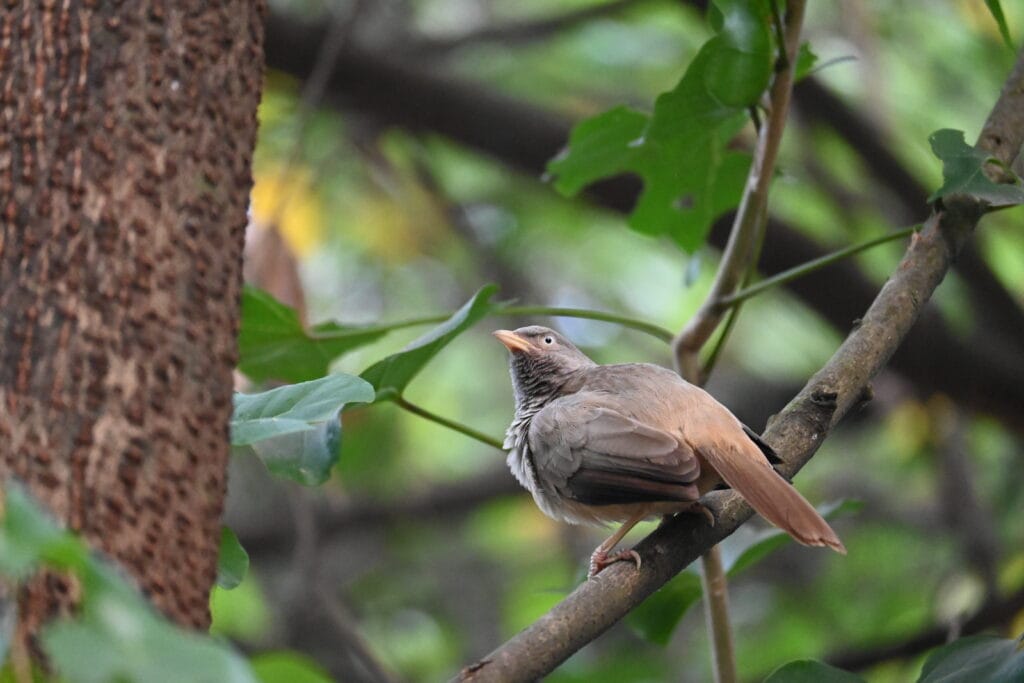
Jungle Babbler | near Kihim Beach, Alibaug
If Indian forests had a background soundtrack, the Jungle Babbler would be impossible to mute.
Commonly known as the “Seven Sisters”, the Jungle Babbler (Argya striata) is one of India’s most social and talkative birds. Rarely seen alone, this species thrives on companionship, constant movement, and endless chatter — a true extrovert of the avian world.
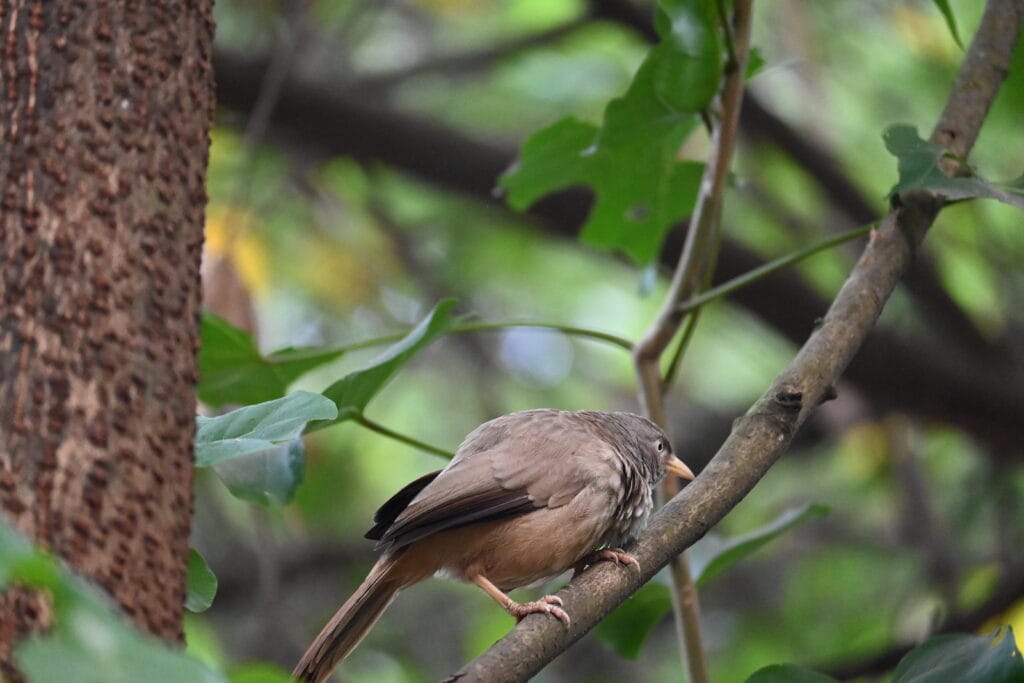
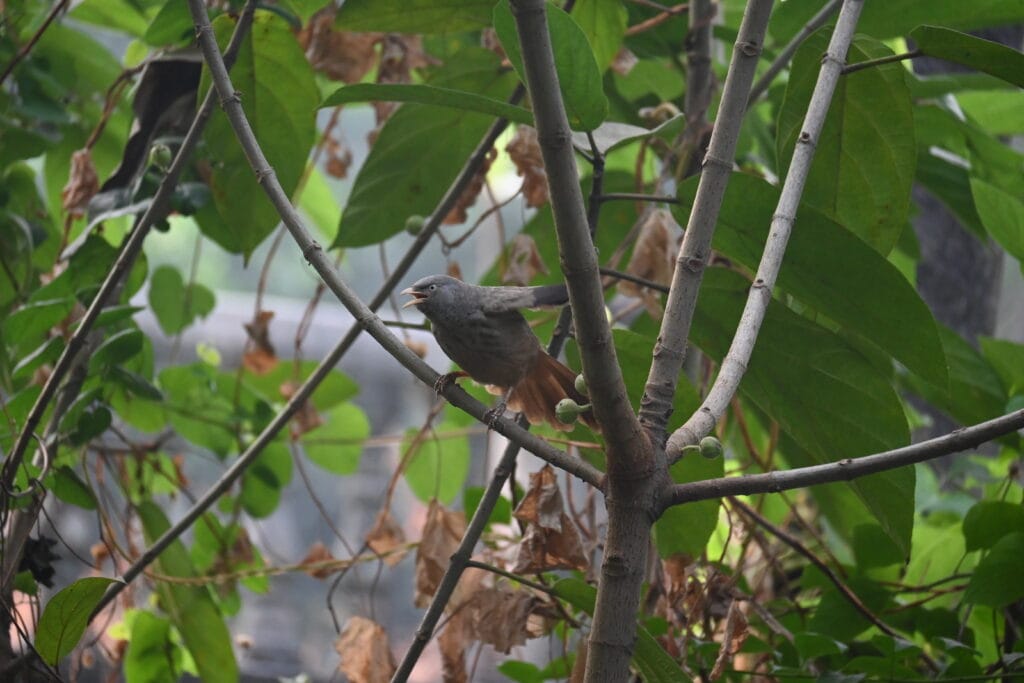
These photographs capture the Jungle Babbler in its natural setting, alert and observant, perched on forest branches while keeping close contact with its group.
A Forest Sighting near Kihim Beach, Alibaug
This sighting was recorded near Kihim Beach, Alibaug, where coastal greenery blends seamlessly with dense tree cover. The region’s mix of forest patches and quiet natural spaces creates an ideal habitat for birds like the Jungle Babbler.
Here, away from crowds, the bird moves confidently through the foliage — scanning, calling, and coordinating with its flock, reminding us that even near popular coastal destinations, rich wildlife quietly thrives.
Behavior & Habitat
Jungle Babblers are highly adaptable and can be found across forests, scrublands, gardens, and urban green spaces throughout India. Their defining trait is their strong social structure — they live, forage, and defend territory together.
Silence often signals danger for them. Constant vocal communication keeps the group alert, united, and safe.
Why Birdwatchers Love the Jungle Babbler
For birdwatchers and wildlife photographers, the Jungle Babbler offers endless moments of interaction. Its expressive movements, group dynamics, and fearless nature make it both challenging and rewarding to photograph.
One moment it sits perfectly framed — the next, it vanishes into foliage, leading its group onward.
Fun Facts
- Nicknamed “Seven Sisters” because of their close-knit group behavior
- Rarely seen alone — they rely on collective movement and alertness
- Highly vocal, communicating even while resting or feeding
- Known to collectively mob predators to protect the group
📍 Location: Near Kihim Beach, Alibaug, Maharashtra
📷 Captured in the wild | © TravelonTales
Click here to explore more wildlife stories on TravelonTales
Kihim, and why it is good for birds
Kihim is a small beach village south of Alibaug, and its reputation among birders is older than its reputation among weekenders. Salim Ali did much of his early work here — the village is where he studied the Baya Weaver, and his writing about it put Kihim on the map for anyone who reads Indian ornithology.
What makes it productive is the mix. Behind the beach there is casuarina, then old mango and tamarind gardens, then scrub, then paddy and marsh. Four habitats within a short walk, and babblers use all of them.
Babblers in a coastal garden
Jungle Babblers here behave differently from the ones in a dry central Indian forest. There is more cover, more leaf litter and more fruit, and the flocks are correspondingly less mobile — a group will work the same few compounds for weeks.
They are also noticeably bolder around houses. A flock will come onto a verandah, turn over a doormat, and argue about it at length.
What else you will see on the same walk
- Coppersmith Barbet calling monotonously from a bare branch.
- Baya Weaver colonies in the palms during the monsoon.
- Golden Oriole, Paradise Flycatcher and Iora in the old gardens.
- White-throated Kingfisher everywhere, including well away from water.
- Waders on the beach at low tide — sandplovers and stints.
- Malabar Grey Hornbill occasionally, in the larger tree gardens.
Practical notes
- Getting there: the RoRo ferry from Mumbai to Mandwa, then about twenty minutes by road. Far better than driving around the creek.
- Best time: November to February for the widest bird list; the monsoon for weavers and a green landscape.
- Walk early. The lanes behind the beach between six and eight are the whole point.
- Stay in a homestay rather than a resort — the gardens are where the birds are.
Frequently asked questions
Is Kihim good for birdwatching?
Yes, unusually so for a beach village, because beach, casuarina, old gardens, scrub and paddy sit close together.
What is Kihim’s connection to Salim Ali?
He carried out his well-known Baya Weaver studies here and wrote about the village at length.
How do I reach Kihim from Mumbai?
Take the RoRo ferry to Mandwa and drive about twenty minutes.
When should I visit?
November to February for birds generally; the monsoon for weaver colonies.
Related: The Babbler and the Seven Sisters.
