
Marsh Sandpiper in Bhigwan – Elegant Reflection of a Wetland Wanderer

Published on April 3, 2026

Marsh Sandpiper in Bhigwan – A Reflection of Elegance

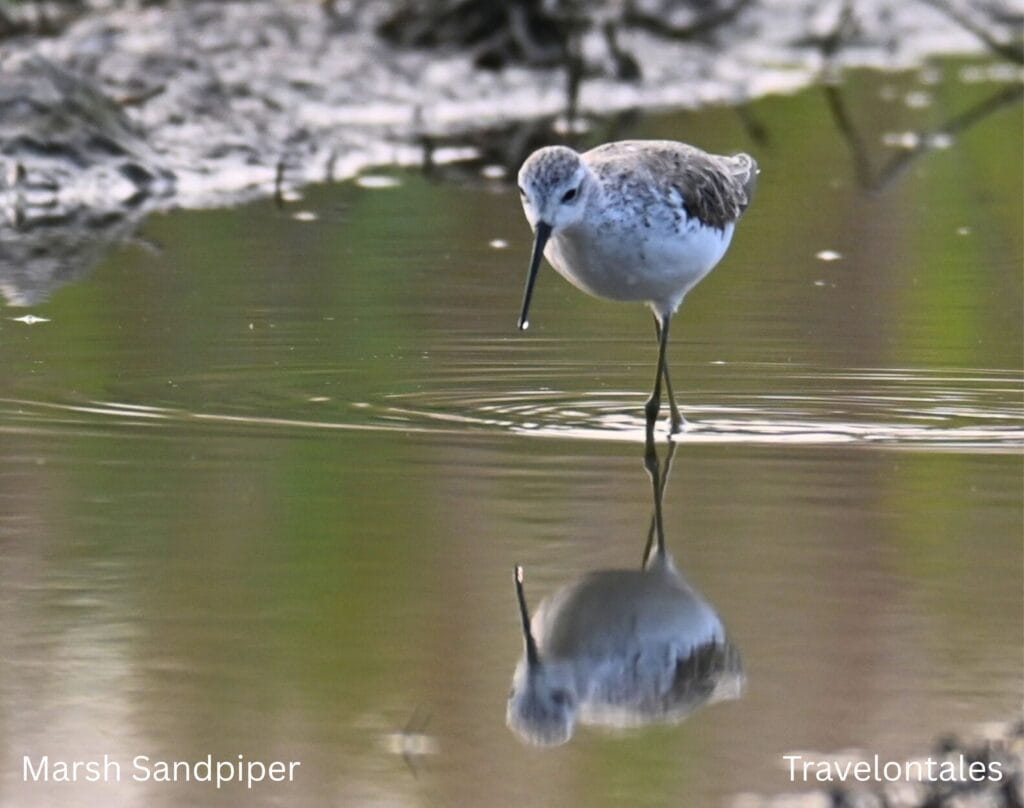
The Marsh Sandpiper in Bhigwan offers one of the most graceful sights in India’s wetlands, this migratory bird walks gently through shallow water, creating ripples that mirror its delicate reflection.

Marsh Sandpiper in Bhigwan – A Perfect Reflection Moment

Known scientifically as Tringa stagnatilis, the Marsh Sandpiper is a long-distance migratory bird that visits India during winter. Bhigwan, often called the “Bharatpur of Maharashtra,” becomes a vital habitat for such species.

This image highlights the elegance of the Marsh Sandpiper in Bhigwan, where calm waters create a near-perfect reflection. The bird’s slender legs, soft plumage, and gentle movement bring a sense of peace and balance to the frame.

Behavior and Habitat

The Marsh Sandpiper prefers shallow wetlands, where it feeds on small aquatic organisms. Its slow and careful movements are designed to avoid disturbing the water, allowing it to hunt efficiently.

Bhigwan’s ecosystem supports a variety of migratory birds, making it a paradise for wildlife photographers and bird enthusiasts alike.

Why This Moment Matters

Unlike action-packed wildlife shots, this photograph tells a story of calm observation. The reflection doubles the visual impact, symbolizing harmony between nature and its environment.

Capturing a Marsh Sandpiper in Bhigwan with such clarity requires patience, timing, and an understanding of bird behavior.

Photography Insight

Reflection shots like this work best in still water and soft light. Keeping a low angle and maintaining distance ensures natural behavior while achieving a clean composition.

Explore more wildlife stories and photography at TravelOnTales.

The most elegant wader on the mudflat

Among a crowd of feeding waders the Marsh Sandpiper stands out by being finer than everything around it. Long legs, a slim body, and a bill like a needle — perfectly straight, thin, and dark.

It looks like a small, delicate Greenshank, and that is essentially what it is: same family, slighter build, straighter and finer bill.

Marsh Sandpiper vs Common Greenshank

  • Bill: Marsh Sandpiper — needle-fine, dead straight. Greenshank — thicker and slightly upturned.
  • Size: the Marsh Sandpiper is distinctly smaller and slimmer.
  • Legs: proportionally longer on the Marsh Sandpiper, extending well past the tail in flight.
  • Feeding: the Marsh Sandpiper picks delicately; the Greenshank is more active and will chase fish.

That bill is the reliable feature. Straight and fine means Marsh Sandpiper.

A very long commute

The Marsh Sandpiper breeds across the steppe and wetlands of Russia and Central Asia, and winters in Africa, South Asia and Australia.

The birds at Bhigwan in December have crossed a continent to be there. They arrive with the cold, feed through the winter, and leave again in spring. A wader standing quietly on a mudflat is midway through an annual journey of thousands of kilometres.

How it feeds

Delicately, and usually in shallow water rather than on dry mud. It walks steadily, picking small invertebrates from the surface and just below it, and will sometimes sweep the bill sideways through the water.

It feeds in loose groups rather than tight flocks, spread across the shallows, each bird working its own patch.

Plumage changes

The wintering birds you see in India are pale and plain — grey-brown above, white below, with a white face. In breeding plumage they are much more heavily marked with dark spotting and barring above.

Most Indian sightings are of winter birds, so if you see one heavily marked in spring, it is on its way north and changing.

Photographing waders

  • Get to water level. A wader shot from standing height is a bird on mud. From water level it is a bird in its element, with reflections.
  • Shoot early. Low light on shallow water gives colour and reflection that midday flattens out.
  • Isolate one bird. Mudflats are cluttered. A clean background matters more here than almost anywhere.
  • Get the bill sharp. With this species the bill is the identification, so it has to be in focus.

Frequently asked questions

How do I identify a Marsh Sandpiper?

Very long legs, slim body and a needle-fine perfectly straight dark bill. Smaller and finer than a Greenshank.

Where does it come from?

It breeds in Russia and Central Asia and winters in South Asia, Africa and Australia.

When can I see it in India?

Through the winter, roughly from October to March.

What does it eat?

Small aquatic invertebrates picked from shallow water and the surface of mud.


Related: Birds of Bhigwan — 39 species, Common Sandpiper and Bhigwan Bird Photography Tour.

Scroll to Top