
Rock Eagle-Owl at Bhigwan: The Owl That Owns the Rock Face
A first light encounter at Kadbanwadi — and what it takes to find India’s most imposing owl
Most people who visit Bhigwan Bird Sanctuary come for the flamingos. In peak season, the pink clouds over Ujani Dam are genuinely spectacular.
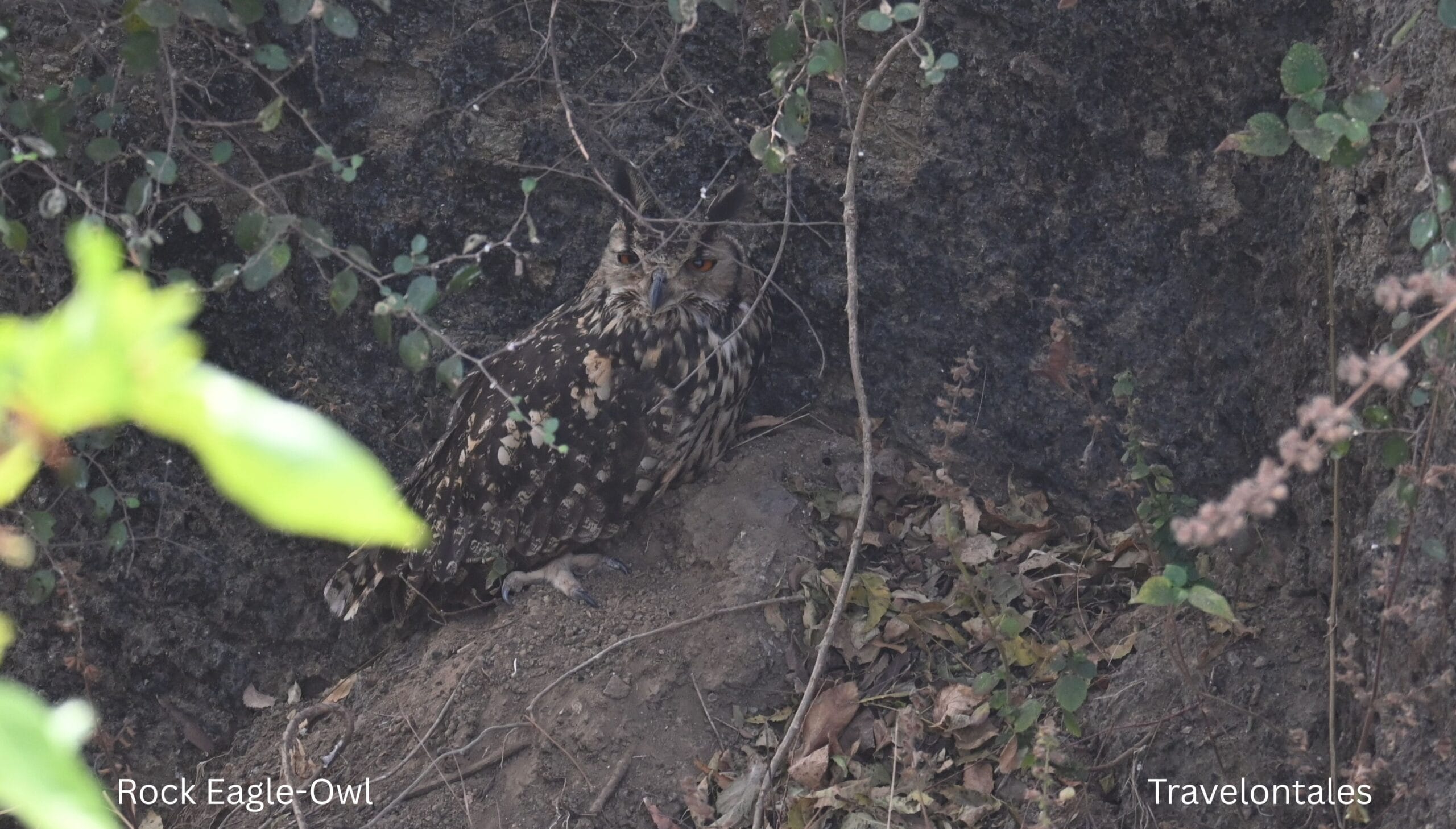
However, the sighting I keep returning to had nothing to do with the backwaters. It happened in shadow, on a rocky hillside, at the end of a long pre-dawn walk through the Kadbanwadi Grasslands. A slow scan of a basalt outcrop, a pair of amber eyes catching the thin early light — and there it was. A Rock Eagle-Owl (Bubo bengalensis), settled into a crevice like it had been part of the rock forever.
Without alarm, it looked straight back at me. Not a shift, not a puff of feathers. Simply watching — at ease in a darkness its feathers were built to match. I stood there for fifteen minutes before I remembered to raise the camera.
Those eyes did not blink once in the time we watched each other. The owl simply owned the rock face — feathers dissolved into basalt, talons pressed into dry earth, completely comfortable with its own invisibility. It was not hiding from me. It just knew I could not touch it. — Field notes, Kadbanwadi Grasslands, Bhigwan, February 2026
Bhigwan and the Grassland Nobody Talks About
If you have read the complete Bhigwan Bird Sanctuary field guide, you already know this place is not just a wetland. The Ujani Dam backwaters are the headline act. However, the real depth of Bhigwan lies in three distinct habitats — the Kadbanwadi Grasslands, the Ujani backwaters, and the open plains near Shirsufal outside Baramati. Each one delivers a completely different bird list. Together, they make Bhigwan one of the most varied birding spots in Maharashtra.
In particular, Kadbanwadi is where Bhigwan quietly excels at raptors. The flat Deccan grassland, with its low scrub and rocky outcrops, hosts multiple harrier species in winter — Montagu’s, Pallid, Western Marsh. Short-toed Snake Eagles and Changeable Hawk-Eagles use exposed perches here too. Several owl species also roost in the rocky margins after a night of hunting. As a result, the Rock Eagle-Owl I found had almost certainly spent the night working the grassland for rodents before retreating to this hollow just before dawn. The whitewash below the crevice and the worn soil confirmed it — this bird had used this exact ledge for more than one season.
Most visitors arrive at Bhigwan’s boat point and stay there. That is perfectly understandable. The boat safari on the Ujani backwaters is one of the great birding experiences in Maharashtra. Still, if you leave Bhigwan without spending a pre-dawn hour in the Kadbanwadi rocky margins, you are leaving its best owl country completely unwalked.
The Rock Eagle-Owl: What You Are Looking At
India’s largest owl of open and rocky country is the Rock Eagle-Owl. It belongs to the Bubo genus — the same family as the large Eurasian Eagle-Owl. In fact, it was considered the same species until fairly recently. The split is now widely accepted. Today, Bubo bengalensis stands as a distinct Indian species, built for rocky open land rather than the dense forests preferred by its European relative.
How to Identify It in the Field
Spotting this owl is straightforward once you know what to look for. The key features are the large widely-spaced ear tufts that give the head its bold shape, those deep amber-to-orange eyes that pick up light at great distances even in shadow, and the heavily streaked brown-and-buff feathers that break the bird’s outline against rock almost perfectly. At rest, a Rock Eagle-Owl looks less like a bird and more like a pattern in the stone — which is, of course, exactly the point.
The Camouflage: How This Owl Disappears in Plain Sight
The Rock Eagle-Owl does not hide. That is the important thing to understand. Staying still is its only strategy — and it is very, very good at it.
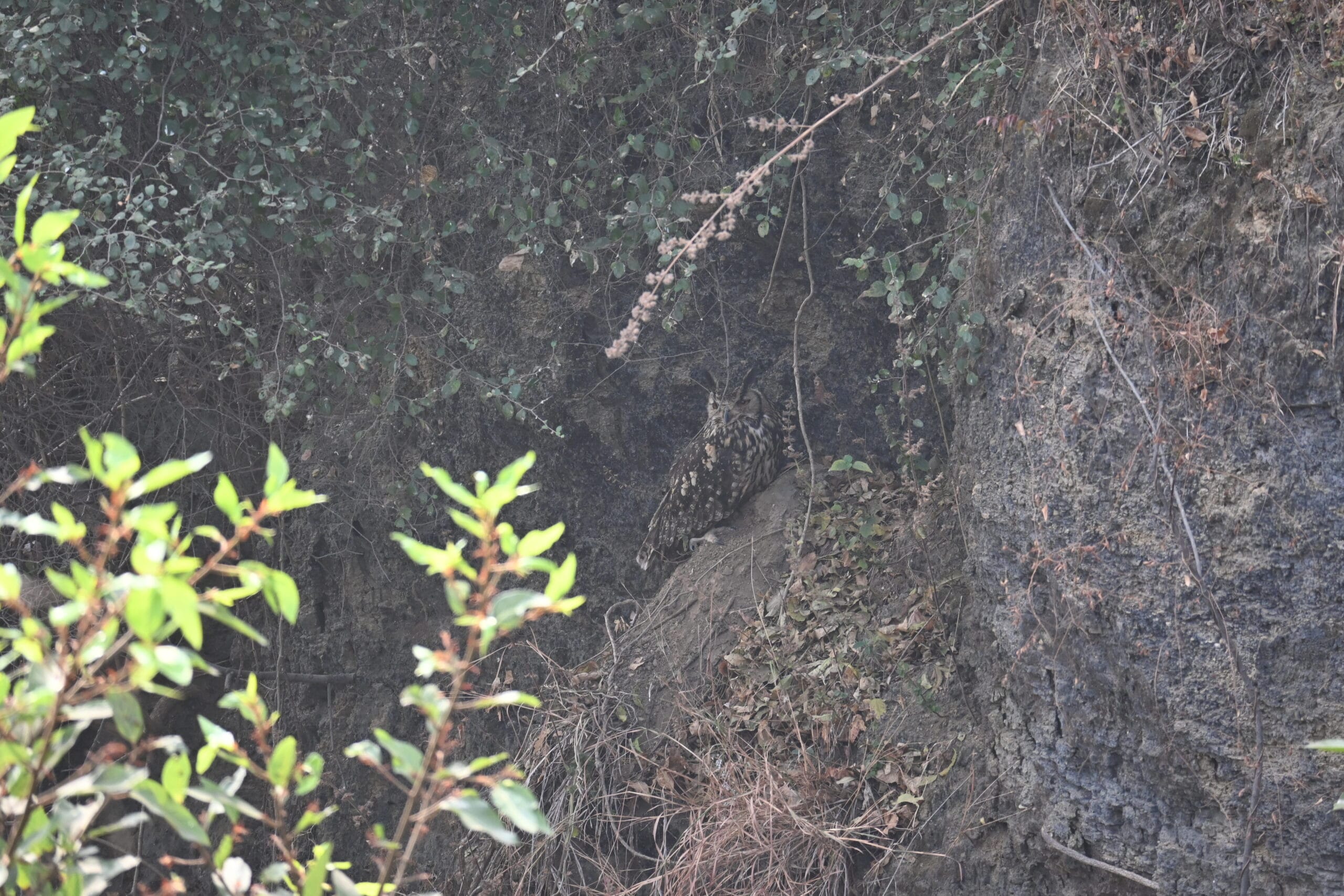
Look at the photograph above. Those dark brown streaks running down the owl’s chest are not random. Each one matches the vertical lines and cracks in basalt rock — the exact surface this species roosts against. Moreover, the pale background of the feathers mirrors the light patches of lichen and dry soil on the rock face. Even the ear tufts, which should stand out as a clear shape, break the head’s outline so it reads as just another rock edge in shadow.
Why the Pattern Works So Well
This kind of camouflage is known as colour matching — where the animal’s colours blend so closely with the background that it disappears when still. For the Rock Eagle-Owl, it works on two levels. First, the overall colour — dark grey-brown — matches basalt almost exactly. Second, the streaks and spots break up the bird’s body shape. Your eye looks for a clear outline. The streaked feathers give it nothing to lock onto. As a result, you can look directly at a roosting Rock Eagle-Owl and simply not see it.
This is not just about avoiding danger. It is also a hunting advantage. The owl roosts on the same rocky outcrops it hunts from at night. Rodents and small birds passing below in daylight have no reason to look twice at what seems to be another shadow in the rock. By the time they do, it is too late. The camouflage is therefore both a defence and a trap — a passive weapon built into every feather.
How to Use This Against the Bird
Finding this bird at Bhigwan comes down to seeing past the disguise. Do not look for a bird shape. Instead, look for two amber dots — those eyes are the one feature it cannot hide. At dawn, even in deep shadow, the orange eyes catch the early light and give the bird away before any other part is visible. That is exactly how I found this one.
| Scientific Name | Bubo bengalensis |
|---|---|
| Common Names | Rock Eagle-Owl, Indian Eagle-Owl, Bengal Eagle-Owl |
| Family | Strigidae (True Owls) |
| Size | 50–56 cm; wingspan approximately 130 cm |
| Eye colour | Deep amber to orange — highly diagnostic |
| Ear tufts | Long, prominent, widely spaced — unlike any other large Indian owl |
| Plumage | Dark brown upperparts heavily streaked buff-white; bold streaking below |
| Voice | Deep resonant bu-bo duet; second note slightly lower; audible up to 1 km at dusk |
| Diet | Rodents, frogs, reptiles, smaller birds, bats; capable of taking hares and monitor lizards |
| Nesting season | November–March in Maharashtra; bare scrape on rocky ledge or cliff base |
| Habitat | Rocky hillsides, ravines, dry scrub edges, riverine cliffs, Deccan basalt outcrops |
| IUCN Status | Least Concern; locally declining where rocky habitat is quarried or disturbed |
| eBird code | reow1 |
The bird I photographed was in a typical daytime roost posture — body lowered and compact, feathers slightly relaxed, eyes at a narrow watchful squint. A bird this settled has clearly been at this spot for hours. Moreover, the way the talons pressed flat into the soil rather than gripping a vertical perch strongly suggested a nest on the ground. This was very likely a nest site. Rock Eagle-Owls in Maharashtra breed between November and March. By February, a pair may well have eggs or small chicks tucked into the back of a crevice exactly like this one.
How to Find the Rock Eagle-Owl at Bhigwan
This is not a species you sit and wait for. Instead, the strategy is find first, approach second. Rock Eagle-Owls roost at very predictable spots — specific rocky ledges, overhangs, and crevices they return to night after night. Sometimes they use the same site season after season. The challenge is simply locating the right ledge, which the first time takes either patience or local knowledge.
The most reliable method is to be in the rocky scrub margins of Kadbanwadi before first light. Move slowly on foot or in a stopped vehicle and scan every exposed rock face with a pair of field glasses. Look for those ear tufts outlined against the pale sky on ledge edges, or the amber eyeshine when a torch catches a bird in shadow. Even better, listen first. The deep double hoot carries a long way at dusk. A bird heard calling at last light almost certainly roosts within 200–300 metres of that spot.
Working with a local guide makes a real difference here. For example, Abhishek from Wildagram Expeditions, who organises the Bhigwan birding trips, knows specific roost sites that take independent visitors multiple visits to find on their own. On a short trip, therefore, that local knowledge is not a small advantage — it is the difference between a possible sighting and a near-certain one.
Best Time of Year for the Rock Eagle-Owl at Bhigwan
Fortunately, this aligns perfectly with Bhigwan’s main birding season. The same November-to-March window that brings flamingos to the Ujani backwaters and harriers to Kadbanwadi is also when the Rock Eagle-Owl is most settled, most vocal, and most reliably found at a fixed roost. You do not need a separate dedicated trip — the owl fits naturally into the same three-day Bhigwan itinerary that covers all the main habitats.
Photographing the Rock Eagle-Owl: What Actually Works
Owl photography has a reputation for being either very easy or completely impossible. The Rock Eagle-Owl is no exception. Find the bird settled at its roost and it will sit for you all morning — as long as you approach it right. Flush it through careless movement or advancing too fast, and you will watch it vanish into the scrub. That is the end of your session.
Above all, approach technique matters more than any camera setting. Come from the side rather than head-on. Crouch as you move — lowering your height reduces the sense of threat. Stop often and let the bird settle. Watch its body closely: if the owl draws itself tall, pulls its feathers tight, and fixes both eyes on you, stop right away. That is the pre-flush posture. Back up half a step and wait it out. In this case, the bird I photographed was thirty metres away when I stopped moving. It never once looked alarmed, so that distance worked well here. It may vary at another site.
The Light Problem: Shooting in Deep Rock Shadow
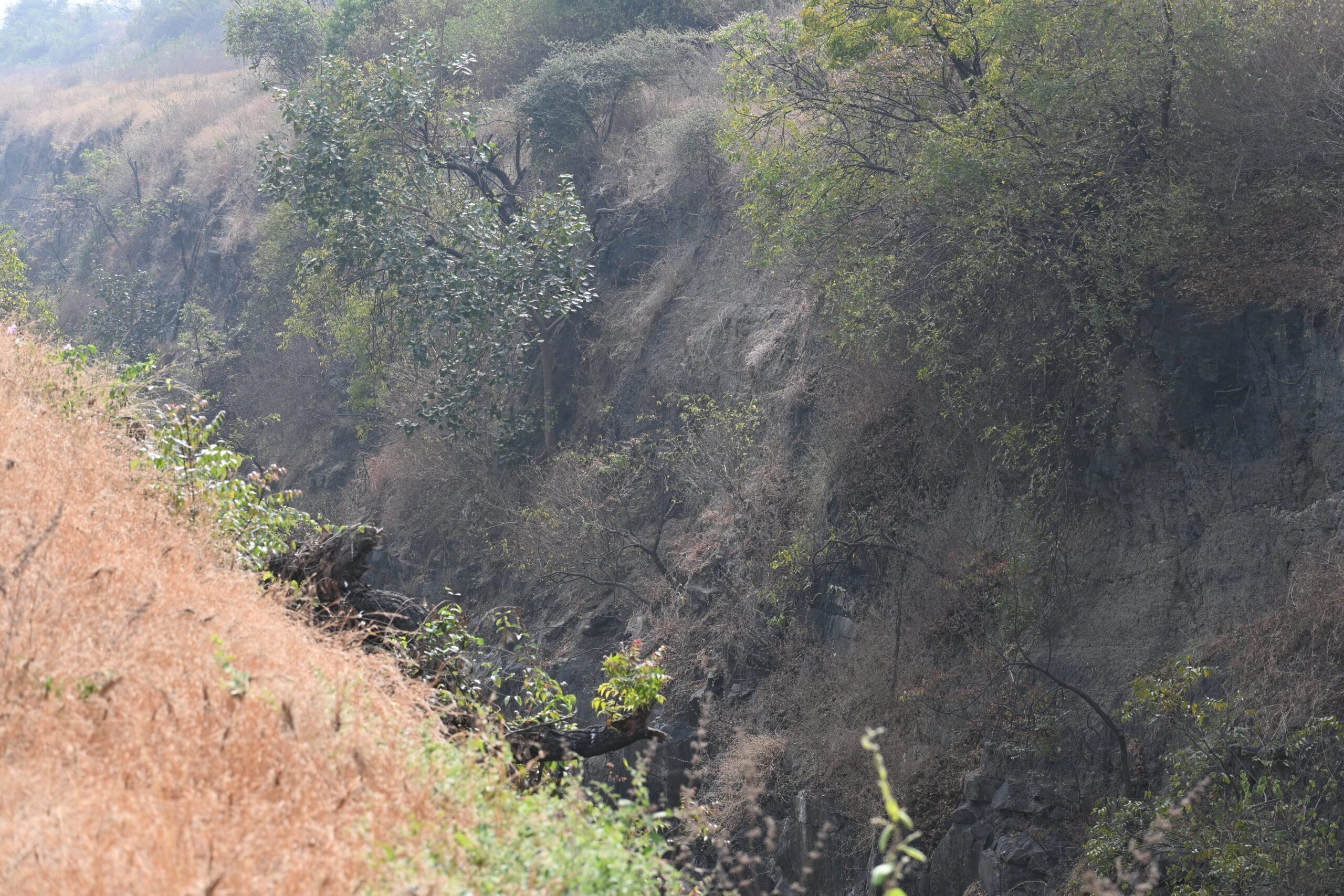
The main challenge at Bhigwan’s rocky sites is light. Basalt crevices are deeply shaded even in good morning sun. Meanwhile, the foliage or open sky around them can be two to three stops brighter than the owl. As a result, your camera’s metering will almost certainly underexpose the bird unless you step in. In this image, the dark background actually helped — the meter was not pulled by a bright sky. Even so, the shadow inside still needed a positive EV boost to hold detail in the feathers.
Mode: Aperture Priority with +0.7 EV boost dialled in
Aperture: f/5.6 to f/6.3 — wide enough for subject isolation against the dark basalt, with enough depth to keep the full facial disc in focus
Shutter speed: 1/200s to 1/400s — the bird is stationary; prioritise lower ISO over faster shutter
ISO: Auto ISO capped at 3200 — expect ISO 1600–2500 in deep shade without direct sun
Focus: Single point AF locked on the nearest eye. The Z50’s eye-detect subject tracking works reliably on owl faces — those large amber eyes give it a clear target even in low light
White Balance: Shade preset or AWB — avoid Daylight in basalt shadow, which adds a cold blue cast that kills the warm brown tones of the rock and feathers
Drive: Single shot or low-speed continuous — the mechanical sound of a fast burst is more likely to disturb the bird than slow deliberate frames
The one rule for owl portraits: expose for the eyes. If you have to choose between eye detail and feather detail, choose the eyes. An owl photograph lives or dies on whether those amber eyes are sharp and properly lit. Everything else is secondary.
Reading the Bird: What the Body Language Tells You
There is a lot to understand from a Rock Eagle-Owl even when it appears to be doing nothing. Look closely at this photograph and it tells a fairly complete story. Settled but attentive — body held lower than full alert, feathers slightly relaxed but not fluffed for sleep, eyes open and tracking. A bird this calm at a roost site has clearly been here for hours. Flat-pressed talons on soil, rather than wrapped around a vertical perch, strongly point to a ground-level nest scrape rather than a casual daytime stop.
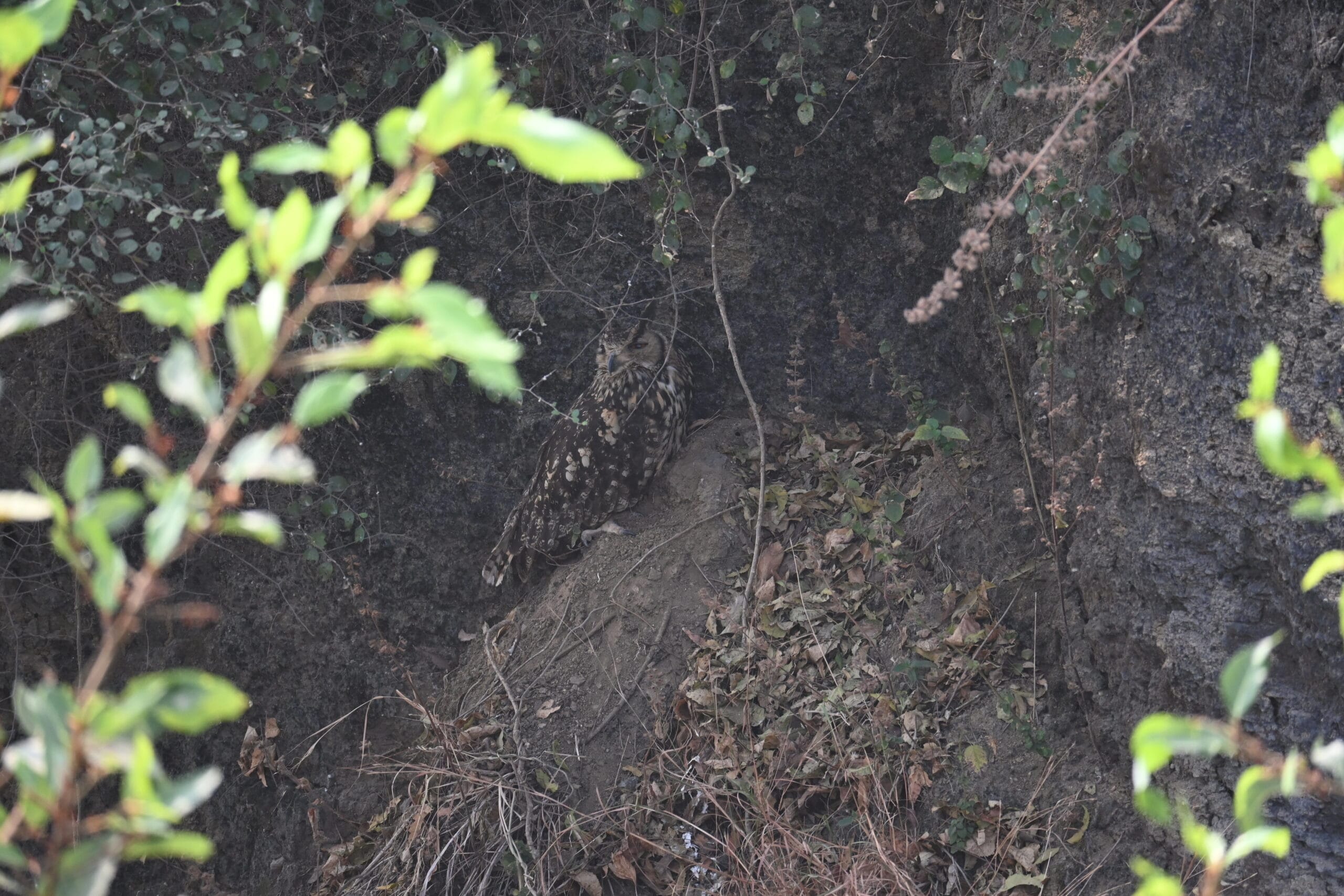
Notice also the slight puffing of the upper breast feathers. That is a heat-retention response — the early morning was cool, and the bird was holding warmth after a full night of hunting. Furthermore, the position itself is exactly what this species prefers: tucked into the back corner of a rocky hollow, with leaves and branches partly blocking the entrance and clear sightlines forward. Dark, sheltered, easy to defend. This is precisely the structure the Rock Eagle-Owl selects for roosting and nesting across the Deccan.
The Transformation at Dusk
If you are lucky enough to watch a Rock Eagle-Owl at dusk, the change from daytime bird to hunter is something else entirely. That still shape stretches wide, yawns, and slowly rotates its head in a full survey of the area. Suddenly everything shifts — this is a completely different animal now. When the bu-bo call comes, it is not loud so much as deep. Nothing else in the grassland sounds quite like it. Hearing that call drift across open Deccan scrub after dark is the kind of moment that makes this whole obsession worthwhile.
Where the Rock Eagle-Owl Fits in a Bhigwan Trip
If you are doing three days at Bhigwan — the right amount of time to cover the main habitats without rushing — the Rock Eagle-Owl fits naturally into the Day 2 pre-dawn Kadbanwadi session. That morning safari runs from around 5:30 am. It focuses on owls and dawn-active species that are still out as daylight builds. On the same outing, Spotted Owlets are near-guaranteed. In addition, an Indian Fox crossing the open track in the half-dark is entirely possible if you are quiet.
Afternoons on Day 2 belong to the boat safari on the Ujani backwaters — Painted Storks, Black-winged Stilts, Northern Shovelers, and flamingo clouds in peak season. Then on Day 3, the circuit moves to Shirsufal near Baramati. This is flat open grassland with a completely different raptor feel — Short-toed Snake Eagles on the thermals, more harriers, Desert Wheatear on every raised stone. In total, all three zones make a circuit that covers genuinely distinct Deccan habitats, with the Rock Eagle-Owl sitting right at the centre of it.
Why This Owl Stays With You
Bhigwan has other owls worth finding. Spotted Owlets are charming and show themselves freely. On the night walking safari, for instance, an Indian Nightjar’s red eyeshine appearing out of total darkness is startling every single time. Still, none of them carry the same weight as a Rock Eagle-Owl encounter. It is the size of the bird, the absolute stillness, those amber eyes holding yours across thirty metres of quiet morning air. Above all, it is the feeling that you have walked into someone else’s territory — not the other way around.
⚠ A Note on Watching Owls Responsibly
The Rock Eagle-Owl is not globally threatened. However, it is sensitive to disturbance at nest sites — and many of the best Bhigwan sightings involve birds that are actively breeding. Flash photography at roosting owls causes real stress to the bird. Similarly, playback calls used repeatedly alter natural behaviour and can cause birds to leave roost sites entirely. Crowding a nest scrape with multiple photographers is simply not acceptable. Therefore, always observe from a distance that does not change the bird’s behaviour. If the owl stands tall and stares directly at you, you are already too close — back off quietly. No photograph is worth flushing a bird from its nest.
📌 Planning a Bhigwan birding trip?
The complete field guide covers the full three-day itinerary, all three habitats, boat safari booking, where to stay, and how to reach Bhigwan from Pune and Mumbai.