
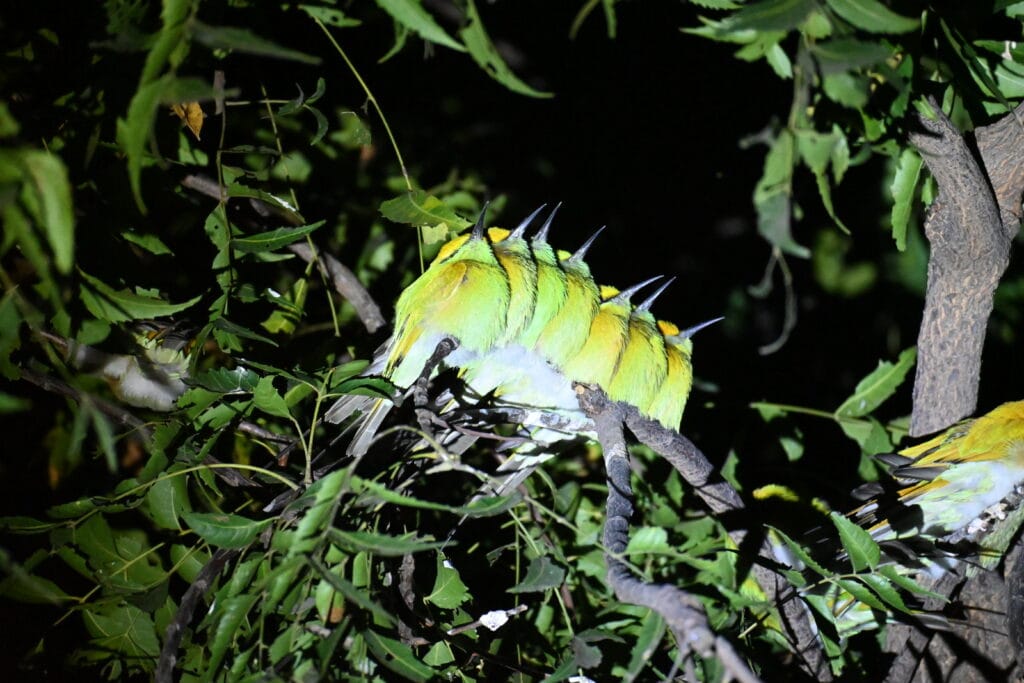
Green Bee-eaters Sleeping on Tree | Bhigwan Night Safari Wildlife Moment

Green Bee-eaters Sleeping on Tree | Bhigwan Night Safari Wildlife Moment
Published on April 3, 2026

Green Bee-eaters Sleeping on Tree | Bhigwan Night Safari

A rare and peaceful moment captured during a night safari at Bhigwan — a group of Green Bee-eaters resting quietly on a tree branch. Known for their vibrant green feathers and active hunting during the day, these birds reveal a completely different side at night.

Perched closely together, they form a synchronized line, showcasing nature’s instinct for safety and warmth. This behavior, known as roosting, helps them stay protected from predators while conserving energy for the next day.

Behavior Insight

Green Bee-eaters are highly social birds. During the night, they prefer to sleep in groups on thin branches, often returning to the same spot every evening. Their calm posture and tight formation create a visually stunning and peaceful scene in the wild.

Why This Moment is Special

Wildlife photography often focuses on action — hunting, flying, or movement. But moments like these capture something deeper: stillness. It’s a reminder that nature isn’t always loud; sometimes, it’s beautifully quiet.

Fun Fact: Green Bee-eaters often wake up early and sunbathe to warm their bodies before starting their day!

Bhigwan, known for its birdlife, offers not just daytime excitement but also magical night experiences like this — where even the wild takes a pause.

Why they sleep in a row

Green Bee-eaters roost communally, packed along a branch or a wire pressed tightly together, sometimes dozens in a line. It is one of the more photogenic things a common bird does, and there are solid reasons behind it.

  • Warmth. A small bird loses heat fast overnight. Contact with neighbours on both sides reduces the exposed surface substantially.
  • Safety. Many birds mean many eyes, and a predator approaching a packed row triggers an immediate collective reaction.
  • Position matters. The birds in the middle are warmest and safest. The constant shuffling along a roosting line is competition for those spots.

Finding a roost

Roosts are traditional. The same branch, wire or thorny bush is used night after night, often for whole seasons.

The way to find one is to watch at dusk rather than to search. Bee-eaters converge on the roost from all directions in the last twenty minutes of light, and once you have located it you can return to the same spot repeatedly.

Ask locally too. A roost of forty bee-eaters on a wire is the kind of thing people living nearby have noticed even if they have never named the bird.

The timing

They arrive later than you expect and settle quickly. There is usually a period of noisy repositioning, then it goes quiet.

This gives you a narrow window. The light that makes the picture is gone within about fifteen minutes of them settling, so being set up in advance is not optional.

Photographing a roost

  • Be in position before they arrive. Walking up to a settled roost will empty it.
  • Shoot against the sky. A row of silhouettes on a wire at dusk is the strongest version of this image.
  • Try for the whole line. Fill the frame with birds rather than isolating one — the row is the subject.
  • Push the ISO. Light disappears fast. A grainy sharp frame beats a clean blurred one.
  • Come back. Roosts are reliable, so you get repeated attempts at the same picture in different weather.

Behaviour to watch for

Before settling, bee-eaters preen heavily and often engage in allopreening, where neighbouring birds preen each other around the head and neck.

You may also see late arrivals attempting to push into the middle of the line and being resisted. That jostling is worth photographing — it is more interesting than a static row.

Frequently asked questions

Why do bee-eaters sleep together?

For warmth and safety. Huddling reduces heat loss, and a group detects predators more reliably.

Do they use the same roost every night?

Yes, roosts are traditional and often used for entire seasons.

When do they come in to roost?

In the last minutes of daylight, later than most people expect, and they settle quickly.

Why do they keep shuffling?

Positions in the middle of the row are warmer and safer, so birds compete for them.


Related: Green Bee-eater identification and hunting, Chestnut-headed Bee-eater and Birds of Bhigwan.

Scroll to Top