
A male sandgrouse can carry water in his feathers. Not in his bill, not in a crop — in his feathers, soaked up like a sponge and flown twenty or thirty kilometres back to chicks that cannot yet make the journey themselves.
That is the fact that makes this family worth caring about, and it is the reason a dull brown bird crouched in the grass is one of the more remarkable things you can find in dry country.
How the water carrying works
The belly feathers of male sandgrouse have a modified structure — coiled barbules that unwind when wet and hold water by capillary action, the way a wick does. The male wades in, rocks his body to soak the belly, then flies home with several millilitres held in the plumage.
The chicks strip the water out of his feathers with their bills. He does this daily, often at first light, and often at a shared drinking spot where dozens of birds arrive within a few minutes of each other and leave just as quickly.
It is one of the few genuinely unusual pieces of engineering in Indian birds, and it exists because sandgrouse nest far from water in country where there is no cover to walk chicks through.
The bird in front of us
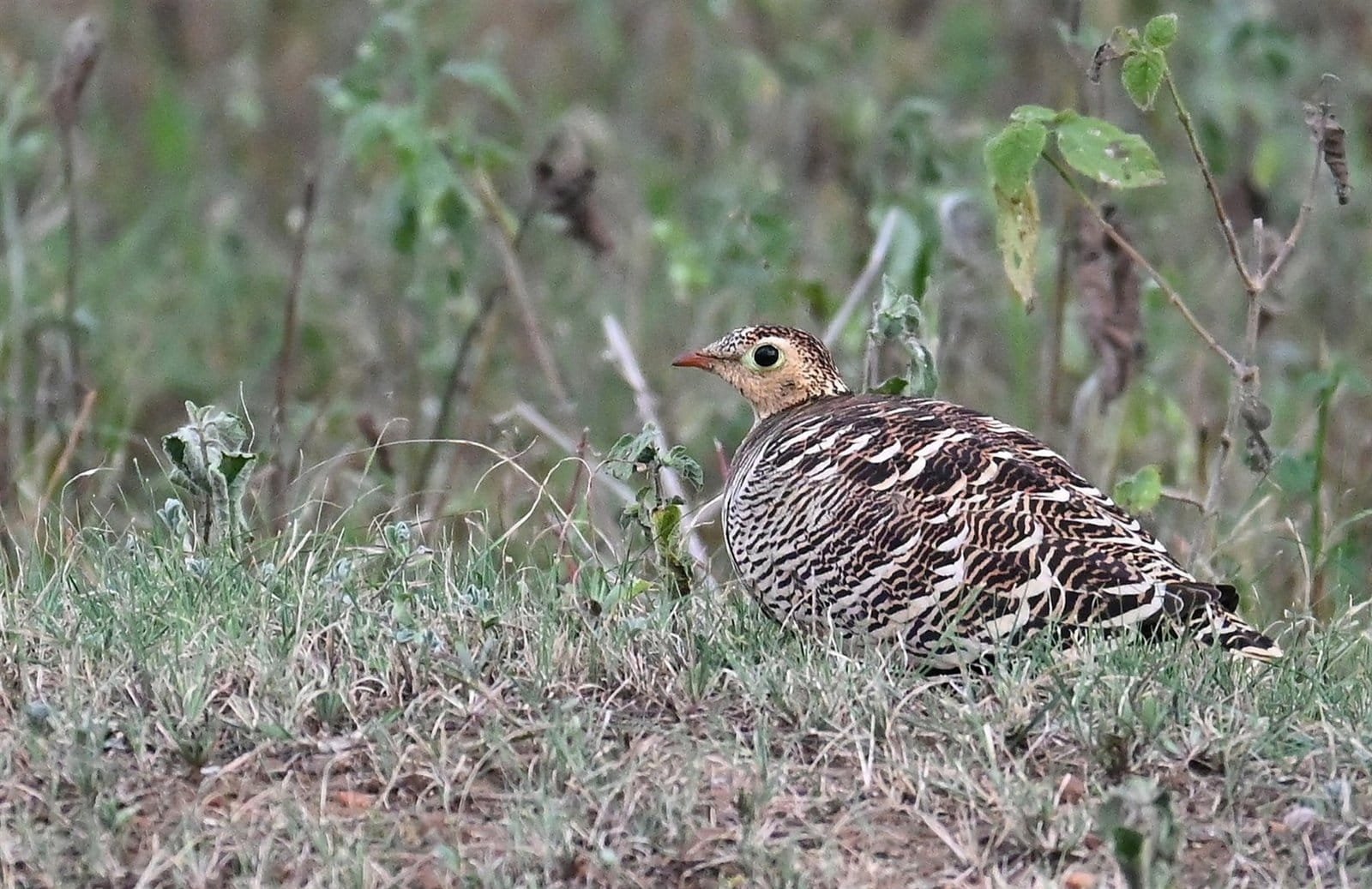
This is a female Painted Sandgrouse. The males are the ones that earn the name — a black-and-white band across the forehead, a clean buff breast, and heavy barring below. Females skip the face pattern and are barred over almost the entire body, which is what you are looking at here.
The bits that give it away are the small details: a coral-red bill, a yellow-green ring of bare skin around the eye, and that dense, fine, zebra-like barring that runs right up over the back.
Compare it with the other sandgrouse of this landscape, the Chestnut-bellied, which is sandier and plainer with a dark belly patch and no red on the bill. Painted Sandgrouse also prefer rockier, scrubbier, more broken ground than the wide open flats the Chestnut-bellied likes.
Why you will walk past them
Sandgrouse do not run and they do not flush early. They sit. A crouched bird on stony ground with dry grass around it is close to invisible, and their first defence is to let you go by.
Which means most people who visit the grassland at Kadbanwadi never see one, not because they are rare but because nobody is looking at the ground properly. Walk slowly. Scan ahead rather than at your feet. Look for the eye and the bill, not the bird.
And listen at dawn. Sandgrouse are far easier to detect flying than sitting — they call in flight, a soft clucking or bubbling note, and they move in small fast parties towards water in the first hour of light.
Best time to try
- Early morning, especially the first hour, when birds move to drink.
- The dry months, when water is concentrated and the flights are predictable.
- Rocky, broken ground with short grass and scattered scrub rather than open flats.
- On foot, or from a slow vehicle. They tolerate vehicles far better than people walking upright.
If you do find one, keep your distance and let it sit. A crouching sandgrouse is a bird that has decided you have not seen it, and there is no reason to prove otherwise. The photograph above was taken from a track, without approaching.
Everything else the grassland holds — harriers, larks, foxes, chinkara — is in the Kadbanwadi piece, and the wetland side of the same trip is here.
A note on names: we identify these birds ourselves and we do not always get it right. If you think we have called one wrongly, tell us — we would rather fix a name than leave it standing.