
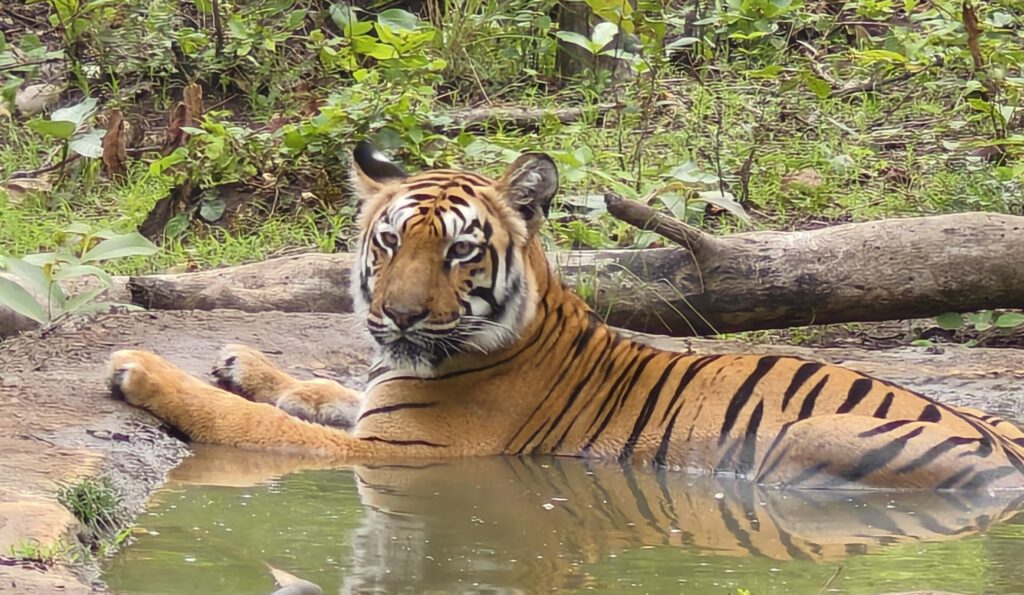
The Bengal Tiger (Panthera tigris tigris) is not just a symbol of strength and courage, but also the beating heart of India’s forests. Tadoba Andhari Tiger Reserve, Maharashtra, the tiger embodies both power and grace as it cools off in a forest waterhole.
Habitat & Distribution
The Bengal Tiger is primarily found in India, with smaller populations in Bangladesh, Bhutan, and Nepal. India alone holds nearly 70% of the world’s wild tigers, thanks to its network of tiger reserves like Tadoba, Bandhavgarh, Kanha, and Ranthambore.
Behavior & Diet
Tigers are solitary hunters, relying on stealth and strength. Their diet mainly includes deer, wild boar, and sometimes even gaur. A tiger can consume up to 40 kg of meat in one meal!
Why Tadoba is Special
Tadoba is one of India’s best tiger reserves with a high tiger density, making sightings relatively common. Photographers and wildlife enthusiasts from around the world flock here to witness the king of the jungle in his natural throne.
Fun Facts About Bengal Tigers
- A tiger’s roar can be heard up to 3 kilometers away.
- No two tigers have the same stripe pattern – it’s their fingerprint.
- Tigers love water! Unlike most cats, they are strong swimmers.
- Their night vision is six times stronger than humans.
click here
https://travelontales.com/bengal-tiger-panna-national-park/
Built for one explosive rush
A tiger is not a distance runner. Everything about it is arranged for getting close unseen and then covering the last few metres faster than the prey can react.
The hind legs are longer than the front, which is what produces the acceleration and the leap. The forelimbs are heavily muscled for grappling and holding an animal that may weigh as much as the tiger does. The retractable claws stay sharp because they are not walked on.
The senses
- Night vision roughly six times better than ours, helped by the tapetum lucidum — the reflective layer behind the retina that makes eyes shine in a torch beam.
- Hearing far more acute than sight for locating prey. Tigers can detect and act on sounds well outside our range.
- Smell is moderate for hunting but central for communication — reading scent marks rather than tracking prey.
- Whiskers that judge gaps and, at the kill, help locate the neck in the dark by touch.
Tigers hunt mostly at night, and every one of these is why.
The stalk
The approach is slow, low and patient, using cover, and it stops entirely whenever the prey lifts its head. A stalk can take a long time and end without any rush at all if the tiger judges it has been detected.
The rush itself covers a short distance. If the tiger cannot close it before the prey is running properly, it gives up. There is no pursuit — a chase would cost more energy than the meal returns.
The kill
Smaller prey is killed with a bite to the nape, severing the spinal cord. Larger animals — sambar, gaur — are taken by the throat and suffocated, which takes minutes and requires the tiger to hold on throughout.
This is the dangerous part of a tiger’s life. A gaur or a large sambar can injure or kill a tiger, and an injured tiger that cannot hunt does not recover. It is a large part of why tigers are so selective about what they attempt.
After the kill
A tiger will drag a carcass into cover, sometimes a considerable distance, to eat away from vultures and other scavengers. It may stay with a large kill for two or three days, feeding and resting nearby.
If your guide knows a kill has been made, that is the most reliable sighting opportunity available, because the animal is not going anywhere.
What this means on safari
- Dawn and dusk overlap with hunting activity. Midday tigers are resting.
- Alarm calls from chital, sambar and langur are the practical way to locate a hunting tiger.
- A known kill is worth waiting at, however dull the wait looks.
- Silence matters. A stalking tiger will abandon an approach if disturbed, and that costs it real energy.
Frequently asked questions
How fast can a tiger run?
Fast over a very short distance, but with no stamina. Hunts are decided in seconds, and a tiger will not pursue prey that gets away cleanly.
How do tigers kill large prey?
Small animals with a bite to the nape; large animals by holding the throat and suffocating them.
Do tigers hunt at night?
Mostly. Their night vision, hearing and whiskers are all suited to it.
Why do tigers drag their kills?
To move the carcass into cover, away from vultures and other scavengers.
Related: Why tigers rest 18 hours a day, Chital alarm calls and Tadoba Safari Guide.
