
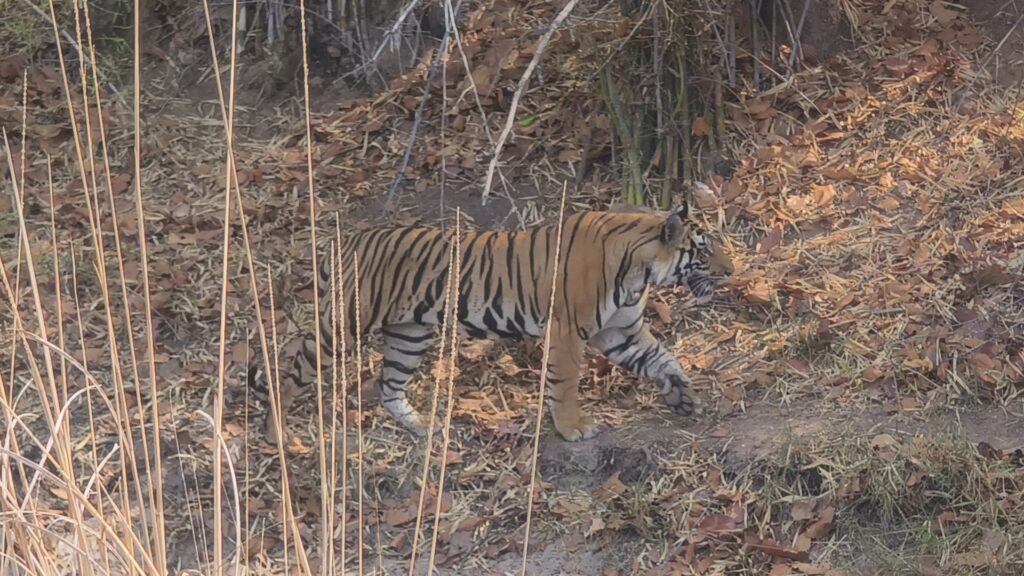
A tiger walking through the dry leaves of Bandhavgarh Tiger Reserve is one of the most breathtaking sights a wildlife enthusiast can hope for. Known for having one of the highest densities of tigers in India, Bandhavgarh offers intimate encounters with the Royal Bengal Tiger (Panthera tigris tigris) in its natural home.
This image beautifully captures the tiger’s fluid stride, blending strength with elegance. The camouflage of its orange coat and dark stripes allows it to move silently through the forest, almost invisible among the dry bamboo and forest floor. Each step echoes the story of survival, dominance, and mystery in the wild.
Bandhavgarh is not just about tigers—it’s a complete ecosystem. Yet, the tiger remains the heart of the forest, drawing photographers, conservationists, and safari travelers from around the world. Watching a tiger on the move here is more than a sighting—it’s an emotion, a memory etched forever.
About Tigers in Bandhavgarh
- High Density: Bandhavgarh has one of the highest tiger densities in India, increasing the chances of sightings compared to many other reserves.
- Territorial Kings: A male tiger’s territory can stretch over 60–100 square kilometers, which it fiercely defends.
- Silent Walkers: Tigers have soft pads under their paws that let them move almost noiselessly while stalking prey.
- Powerful Hunters: Despite their size, tigers can sprint at speeds of up to 60 km/h for short distances.
Reading a pugmark
A tiger walking on a forest road leaves a record of itself. Guides read those prints constantly, and most of what they are doing is available to you once you know what to look at.
- Direction. The toes point the way the animal went. Obvious, and the first thing to establish.
- Freshness. A fresh pugmark has sharp, crisp edges. Overnight prints soften, collect windblown dust and lose definition. Prints over vehicle tyre tracks were made after the last vehicle passed.
- Size. Male pugmarks are larger and squarer. Female prints are smaller and more oval.
- The toe pads. Male toes tend to be blunter and set squarer; female toes are usually more slender and forward-set.
Sizes vary and individual animals overlap, so nobody serious identifies a tiger from a single print. But sex and freshness are usually readable, and that is what changes what you do next.
Why tigers use roads
The same reason we do. Forest roads are the easiest walking available, and a tiger moving through its territory will take the path of least resistance.
Roads are also convenient for marking. Scrapes show well in dust, and there are trees along the edges to spray. A tiger patrolling its boundary will often follow a road for a long stretch, and that is why so many sightings happen on them.
Pugmarks and the old census method
For decades India estimated tiger numbers by taking plaster casts and tracings of pugmarks and treating each as an individual signature.
The method turned out to be unreliable — soil, gait and slope all change a print, and the same animal produces different-looking pugmarks on different surfaces. Camera trapping and stripe-pattern matching replaced it, and estimates changed substantially as a result.
Pugmarks are still valuable for tracking on the day. They just are not a census tool.
Putting the signs together
A working guide is combining several things at once:
- Fresh pugmarks with direction
- A scrape or spray mark that has not weathered
- Alarm calls from chital, sambar or langur
- Knowledge of which tiger holds that ground
Any one of these on its own means little. Two or three together is what makes a guide stop the vehicle and switch the engine off.
Photographing a walking tiger
- Get ahead of it, do not follow. A tiger walking towards you is a photograph; a tiger walking away is a rear view.
- Stay low and still. Standing up in a jeep changes your outline and tigers notice.
- Shoot the road. A tiger on a forest track with the road leading into the frame gives context that a tight crop loses.
- Photograph the pugmarks too. With something for scale, they make a genuinely interesting image and tell part of the story.
Frequently asked questions
How do you tell a male tiger pugmark from a female?
Male prints are larger and squarer with blunter toe pads. Female prints are smaller and more oval. It is indicative rather than definitive.
How fresh is a pugmark?
Sharp defined edges mean recent. Softened, dusty or partly filled prints are older. A print on top of a tyre track was made after that vehicle passed.
Why do tigers walk on roads?
Easy travel and good marking opportunities. Roads run through territory and offer dust for scrapes and trees to spray.
Are pugmarks used to count tigers?
Not any more. The pugmark census proved unreliable and was replaced by camera trapping with stripe-pattern matching.
Related: How Tigers Mark Territory, Tiger stripes and how tigers are counted and Bandhavgarh Safari Guide.
