
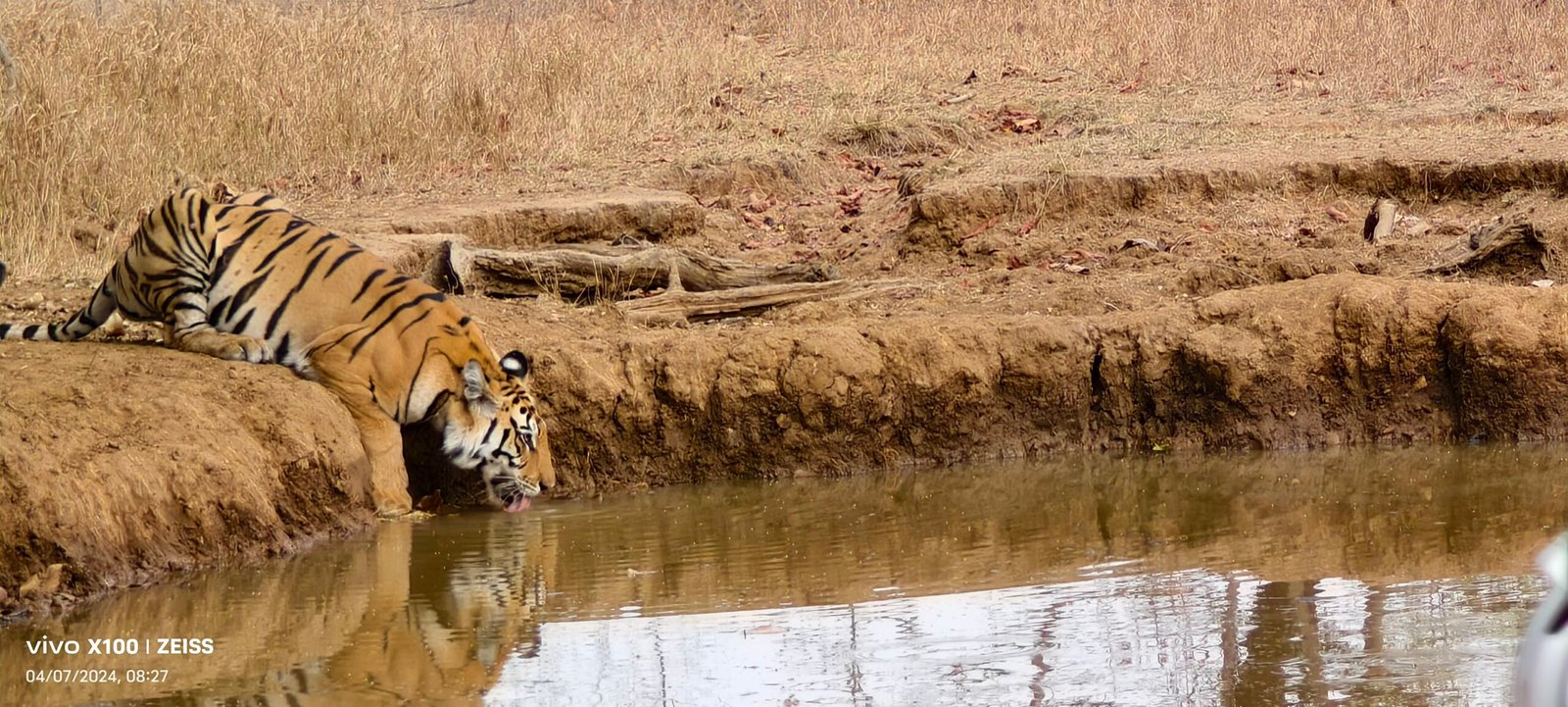
These tiger sighting photos were taken during an April morning safari in Panna Tiger Reserve. A tiger leaned over a forest pool to drink. A little later, the photographs show two tigers resting on the dry bank. The series ends with a tiger walking between the trees. These are photographs from one morning in the reserve, presented in the order they were taken.
At the pool
The first frame gives the place as much room as the animal. A low mud bank runs across the picture, with still water below it and dry grass above. The tiger’s forelegs are braced on the edge as it lowers its head to drink. Its reflection is visible in the water. Keeping the bank in the frame helps explain what the tiger was doing; a tight crop of the head would lose that context.
Two tigers on the bank
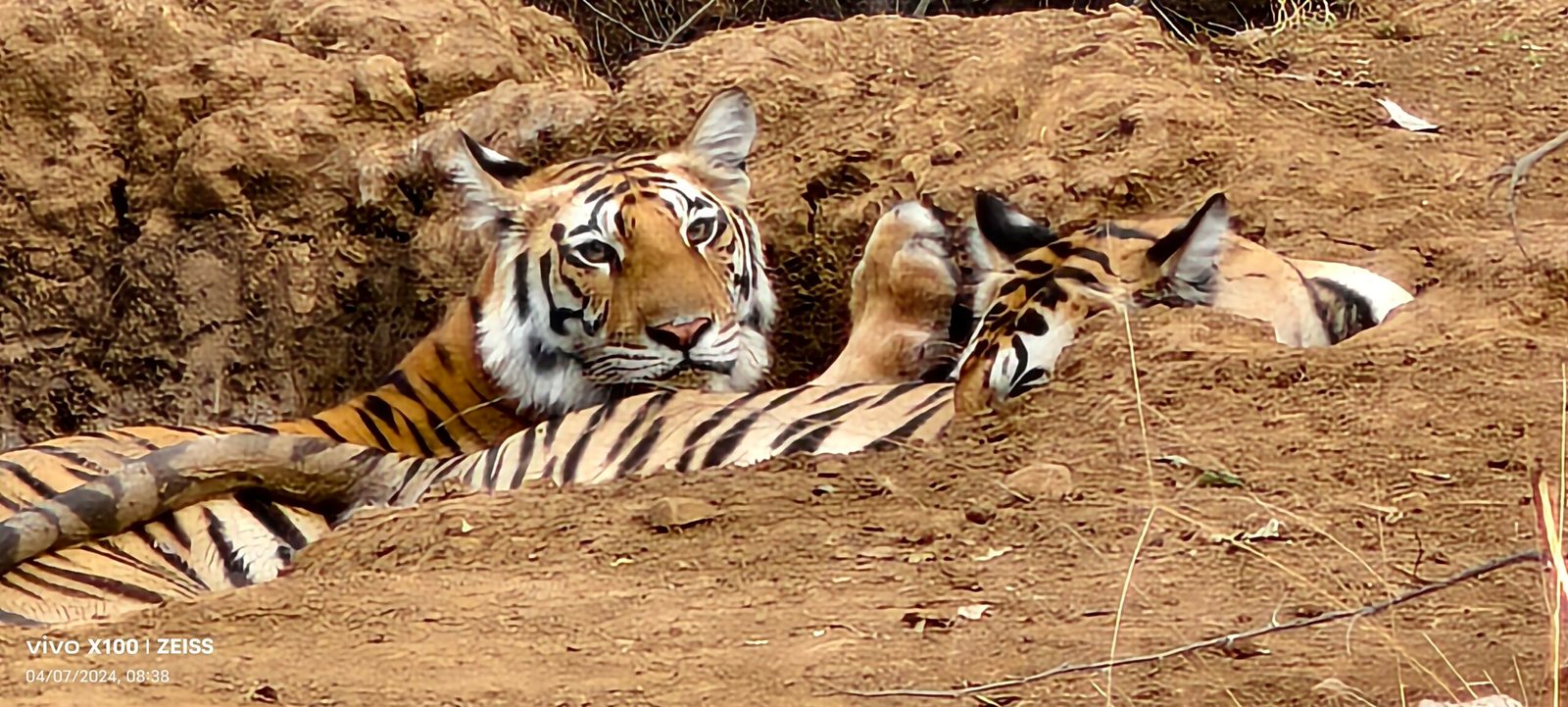
In the later frames, two tigers lie beside each other on bare earth. One looks toward the camera; the other has its head turned sideways. Their striped bodies overlap, so the wider picture is more useful than separate close-ups. It shows their position and the open ground around them.
The photographs do not establish their relationship, and they do not show what happened before or after this short period. There is no need to invent a story about why they were together. Seeing two tigers in a single frame is enough to make this a memorable part of the safari.
The clearest picture is also a lesson in choosing a frame. The tiger facing the camera has a visible eye and an unobstructed face, while the second tiger gives the picture its scale and makes it different from a standard tiger portrait. A tighter crop would make the animals appear larger on a phone, but it would remove the second body and the bare bank that tie this scene to the earlier drinking photo. For this article, the wider view tells the story better.
Back into the forest
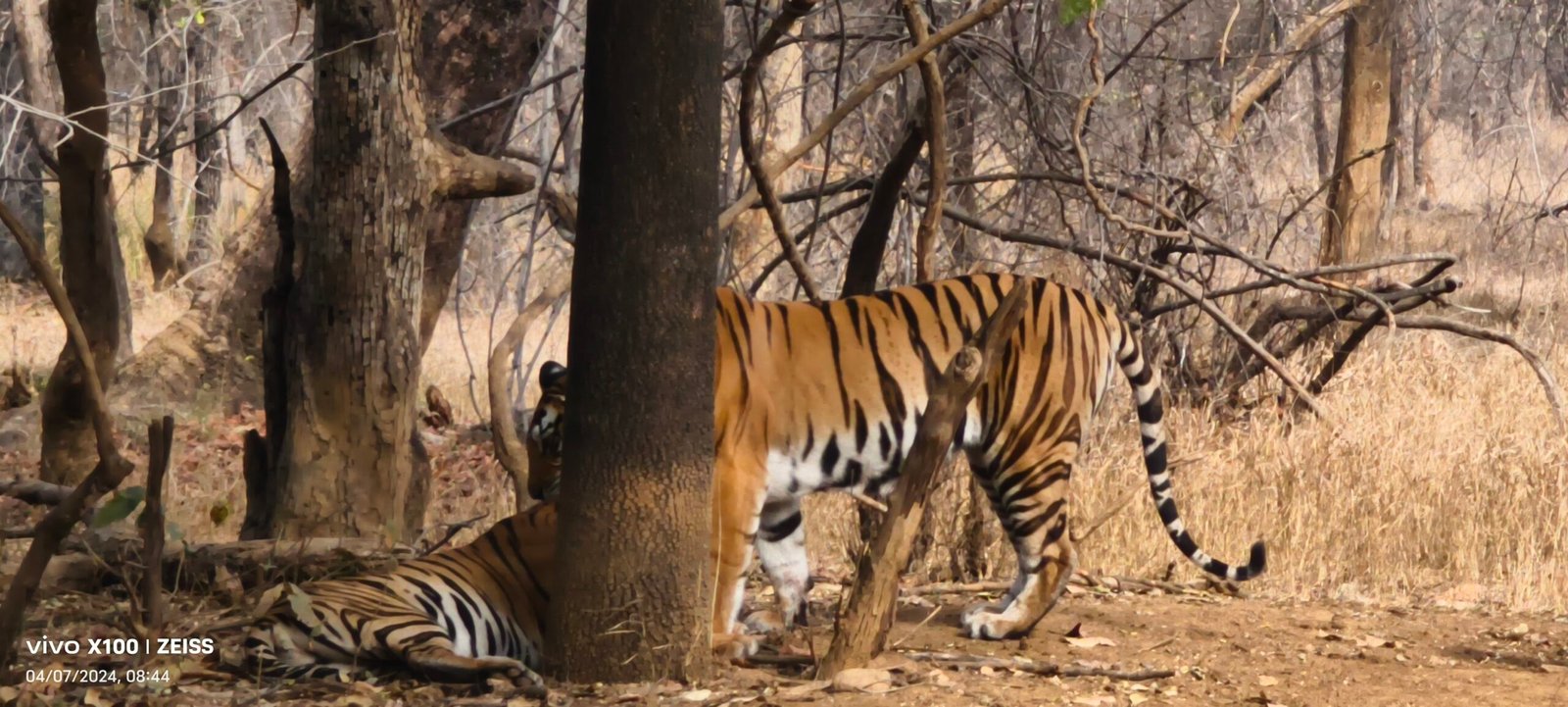
A later photograph catches a tiger between tree trunks. The dry leaves and pale ground make its orange coat easy to see, while the vertical trunks break up the body. It is a different kind of picture from the pool frames: it shows how quickly a tiger can become difficult to follow in open-looking forest.
The images were taken close together in time, but the photographs alone cannot prove that the walking tiger is the same individual shown drinking. We have kept them as one morning’s photo sequence without attaching an identity to the animal.
In the walking frame, the tiger is already partly screened by a trunk. The background is busy, and there is much less separation between animal and forest than in the pool pictures. That is worth seeing because safari photographs do not always come as clean portraits. Often the useful record is a brief opening between branches. We kept this image to show the change in setting, rather than cropping away every tree to make the tiger fill the frame.
What these photos tell us about a Panna safari
A tiger sighting is only part of a safari. The pool, bare banks, dry leaves and trees explain where the animals were and how the light fell. In this series, the wider photographs carry more information than a heavy crop. They also let a visitor see the distance and setting rather than only the stripes.
These frames are from one visit, so they are not a promise of a similar sighting on another day. For gates, booking, the Ken River and a fuller account of the reserve, read our Panna Tiger Reserve safari guide. If you are deciding between reserves, our Tadoba, Bandhavgarh and Panna comparison covers the different landscapes. This page stays with what the camera recorded on a single morning.
For anyone photographing a similar scene, keep enough room around the animal to show the water or the forest path, and take several frames before changing the composition. A few seconds can alter the position of the head, the eyes or a branch across the face. Review the images later at full size before selecting a cover. The strongest frame is the one that remains clear on a small screen while still showing what was actually happening.