
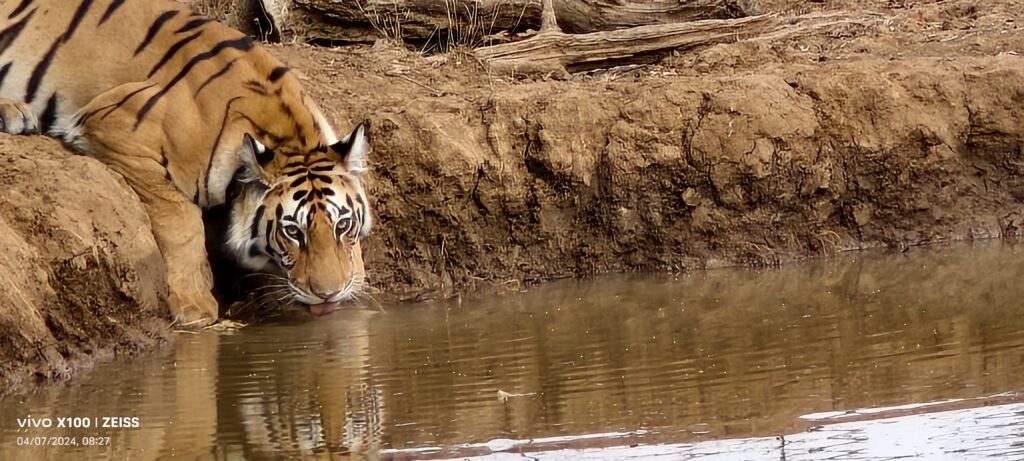
Tiger Drinking Water – Panna Forest

Tiger drinking water in panna forest
Tiger drinking water

Tigers actually love a dip. They’re powerful enough to swim across rivers up to 7 km (4.3 mi) wide. In the summer a tiger can drink approx. 15–20 gallons (≈50–75 litres) of water in a single day

Why water matters so much to a tiger

Almost every big cat avoids water. The tiger is the exception, and in the dry heat of central India that difference shapes its whole day.

A tiger carries a heavy coat and a large body that holds heat. It cannot sweat the way we do. Lying in water is the most efficient way it has to shed heat, which is why in April and May a tiger will spend the hottest hours of the afternoon sitting in a pool with only its head above the surface.

When to look for a tiger at water

This is the single most useful thing to know if you are planning a summer safari.

  • April to June is the window. The forest dries out, temporary pools disappear, and the animals concentrate at whatever water is left.
  • Late morning onwards. As the heat builds, tigers move towards water and often stay through the afternoon.
  • Permanent waterholes matter more than large lakes. A small pool a tiger uses every day is a better bet than a big waterbody it visits occasionally.
  • Ask the guide which pools are active. Tigers use particular ones and ignore others, and this changes through the season.

The trade-off is heat. Summer gives you the best sightings and the least comfortable safaris.

Tigers can swim, and they do it well

Tigers are strong swimmers and will cross wide rivers rather than go around them. They use water as a route, not an obstacle.

In the Sundarbans, where the terrain is tidal creeks and channels, tigers swim as a matter of routine. In a dry forest like Panna it matters less for travel and more for cooling.

About Panna

Panna Tiger Reserve in Madhya Pradesh is one of the more remarkable conservation stories in India. The reserve lost its entire tiger population and was declared to have no tigers in 2009.

Tigers were reintroduced from other reserves, and the population re-established itself over the following years. The Ken River runs through the park, which is why water is easier to find here than in some other reserves.

That river is also why Panna has a different feel from Bandhavgarh or Tadoba. There is more open water, more gorge and cliff, and a strong bird list alongside the mammals.

Photographing a tiger at water

  • Watch the reflection. Still water doubles the animal. A slight change of angle can either give you a clean mirror or a mess of ripples.
  • Expose for the cat, not the water. Bright water fools meters and leaves the tiger underexposed.
  • Wait for the head lift. A drinking tiger lifts its head every few seconds. That is the frame, not the drinking itself.
  • Stay for the exit. The shake as it comes out of the water is often better than anything that happened while it was in.
  • Keep the engine off if the driver allows. Water sounds carry and a settled tiger will stay longer.

Frequently asked questions

Do tigers like water?

Yes, unusually so for a cat. They cool off in it, swim well and will cross rivers rather than go around.

How much water does a tiger drink?

A great deal in hot weather, and it will usually drink daily. In summer, water availability shapes where a tiger spends its day.

When is the best time to see a tiger at a waterhole?

April to June, from late morning through the afternoon, at a waterhole the guide knows is in use.

Are there tigers in Panna?

Yes. Panna was declared to have no tigers in 2009 and the population was re-established through reintroduction. It is now a working tiger reserve again.


Related: Panna National Park Safari Guide, Panna Tiger Reserve Safari Guide and How Tigers Mark Territory.

Scroll to Top