
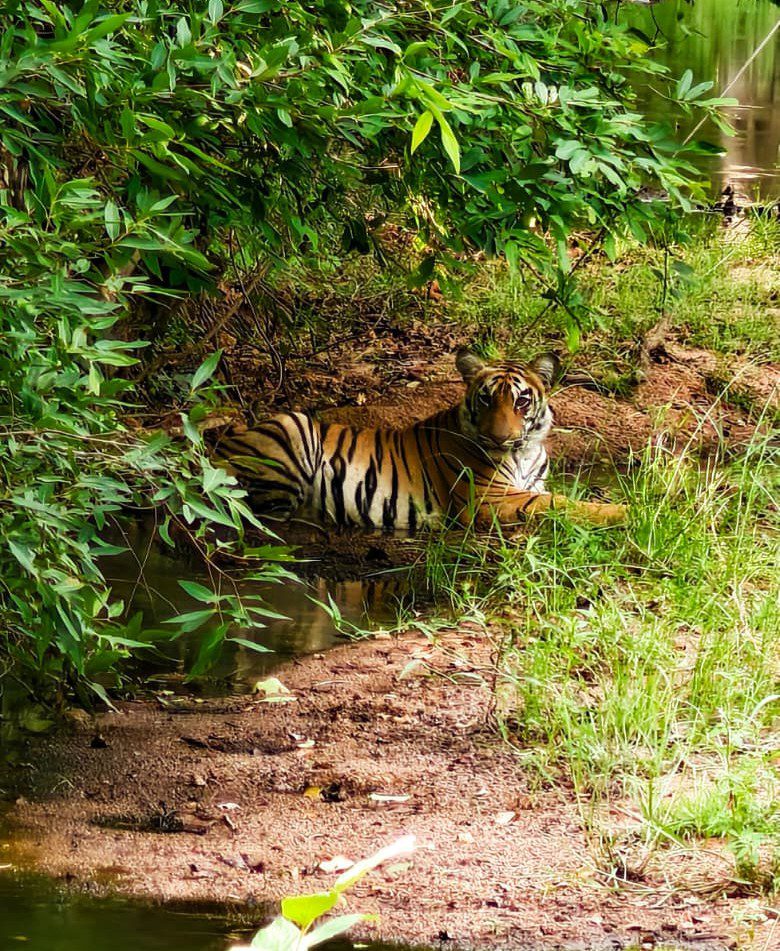
Royal Bengal Tiger Relaxing by a Pond in Tadoba
The Tadoba-Andhari Tiger Reserve is famous for its majestic Royal Bengal Tigers, and spotting one near a waterbody is truly a once-in-a-lifetime experience. This image captures the tiger cooling itself in a forest pond, a typical behavior during the hot summer months in Tadoba.
Why Tigers Love Water
Unlike most cats, tigers enjoy swimming. In the warm forests of Tadoba, tigers often spend hours resting in ponds and streams to regulate their body temperature. Watching a tiger lounging in water is both awe-inspiring and a reminder of their adaptability.
Fun Facts about Tigers in Tadoba
- Largest cat species: Bengal tigers are the biggest members of the cat family.
- Lovers of water: Tigers are strong swimmers and can cross rivers with ease.
- Solitary predators: Each tiger has its own territory marked with scent and scratches.
- Unique stripes: No two tigers have the same stripe pattern, just like human fingerprints.
- Population hub: Tadoba is one of India’s most reliable tiger reserves for sightings.
For wildlife enthusiasts, watching a tiger emerge from dense bamboo thickets to rest in a waterhole is the ultimate safari highlight. Tadoba is one of the few reserves where tiger sightings are frequent, making it a paradise for photographers, researchers, and nature lovers.
A tiger spends most of its life doing nothing
The image people carry of a tiger is of an animal in motion. The reality is that a wild tiger rests for something like 18 to 20 hours out of every 24.
This is not laziness. It is arithmetic. Hunting is expensive and mostly unsuccessful, so between kills the correct strategy is to burn as little energy as possible.
Why hunting so rarely works
Estimates vary by prey and terrain, but a tiger fails far more often than it succeeds — commonly cited figures put success at roughly one attempt in ten to one in twenty.
A tiger is built for a short, explosive rush from close range. It has no stamina for a chase. If it is detected before it is within striking distance, the hunt is over. Chital and sambar are alert, fast, and permanently listening.
So a successful adult may kill something substantial only every few days, then eat heavily and rest.
What resting actually looks like
- In shade, almost always, through the middle of the day.
- Near water in the hot months, often in it.
- Close to a kill, if there is one — a tiger will stay with a large carcass for two or three days, feeding and sleeping in rotation.
- Alert even asleep. Ears keep moving. A resting tiger is monitoring the forest continuously.
What this means for your safari
It explains the shape of a safari day, and why guides plan around it.
- Dawn and dusk are when tigers move. That is when you want to be out.
- Midday sightings are usually of a resting animal — often at water, which is precisely why waterhole sightings are common in summer.
- A tiger on a kill stays put. If a kill is known, patience beats driving around.
- Do not expect action. Most tiger sightings are of an animal lying down. That is normal tiger behaviour, not bad luck.
The cost of disturbance
If resting is how a tiger balances its energy budget, then repeatedly disturbing a resting animal has a real cost — it forces movement that the tiger cannot afford.
This is the reasoning behind vehicle limits, fixed routes and time restrictions in reserves. It is worth understanding rather than resenting.
Photographing a resting tiger
- Work the eyes. A sleeping tiger is a shape. The moment it opens its eyes, you have a photograph.
- Wait for the yawn or stretch. Resting tigers do both, and the timing is predictable once one starts shifting.
- Use the reflection if it is in water.
- Be quiet and be patient. The animal will do something eventually, and it will do it sooner if the vehicle is silent.
Frequently asked questions
How many hours a day does a tiger sleep?
Roughly 18 to 20 hours of rest in a 24-hour cycle, conserving energy between hunts.
How often do tigers hunt successfully?
Infrequently. Commonly cited figures suggest around one success in every ten to twenty attempts.
Why do tigers rest near water?
To cool down. Tigers cannot sweat effectively and use water for thermoregulation, particularly from March to June.
Why is the tiger I saw just lying down?
Because that is what tigers mostly do. Resting is the normal state; movement is the exception.
Related: Tadoba Safari Guide, How Tigers Mark Territory and Tigers and water.
