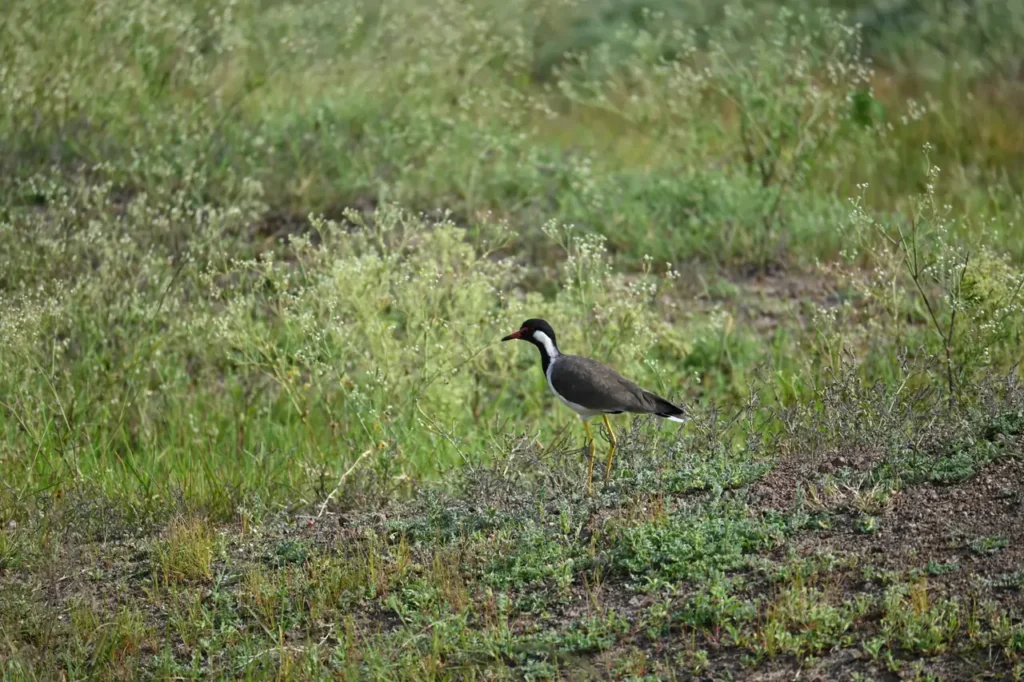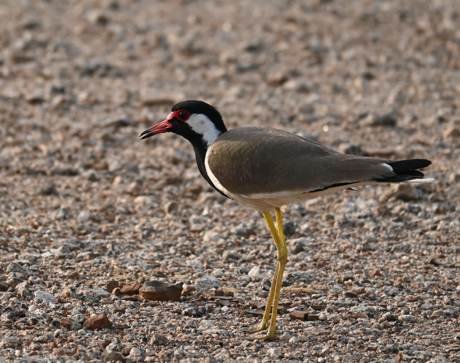
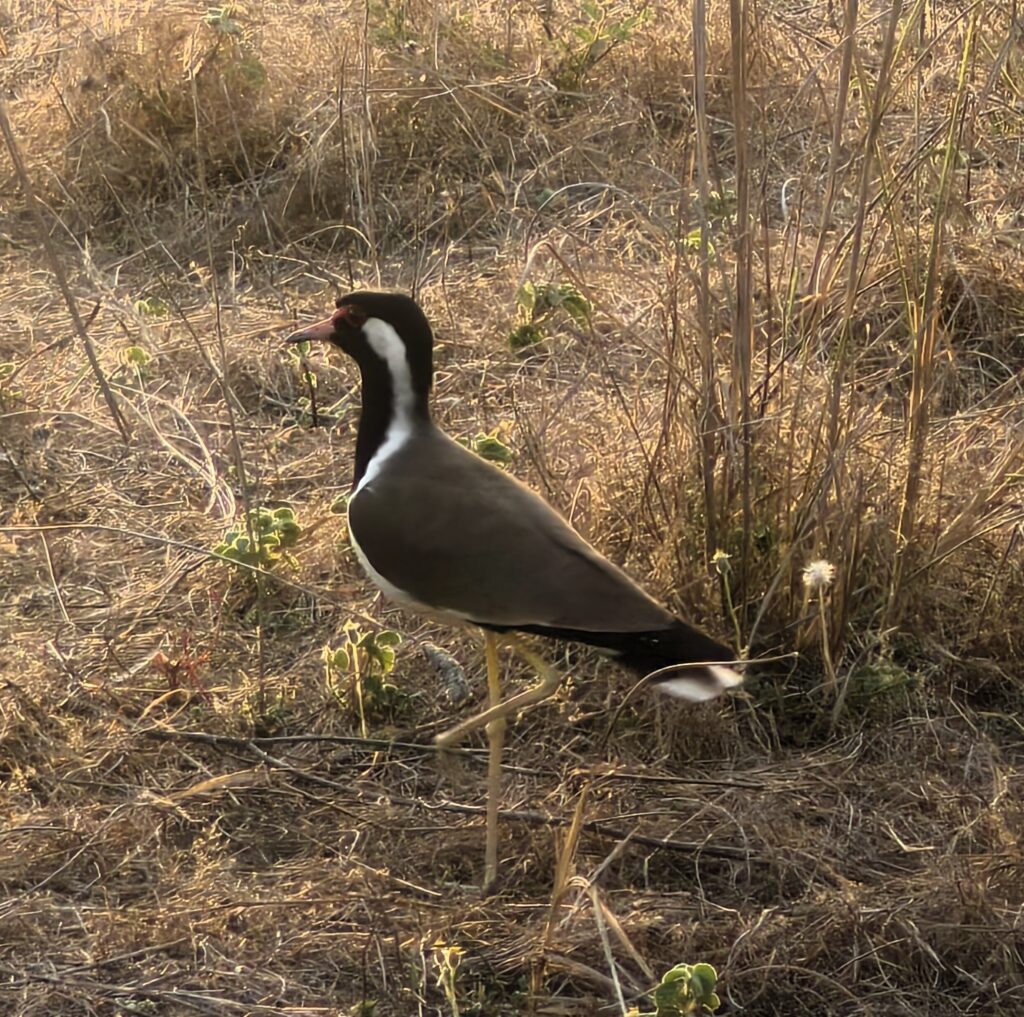
Hindi name: टिटहरी (Titihari) — the same bird, known across India for its loud “did-he-do-it” call.
Introduction
The Red-wattled Lapwing (Vanellus indicus) is one of the most striking and vocal birds of India. This elegant bird, photographed in the dry grasslands of Bandhavgarh National Park, is instantly recognizable by its sharp calls, bold plumage, and long yellow legs.
Appearance and Identification
With its glossy black crown, bright red wattles beside the beak, and contrasting white and brown plumage, the Red-wattled Lapwing is hard to miss. Its upright stance and watchful behavior make it a true grassland guardian.
Habitat in Bandhavgarh
These lapwings prefer open fields, scrublands, riverbanks, and grasslands — all habitats found inside Bandhavgarh National Park. Their loud alarm calls often alert safari-goers to the presence of predators like jackals, jungle cats, or even tigers nearby.
Behavior and Calls
The lapwing is famous for its sharp call, endlessly, especially during nesting. It is highly protective of its ground nests and uses diversion tactics — such as pretending to have a broken wing — to keep predators away from its chicks.
Fun Facts about Red-wattled Lapwings
- Known as the “night sentinel” because of its habit of calling loudly after dark.
- Its eggs are so well camouflaged that they are nearly invisible on bare ground.
- They play an indirect role in wildlife tracking by giving away predator movements through alarm calls.
Why Spotting One in Bandhavgarh Matters
Beyond their beauty, these lapwings add excitement to a Bandhavgarh safari. Their restless calls often act as nature’s early warning system, helping both animals and visitors detect danger in the wild.
The bird that never shuts up
The Red-wattled Lapwing is known across India for one thing: the call. A loud, insistent did-he-do-it that it gives at anything it dislikes, at any hour, including the middle of the night.
The old English name for it was the “did-he-do-it bird” for exactly this reason. Once you know the call you will hear it everywhere — over fields, beside tanks, across airport perimeters and on the edge of every village in the country.
Why it calls so much
It is a ground-nesting bird in open country with no cover to hide in. Its entire defensive strategy is to detect a threat early and make an enormous fuss about it.
For a safari visitor this makes it useful. A lapwing going off repeatedly means something is moving across open ground — a jackal, a dog, a person, sometimes a big cat. Guides register it in the same way they register a peacock call.
Identifying it
- Head: black crown, throat and breast, with a clean white band running from behind the eye down the neck.
- Wattle: bright red fleshy lobe in front of each eye, and a red bill with a black tip.
- Legs: long and bright yellow.
- In flight: broad rounded wings with a bold white bar, and slow deliberate wingbeats.
The Yellow-wattled Lapwing is the one to separate it from: that bird has yellow wattles, a black cap without the white neck stripe, and prefers drier scrub.
A nest on bare ground
Lapwings make no real nest. They lay four camouflaged eggs in a shallow scrape on open ground — sometimes on gravel, on a dry field, or on a flat roof.
The eggs are almost invisible. The defence is not concealment of the adult but distraction: a lapwing will walk away from the nest dragging a wing as if injured, drawing a predator after it, then fly off once the danger is far enough from the eggs.
They will also mob directly, diving at dogs, cattle and people who come too close.
Where you will see it
Almost anywhere open and near water. Field edges, dry tank beds, riverbanks, grassland, playing fields, even industrial ground. It does not need a reserve.
Photographing lapwings
- Get low. This is a ground bird on flat terrain; standing height gives you a bird on dirt.
- Shoot the call. Bill open mid-call, wings slightly raised, is far more characteristic than a static bird.
- Watch for the distraction display in breeding season — but recognise it for what it is and move away rather than following.
- Never search for the nest. The eggs are on bare ground and are trivially easy to step on.
Frequently asked questions
Why is it called the did-he-do-it bird?
Its alarm call sounds like the phrase “did he do it”, repeated loudly and often.
Where do Red-wattled Lapwings nest?
In a shallow scrape on open ground, including gravel and flat rooftops. There is no built nest.
Why do they call at night?
They are alert at all hours and respond to any perceived threat. Night calling is entirely normal.
How do I tell it from a Yellow-wattled Lapwing?
Red wattles and a white neck stripe versus yellow wattles and no white stripe. The yellow-wattled also prefers drier ground.
Related: Bird Photography for Beginners, Bird Watching at Bandhavgarh, Lesser Adjutant Stork at Bandhavgarh, Bandhavgarh Safari Guide and Birds of Bhigwan — 39 species.
Related: Safari Alarm Calls: How Guides Find Tigers by Listening
More Photographs