
Bandhavgarh is a tiger park. Everyone says so, and everyone is right. But if you only look for tigers, you will miss half the fun. The park is home to more than 250 species of birds. Some are loud. Some are shy. And some stand so still that you drive right past them.
This is a field guide to the birds we have photographed at Bandhavgarh, and how to enjoy them on a safari.
Birdwatching on a tiger safari: what to expect
A safari at Bandhavgarh is a jeep ride on fixed routes, with a guide. You do not choose where to stop. So birds are what you see in between the big moments. My advice is simple. Keep your camera ready. Ask the guide to stop when you see something you like. And listen. An alarm call often tells you more than your eyes do.
Our two-day tiger trip at Tala is in Bandhavgarh Tiger Safari: I Saw Tigers in 2 Days. Birds were part of every drive.
The red-wattled lapwing (टिटहरी, Titihari)
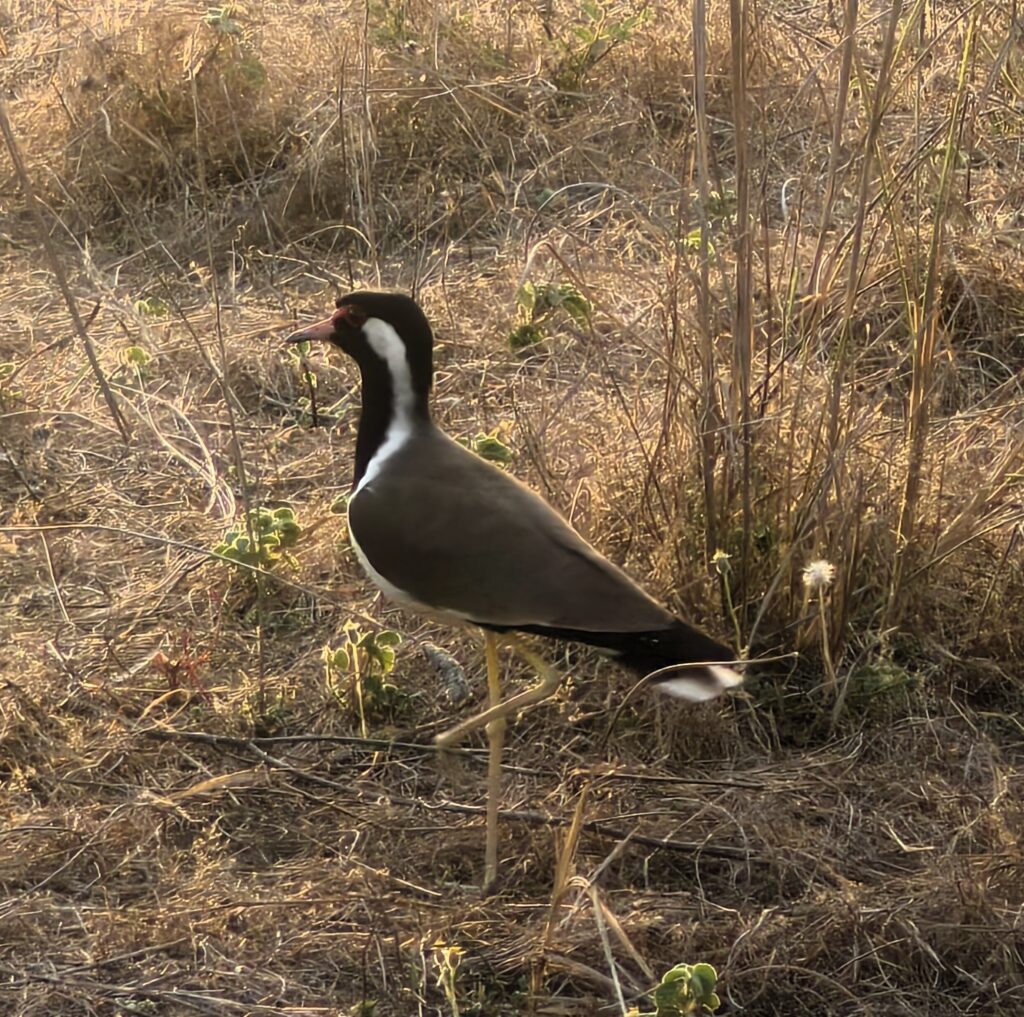
If there is one bird you cannot miss at Bandhavgarh, it is this one. It is the loudest bird in the park and the easiest to find. It stands on open ground and shouts at anything it does not like, at any hour, even in the middle of the night.
The old English name for it was the “did-he-do-it bird”, because the call sounds like that. Once you know the call you will hear it everywhere, over fields and beside tanks and at the edge of every village in India.
How to know it
- Head: black crown, throat and breast, with a clean white band from behind the eye down the neck.
- Wattle and bill: a bright red wattle in front of each eye, and a red bill with a black tip.
- Legs: long and bright yellow.
- In flight: broad rounded wings with a bold white bar.
Why it matters on safari
The lapwing nests on the ground, in open country with no place to hide. Its whole defence is to spot danger early and make a huge fuss. For a safari visitor that makes it useful. A lapwing that keeps calling means something is moving across open ground. It could be a jackal, a dog, a person, or sometimes a big cat. Guides take it as seriously as they take a peacock call.
Lapwings lay four well-hidden eggs in a shallow scrape on the ground. They protect them by pretending to be hurt. A lapwing will walk away from the nest dragging a wing, so a predator follows it. Never search for the nest. The eggs are almost invisible, and very easy to step on.
Full notes, with how to tell it from the yellow-wattled lapwing, are in Red-wattled Lapwing at Bandhavgarh.
The lesser adjutant stork
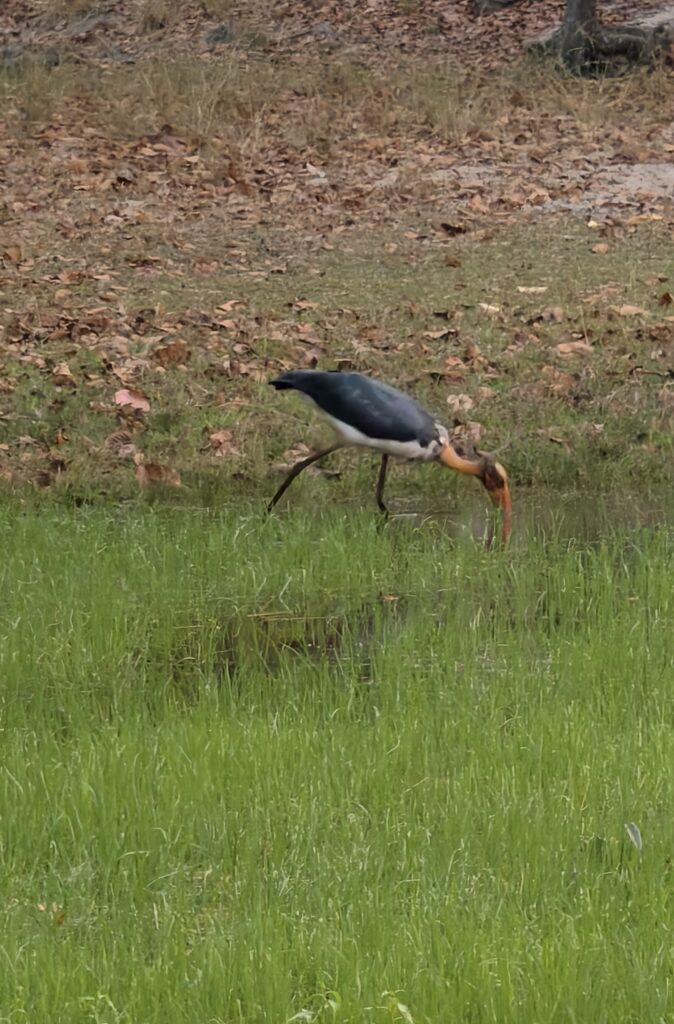
This is a very big bird, about 110 to 120 cm tall. It has dark, glossy upperparts, a clean white belly and a long, heavy, pale bill. Its head and neck are bare and wrinkled, dull yellow to orange.
Why is the head bare? Because this stork feeds at carcasses as well as in wetlands. A feathered head would stay dirty. Bare skin is easier to keep clean and dries fast. Vultures solved the same problem in the same way.
Where do you look? Marshy ground, the edges of water, wet grassland and flooded dips. It often feeds alone or in twos. Look for a very large, dark, upright bird standing still at the water’s edge. It is so quiet and still that many visitors drive past it.
One simple tip. If the neck has no big pouch hanging from it, it is a lesser adjutant. The greater adjutant, one of the rarest storks in the world, has a pouch. In flight, the lesser one keeps its neck pulled in like a heron. It is listed as Vulnerable. See Lesser Adjutant Stork at Bandhavgarh.
The woolly-necked stork
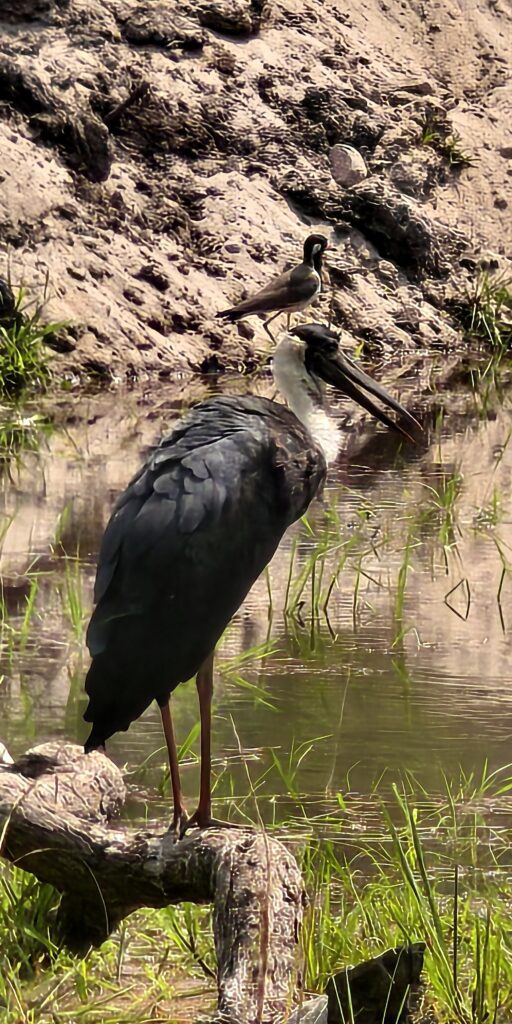
A graceful wetland stork with a white, woolly-looking neck and a dark body. Look for it near water. It often stands on a log or the bank, very still. More in Woolly-necked Stork at Bandhavgarh.
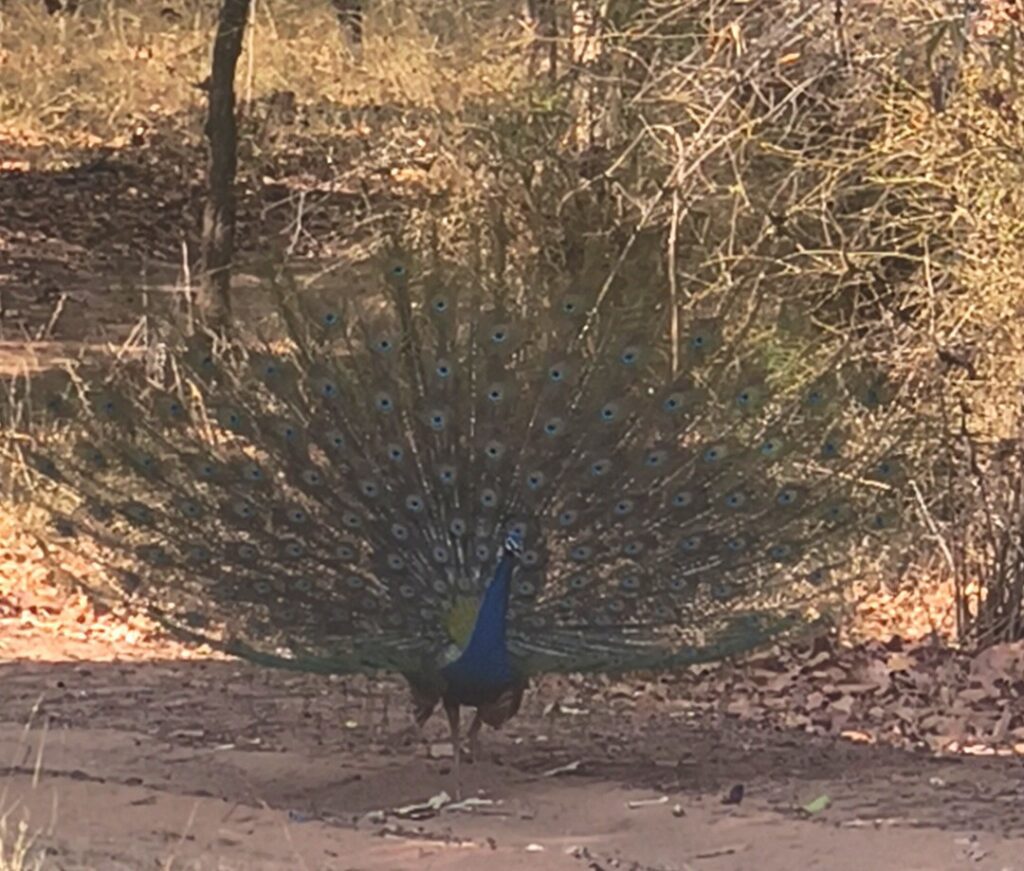
The Indian peafowl
The national bird of India, and common in the forest. Its call is also a safari signal. Guides listen for peafowl alarm calls the same way they listen for langurs and deer. See Peacock vs Peahen, the Indian peafowl guide and the peacock at Bandhavgarh.
Tips for watching birds on a safari
- Listen first. Alarm calls from lapwings and peafowl often mean a predator is moving nearby.
- Look at the edges. Water, marsh and open grass are where waders and storks stand.
- Ask your guide to stop. A few seconds of stillness gives you a sharp picture of a bird that would have been a blur.
- Keep your distance. Never look for nests.
- Carry binoculars. They help you find the bird before you lift the camera.
- Be patient. Birds reward people who sit still.
Planning your Bandhavgarh trip
If you are planning the safari itself, start with the best time to visit Bandhavgarh and Bandhavgarh zones and timings. If you carry a camera, our Bandhavgarh photography guide will help. And for bird photo tips, read Bird Photography for Beginners.
Questions people ask
Can you see birds on a tiger safari at Bandhavgarh?
Yes. The routes pass grass, water and forest, and you see birds all along the way. Ask your guide to stop when you see something you want to photograph.
How many bird species are there at Bandhavgarh?
More than 250 species.
Which birds are easiest to spot?
The red-wattled lapwing and the Indian peafowl. Both are loud and live in the open. Storks take more patience near water.
How do I tell a lesser adjutant from a greater adjutant?
The greater adjutant has a large pouch hanging from its neck. The lesser one does not.
Related: Tiger Photography in India: Field Notes from Bandhavgarh and Tadoba
Related: Bird Photography for Beginners
Related: Best Nature Bird Photography
Related: Bandhavgarh Wildlife Photography: A Photographer’s Guide
Related: Best Time to Visit Bandhavgarh National Park
Related: Peacock vs Peahen: How to Tell the Indian Peafowl Apart
Related: Bird Photography Tours in India
Related: Bird Watching in India: Where to Go and When
Related: Bird in Flight Photography: Simple Tips for Sharp Pictures
Related: Safari Alarm Calls: How Guides Find Tigers by Listening