
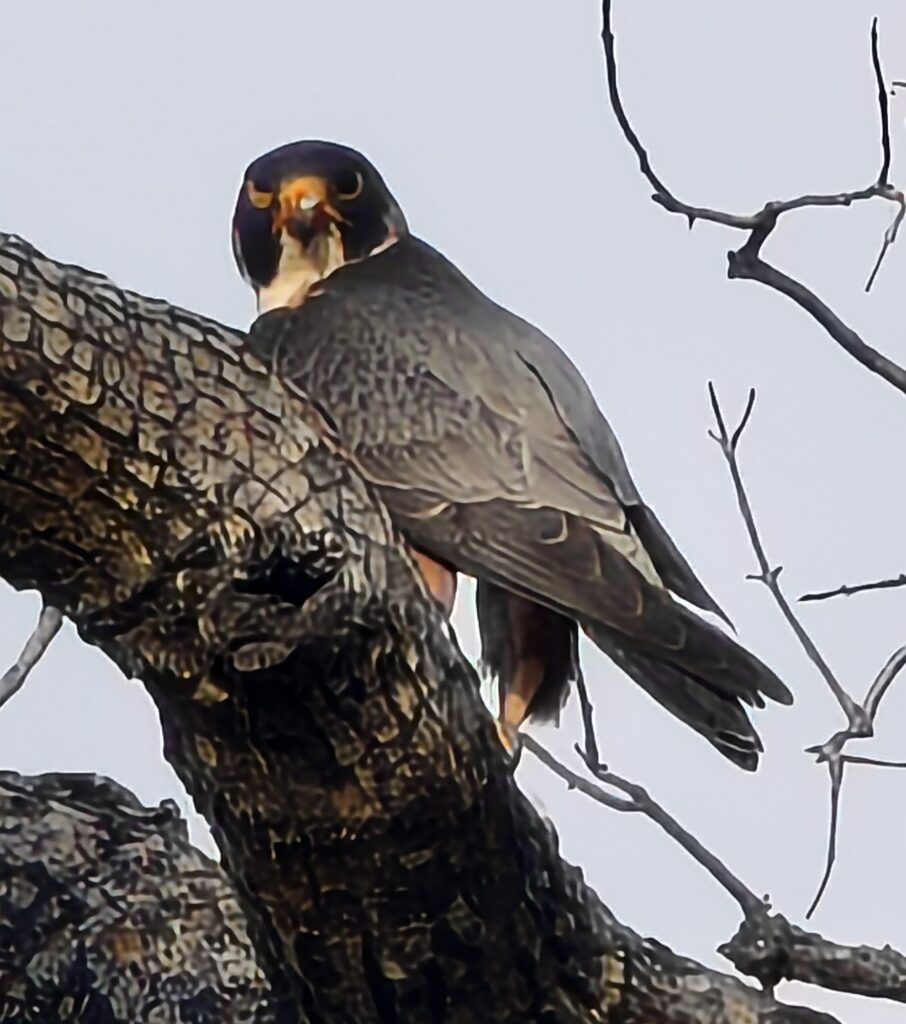
Peregrine Falcon (Falco peregrinus)

Peregrine Falcon (Falco peregrinus)
Peregrine Falcon
Peregrine Falcon (Falco peregrinus) — The Sky Hunter of Panna Forest | TravelonTales

Peregrine Falcon (Falco peregrinus) — The Sky Hunter of Panna Forest

Location: Panna Forest, Madhya Pradesh, India

The Peregrine Falcon (*Falco peregrinus*) is the undisputed king of the skies — the fastest bird on the planet, capable of diving at speeds exceeding 320 km/h (200 mph). Spotted in Panna Forest, this magnificent raptor showcases the perfect blend of power, precision, and grace.

About the Species

The Peregrine Falcon belongs to the family Falconidae and is found across every continent except Antarctica. Its slate-grey wings, barred underparts, and iconic black “moustache” mark distinguish it easily from other raptors. It hunts mainly pigeons, parakeets, and smaller birds in mid-air with stunning accuracy.

Behavior and Habitat

In Panna, these falcons can often be seen resting on high perches like cliffs or dead branches before taking off for their hunting stoop. Their habitats range from forests to urban high-rises — anywhere with open skies and plenty of prey.

Conservation Status

Once critically endangered due to pesticide use (especially DDT), the Peregrine Falcon has made a strong comeback. Today, it’s classified as Least Concern by the IUCN, a triumph for wildlife conservation efforts worldwide.

Fun Facts About Peregrine Falcons

  • They can spot prey from over 3 kilometers away — their vision is eight times sharper than ours.
  • During dives, their nostrils have special bony structures to regulate airflow and prevent blackout.
  • Peregrines mate for life and return to the same nesting site every year.
  • Their aerodynamic design inspired engineers at NASA for jet research.
  • They are found on every continent except Antarctica — a truly global predator.

Text & Photography © TravelonTales

For more safari stories and wildlife encounters, visit https://travelontales.com/category/safaris/.


Caption: Locked eyes with the world’s fastest hunter — the Peregrine Falcon of Panna Forest. #TravelonTales #PannaForest #PeregrineFalcon

Slug: peregrine-falcon-panna-forest

The fastest animal on the planet

A Peregrine in a hunting stoop is the fastest recorded animal of any kind, exceeding 300 km/h in a full dive.

That speed creates problems most animals never have to solve, and the bird is engineered around them.

  • Bony tubercles in the nostrils that break up the airflow, so it can still breathe at speed. The design principle was studied for jet engine intakes.
  • A third eyelid — the nictitating membrane — swept across constantly to clear and protect the eye without blinking.
  • A stiff, narrow, pointed wing that can be tucked into a teardrop shape for the dive.
  • Reinforced keel and shoulder girdle to absorb the impact of a strike at that speed.

The stoop

The Peregrine hunts other birds in flight, almost exclusively. It climbs above its target, folds up, and dives.

The strike is usually a blow with the closed feet rather than a grab — at that velocity a grab would be as dangerous to the falcon as to the prey. The bird is knocked out of the air, and the Peregrine turns and collects it as it falls.

The crash, and the recovery

Peregrine populations collapsed across Europe and North America in the mid-twentieth century. The cause was DDT, which accumulated in birds of prey and caused them to lay eggs with shells too thin to survive incubation.

The species disappeared entirely from large regions. After DDT was banned and captive-bred birds were reintroduced, populations recovered — one of the clearest conservation successes on record, and a case study in how a chemical several steps down a food chain can remove a top predator.

Peregrines in Indian cities

Cities suit them for the same reason they suit pigeons. Tall buildings are cliffs, and pigeon flocks are an abundant, reliable prey supply.

India has resident populations plus migratory birds arriving in winter. Look for a stocky falcon with a heavy dark moustache mark below the eye, perched high on a building, water tank or transmission tower — often quite still for long periods.

Photographing them

  • Find the perch. Peregrines use favoured lookouts repeatedly. Locate one and you can return.
  • Do not expect to photograph a stoop. It is too fast and too unpredictable. Concentrate on the perched bird and the take-off.
  • Look for plucking posts — a regular spot littered with pigeon feathers indicates a bird using the area.
  • Early light on a tall perch gives you the bird lit against a dark background.

Frequently asked questions

How fast is a Peregrine Falcon?

Over 300 km/h in a hunting stoop, making it the fastest animal recorded.

How does it breathe at that speed?

Bony tubercles in the nostrils disrupt the airflow, allowing it to breathe during the dive.

Why did Peregrine numbers collapse?

DDT accumulation caused eggshell thinning. Numbers recovered after the pesticide was banned and birds were reintroduced.

Do Peregrines live in Indian cities?

Yes. Tall buildings serve as cliffs and pigeons provide abundant prey.


Related: Pigeons and urban raptors, Bonelli’s Eagle at Bhigwan and Osprey at Bhigwan.

Scroll to Top