
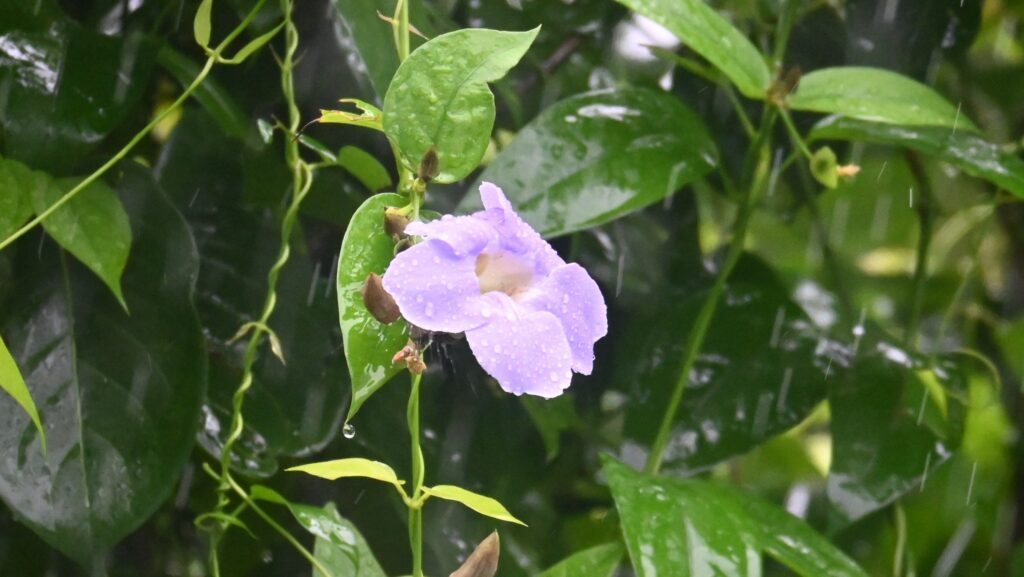
Bengal Clockvine Bloom in the Rain

Introduction

This photograph captures the Bengal Clockvine (Thunbergia grandiflora), a striking purple bloom glistening under fresh raindrops. Set against lush green leaves, the flower becomes the centerpiece of the frame — delicate yet radiant in its moment of bloom.

A Rain-Kissed Flower

The petals of the Bengal Clockvine sparkle with droplets that highlight their natural texture. Each bead of water reflects light, making the lavender hue more vivid against the darker foliage. The fresh monsoon rain turns this simple flower into a jewel of the forest.

The Elegance of Bengal Clockvine

Native to tropical regions, the Bengal Clockvine is a fast-growing climber with trumpet-shaped flowers. Its presence adds charm to gardens and wild landscapes alike. In this image, the bloom leans gracefully forward, as if embracing the rainfall — a symbol of endurance and quiet elegance.

Symbol of Renewal and Grace

Rain often symbolizes

cleansing and new beginnings. This flower, holding onto every raindrop, mirrors the idea that beauty thrives even in storms. The image reminds us to notice how small details in nature tell powerful stories.

Symbolism and Uses

  • The Bengal Clockvine symbolizes resilience and harmony with nature, blooming even during heavy monsoons.
  • It is often grown as an ornamental climber, adding natural beauty to gardens, parks, and eco-trails.
  • In traditional medicine, its leaves are sometimes used for herbal remedies.

Ecological Role

  • The flower attracts bees, butterflies, and hummingbirds, acting as a vital pollinator-friendly plant.
  • As a fast-growing climber, it helps provide green cover and natural shade, making it popular in eco-landscaping.

Fun Facts

  1. The Bengal Clockvine is also known as the Blue Trumpet Vine because of its shape.
  2. It is one of the fastest-growing climbers and can cover an entire wall or archway in just a season.
  3. The blooms often look fresher and brighter when kissed by raindrops, making them a photographer’s delight.

Conclusion

This Bengal Clockvine bloom, caught in the rain, is more than just a flower — it’s a poetic symbol, a reminder from nature that even in challenging moments, beauty continues to shine brightly.

A flower shaped for a specific visitor

Bengal Clockvine (Thunbergia grandiflora) produces large pale blue-purple trumpets on a vigorous climbing vine. That trumpet shape is not decorative — it is a filter.

The corolla tube is wide and deep, and the nectar sits at the bottom. Only a visitor large enough to force its way in and long enough to reach the base gets the reward. In its native range that means carpenter bees, which are big enough to push through and are dusted with pollen as they go.

Watch a clockvine in flower and you will see the large black carpenter bees arriving repeatedly. Smaller bees often cannot get in at all, and some bite through the base of the flower to steal nectar instead.

Why it flowers in the rain

Clockvine flowers heavily through the monsoon, which is when it looks best and when most people photograph it.

The blooms are short-lived and drop readily, so a flowering vine in wet weather is constantly shedding — the ground beneath a clockvine in the rain is often carpeted with fallen trumpets. That is a picture in itself and one most people walk past.

Why it is called Clockvine

The stems twine in a consistent direction as they climb, and the common name refers to that spiralling habit. It is a strong, fast climber that will cover a pergola or a wall quickly.

That vigour has a downside. Outside its native range, in parts of Australia, the Pacific and the Americas, Thunbergia grandiflora is a declared invasive weed, smothering native vegetation and very hard to remove because it regrows from tubers.

What it brings to a garden

  • Carpenter bees in numbers, which are worth watching in their own right.
  • Sunbirds, which will probe the flowers and sometimes pierce the base.
  • Dense cover, which small birds use for nesting and roosting.
  • Shade, quickly, if grown over a structure.

Photographing it

  • Shoot in rain or immediately after. Water on the pale petals and a saturated green background is the strongest version of this subject.
  • Get inside the trumpet. The markings in the throat guide insects in, and photographing straight down the tube shows what the bee sees.
  • Wait for the carpenter bee. The flower alone is pretty; the bee forcing its way in is a photograph.
  • Watch for fallen flowers. A scatter of dropped trumpets on wet ground makes a better image than another flower on a vine.

Frequently asked questions

What pollinates Bengal Clockvine?

Mainly carpenter bees, which are large enough to push into the wide corolla tube and reach the nectar.

When does it flower?

Heavily through the monsoon and warm months, with short-lived individual blooms.

Is it invasive?

In its native range no. Introduced to Australia, the Pacific and the Americas it is a declared weed and difficult to eradicate.

Does it attract birds?

Sunbirds visit the flowers, and the dense growth provides nesting and roosting cover for small birds.


Related: Hibiscus and sunbirds, Why bird-pollinated flowers are red and Daisies and their insect visitors.

Scroll to Top