
Short answer: yes, a gaur can be dangerous. But on a safari, it almost never is.
I know that sounds like a half answer, so let me explain. The gaur is the biggest wild cow in the world. A big bull can weigh more than a tonne. It has thick muscles, heavy horns and a stare that makes you stop breathing for a second. But it is also a shy forest animal. Most of the time it just wants to eat in peace and be left alone.
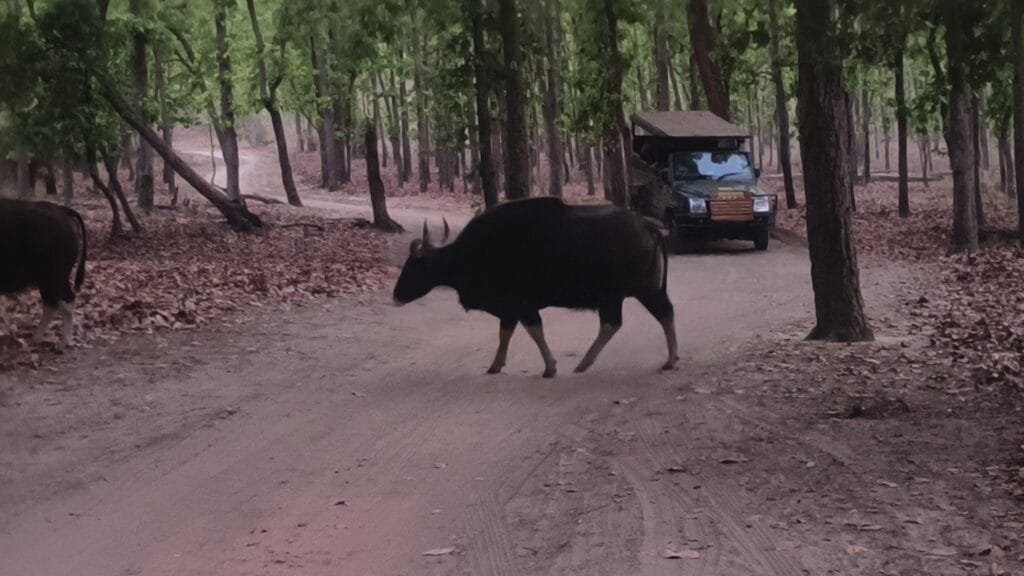
The day a gaur stopped our jeep
It was April in the Tala Zone at Bandhavgarh, and the heat was already heavy. Our jeep was moving slowly when it stopped for no reason that I could see. The naturalist did not say a word. He only pointed to the left.
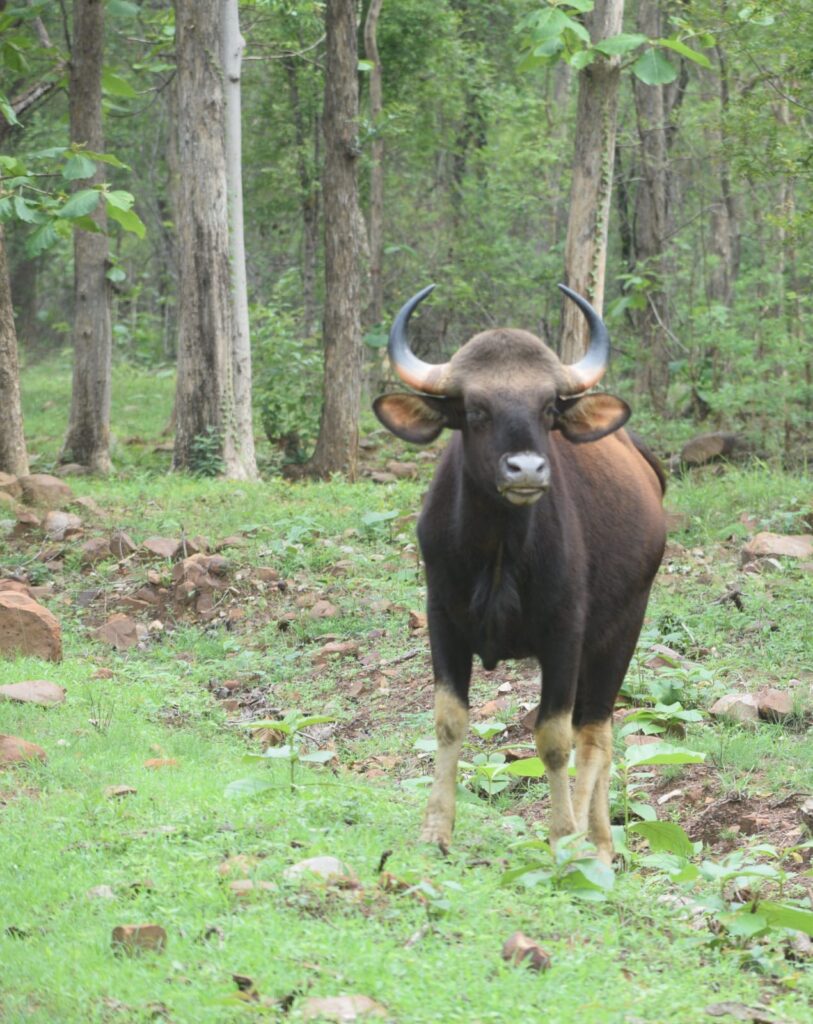
There, about twenty metres from the track, a bull gaur was standing still in the sal trees. I could see the ridge on his forehead, his pale curved horns and his white legs against the dark forest floor. He did not run. He did not charge. He just stood there like he owned the place. Which, of course, he did.
I have thought about that moment many times. It showed me what a gaur really is. It is a huge animal that is not looking for a fight. You can read the full story in our field notes on the gaur at Bandhavgarh.
How big is a gaur, really?
People who have never seen one often guess wrong. Here are the numbers.
| Adult gaur | |
|---|---|
| Weight | About 650 to 1,500 kg. Big bulls are often over one tonne. |
| Height at the shoulder | About 1.7 to 2.2 metres. That is as tall as a grown man, or taller. |
| Horns | Curved, pale at the base and black at the tip. |
| Colour | Dark brown to almost black, with white lower legs. |
Even tigers think twice before they go near a full-grown gaur. That tells you something.
Size alone does not make an animal mean. But it makes a mistake very expensive.
When can a gaur become dangerous?
A gaur does not attack for fun. Almost every story of trouble comes from one of these situations.
- It is surprised at close range. If you walk into a gaur in thick bushes, it has no time to leave. It may defend itself.
- It is hurt or chased. A wounded or scared animal fights back.
- A mother has a calf. Like most large animals, a gaur mother is very protective.
- A bull is in a bad mood. Lone bulls and herd bulls can be more aggressive than the rest of the herd.
- People are on foot. Nearly all serious meetings happen when people walk in the forest or near its edge. They do not happen to people sitting in a jeep.
What gaur do around a safari jeep
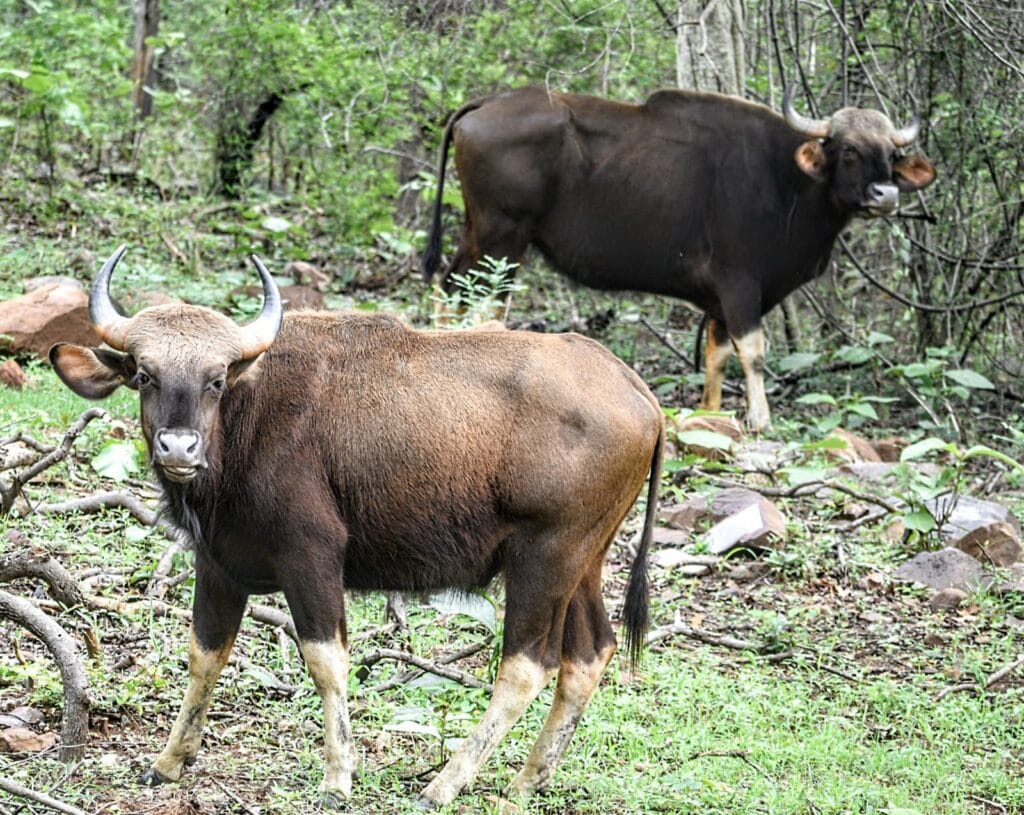
This is the part that surprises people. Gaur are used to jeeps. At Tadoba and at Bandhavgarh, the gaur we met looked at us for a few seconds. Then they went back to eating or walked away. That is normal.
When a gaur looks at you and stays still, it is simply checking you out. Keep quiet and keep still too. Let the guide handle it.
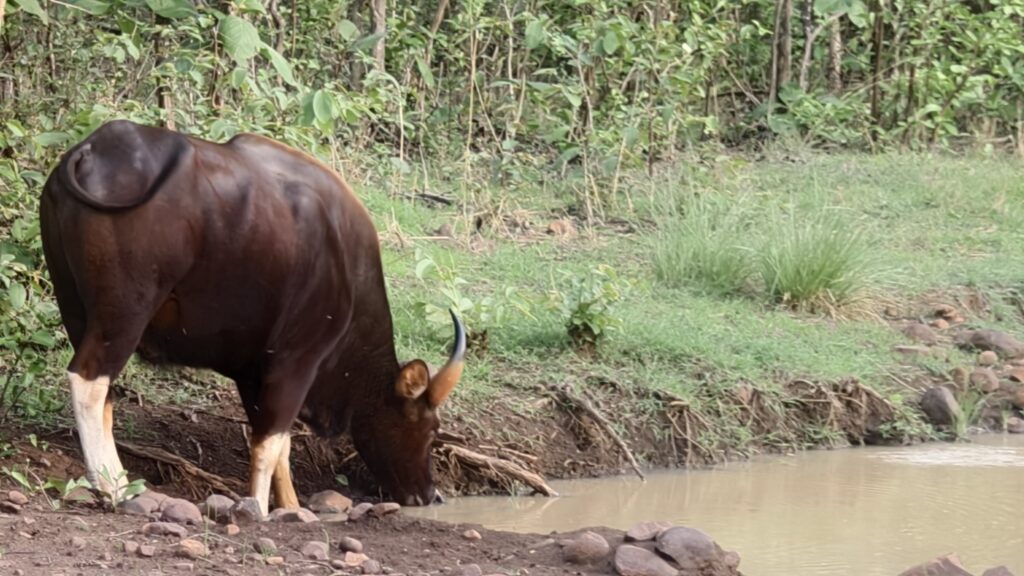
Simple rules for staying safe
- Stay in the vehicle. Always. Even if the gaur looks calm.
- Never get down to take a photo. No picture is worth it.
- Keep your voice low and your movements slow. No sudden noises.
- If a gaur is on the track, wait. Do not drive at it or around it. Your guide will decide.
- Look for calves and lone bulls. Give both extra room.
- If you are walking near a forest edge, such as a village path or a fort trail, watch the bushes. If you see a big dark animal, step back slowly.
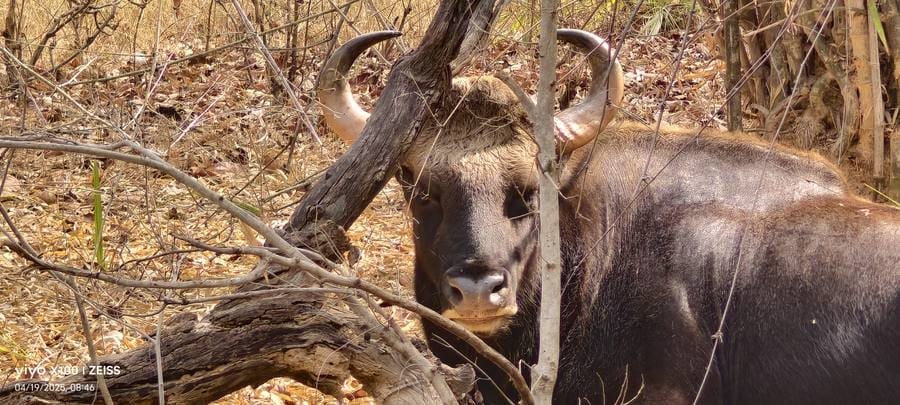
What if you meet a gaur on foot?
This is rare, but it is good to know. Do not run. Do not shout. Do not move toward the animal. Back away slowly and keep something between you and the gaur if you can, like a tree or a rock. Leave the way you came. If a gaur lowers its head and paws the ground, that is a warning. Move away calmly and quietly.
Is a gaur more dangerous than a tiger?
They are two different kinds of danger. A tiger is a hunter. A gaur is a plant eater that fights when it feels trapped or scared. In a jeep, neither should be a problem. On foot, you should stay away from both.
First, be sure it is a gaur
If you cannot tell what you are looking at, you cannot guess what it will do. The easy rule is this: a large, dark animal with white feet is a gaur. A buffalo has dark legs. A bison is not found in India at all. We explain the full difference in Indian Bison: Why the Gaur Is Not a Bison.
Photographing a gaur safely
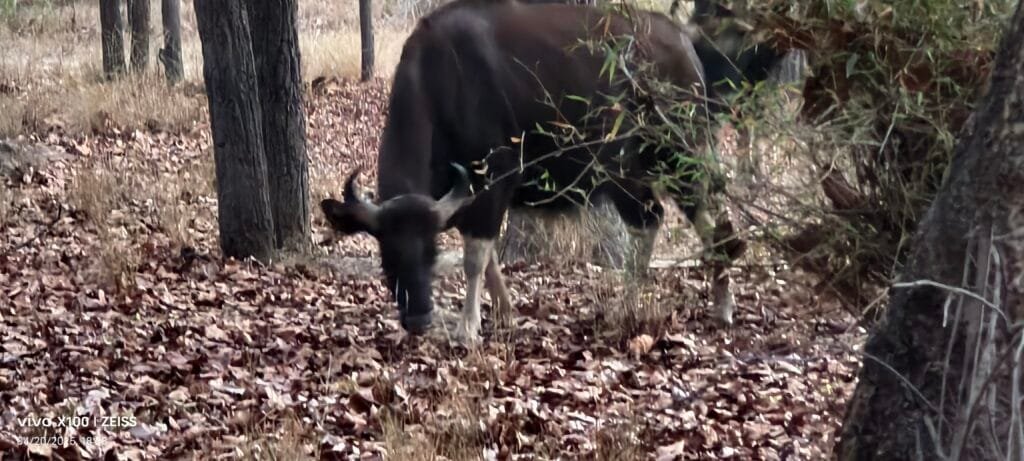
A gaur is a lovely subject. It is big, it stays still and it does not run away fast. A few tips:
- Use a long lens. It lets you stay far away and still fill the frame.
- Gaur are dark. In deep forest shade, raise your exposure a little so you can see the eyes and the white legs.
- Wait for the head to come up. A photo with the eyes visible is much better.
- Do not ask the driver to go closer. If the gaur is relaxed, it will stay relaxed.
- Watch the calves. If you see one, step back from the idea of a close picture.
For more camera ideas, see our tiger photography guide. Most of it works for gaur as well.
Questions people ask
Is the Indian gaur dangerous to humans?
It can be, if it is surprised, hurt, protecting a calf, or met on foot. Gaur usually avoid people. A safari in a vehicle, with a guide, has very little risk.
Will a gaur attack a safari jeep?
It is very unlikely. Gaur see jeeps all the time in the parks. The risk goes up only if the driver crowds the animal or gets between a mother and her calf. That is why you should let the guide decide how close to go.
Is a gaur dangerous to tigers?
A full-grown gaur is a hard animal to hunt. Tigers are careful with big adult gaur, and often go after young or weak ones instead.
What should I do if a gaur is near the road?
Stop. Stay quiet. Let it cross or walk away. Do not honk, do not rev the engine, and do not get out.
Are gaur and Indian bison the same animal?
Yes. People call the gaur the Indian bison, but it is not a true bison. It belongs to the cattle family, like the cows we see every day, only much bigger.
Related: Jungle Safari Rules in India