
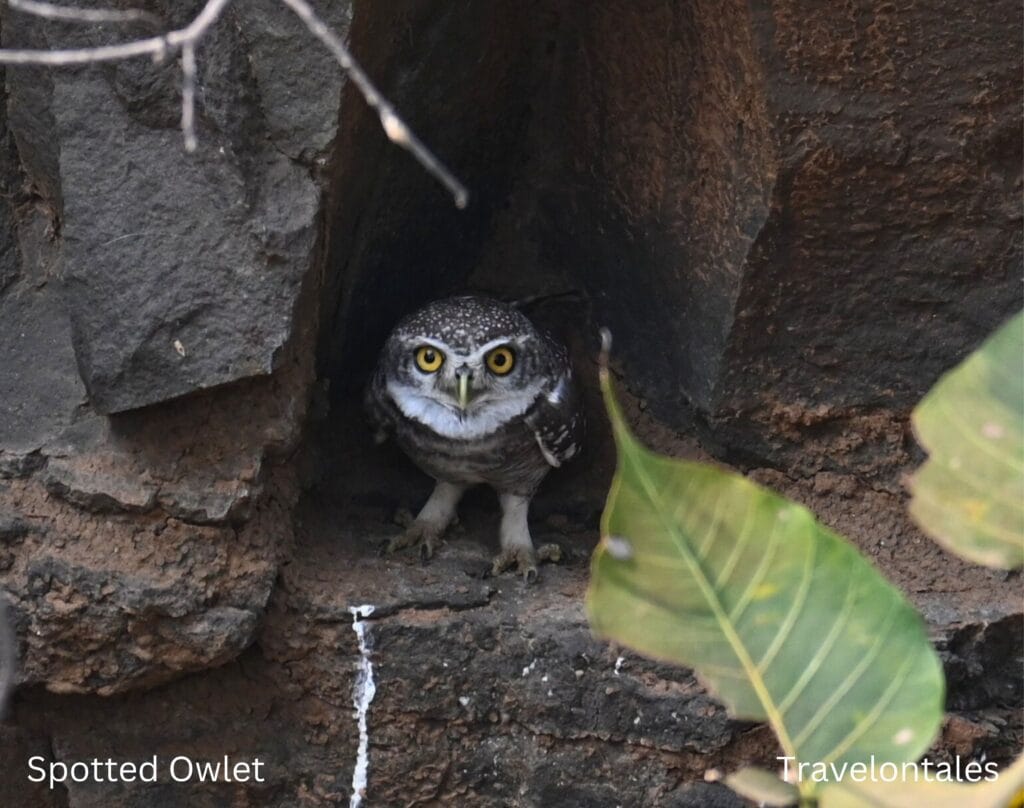
Spotted Owlet of Bhigwan: The Tiny Guardian of the Rocks
Some wildlife moments don’t come with noise… they come with a stare.
Tucked inside a rugged basalt crevice, a Spotted Owlet (Athene brama) Those bright yellow eyes didn’t just look… they assessed. And for a brief moment, it felt like the wild was watching back.
Bhigwan, often called Maharashtra’s flamingo paradise, hides a quieter secret. Beyond the wetlands lies a rugged world of rocks and scrub—perfect for owls, raptors, and birds that don’t crave attention.
Meet the Spotted Owlet
Small in size, massive in personality—this owl is one of India’s most adaptable birds.
- Size: Around 21 cm
- Eyes: Bright yellow, forward-facing
- Habitat: Rocks, ruins, trees, even cities
- Diet: Insects, rodents, lizards
- Behavior: Bold, curious, often active in daylight
That Unforgettable Gaze
Owls don’t move their eyes—they rotate their heads. So when one locks onto you, it’s not casual… it’s deliberate.
Photography Insight
- Natural rock framing creates a cinematic tunnel effect
- Eye-level shot builds a powerful connection
- Foreground leaf adds depth and realism
- Low light enhances contrast and drama
This isn’t just a photograph—it’s a portrait with attitude.
Responsible Wildlife Photography
A roosting owl is in its safe zone. Respect matters.
- Maintain distance
- Avoid flash
- Keep noise minimal
- Limit time near the subject
Final Thought
This tiny bird, hidden in silence, carries a presence that stays longer than any roar.
✨ Fun Facts
- Spotted Owlets often live near humans—even in cities
- They bob their heads when curious (or confused)
- They can rotate their heads up to 270°
- Their call sounds like soft chuckling
Want to explore more wildlife stories?
👉 Click Here