
Sometimes, It’s About Looking Up
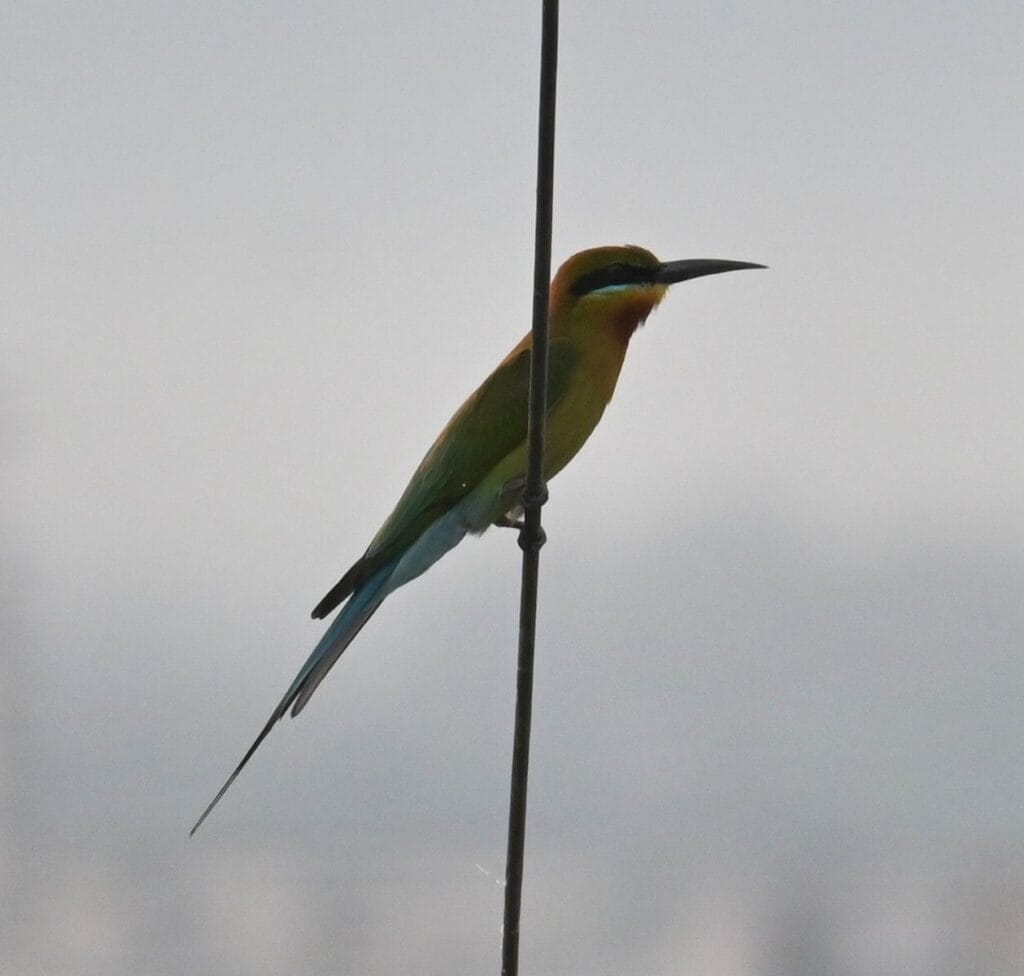
Green Bee-eater photography often reminds us that travel moments don’t always come from forests, safaris, or dramatic landscapes. Sometimes, they come from simply looking up.
A Quiet Moment in the Everyday Sky
This was seen sitting quietly on a wire, framed against a soft grey sky. No dramatic action. Just a pause — as if the bird itself was taking a breath.
There is something deeply calming about such moments. When nothing is happening, everything suddenly feels visible.
About the Green Bee-eater
The Green Bee-eater (Merops orientalis) is a common yet beautiful bird found across India. Its slim body, long central tail feathers, curved black beak, and striking mix of green, blue, and yellow make it hard to ignore once you truly notice it.
Often seen near open fields, roadsides, and even urban areas, this bird quietly blends into daily life — until a still moment brings it into focus.
The Beauty of Simplicity in Bird Photography
What makes this photograph special is its simplicity. The empty background removes all distraction and allows the bird to stand alone — balanced, alert, and elegant.
It reminds us how often beauty sits right in front of us, unnoticed, while we keep searching elsewhere for something grand.
Birds like these don’t demand attention.
They reward patience.
Fun Facts About the Green Bee-eater
- Green Bee-eaters often sit on wires or bare branches to scan for insects.
- Despite the name, they eat more than bees — dragonflies and beetles are favourites.
Click here to explore more bird photography on TravelOnTales
The most-seen bee-eater in India
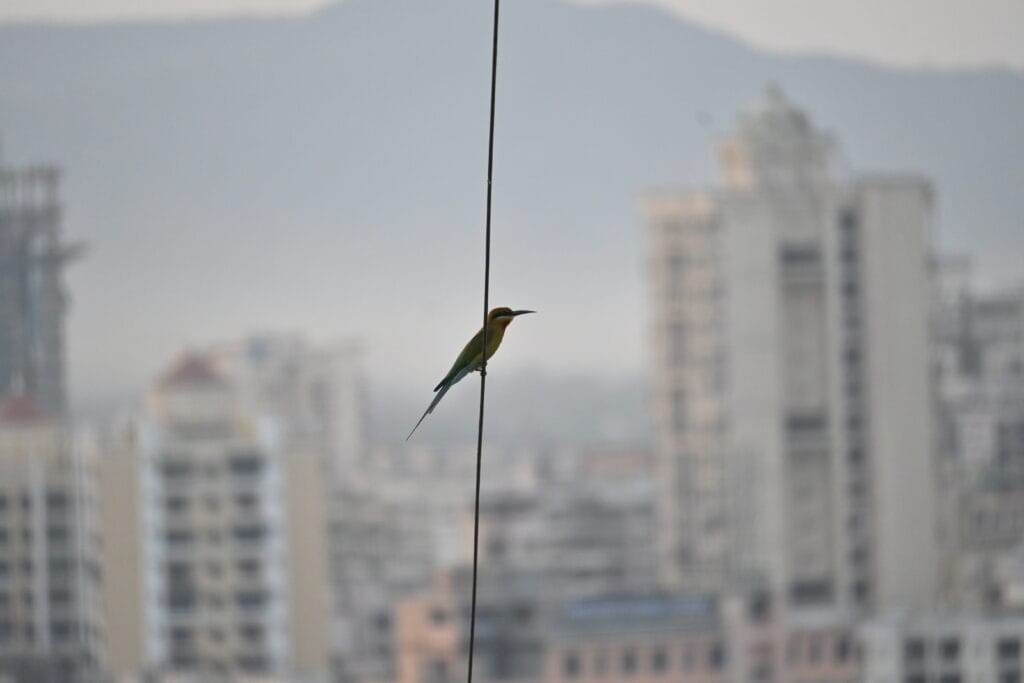
If you have noticed a slim green bird on a wire with a thin tail spike, it was almost certainly a Green Bee-eater. It is one of the most widespread birds in the country and one of the easiest to watch well.
Unlike its forest relatives it likes open country — farmland, scrub, roadsides, riverbanks and the edges of towns. It does not need you to go anywhere.
Identifying it
- Colour: bright green overall, with a golden-rufous wash on the crown and nape.
- Throat: blue, separated from the breast by a thin black band.
- Mask: a black stripe through the eye.
- Tail: two central feathers extended into fine spikes beyond the rest.
- Size: about 16 to 18 cm including those streamers. Noticeably slimmer than the Chestnut-headed Bee-eater.
The streamers are the quickest separator from the Chestnut-headed Bee-eater, which has a square tail and a chestnut crown.
How it hunts
From a perch, always. It sits on a wire, a fence, a bare twig or a stem, watches, launches, takes the insect in mid-air with an audible snap, and returns — usually to the same spot.
That predictability is a gift to a photographer. Find an active perch, frame it, and the bird will come back to you repeatedly.
Dealing with a sting
Bee-eaters take stinging insects and have a procedure for it. The bird returns to the perch, beats the insect against the wood to kill it, then rubs the abdomen tip hard along the branch to express the venom before swallowing.
Watch one for a few minutes and you will see the whole sequence. It is the reason they return to a perch rather than eating on the wing.
Nesting in the ground
Green Bee-eaters dig tunnels into flat or sloping bare earth — a track, a bank, the side of a ditch — often in loose colonies. The tunnel runs a metre or more back to a chamber.
This makes them vulnerable in a way that tree-nesting birds are not. A nesting bank cleared, graded or driven over destroys the colony outright.
Behaviour worth watching
They roost communally, packed along a branch or wire in a long line. They also engage in cooperative breeding, with helpers assisting a pair to raise young — the same strategy the babblers use.
Photographing them
- Pick the perch and wait. Do not follow the bird. It will return.
- Shoot the return, not the launch. A bird landing with an insect is the picture.
- Watch for the beat-and-rub. It is characteristic behaviour and rarely photographed properly.
- Backlight the streamers. Low sun through the tail spikes separates the bird beautifully from the background.
Frequently asked questions
How do I tell a Green Bee-eater from a Chestnut-headed Bee-eater?
The Green has long thin tail streamers and a blue throat. The Chestnut-headed has a square tail and a chestnut crown with a yellow throat.
Do bee-eaters get stung?
They avoid it by beating the insect and rubbing out the venom on a perch before swallowing.
Where do Green Bee-eaters nest?
In tunnels dug into bare earth — banks, tracks and ditch sides — often in small colonies.
Are they common?
Very. They are among the most widespread and easily seen birds in open country across India.
Related: Chestnut-headed Bee-eater, Green Bee-eater in Bhigwan and Birds of Bhigwan.
