
The Indian wolf is a wolf of open grasslands and scrub. It is smaller and slimmer than the wolves of cold countries, with a short coat that suits the hot Deccan. At dusk at Kadbanwadi, near Bhigwan, one stood behind the bushes and looked straight at us.
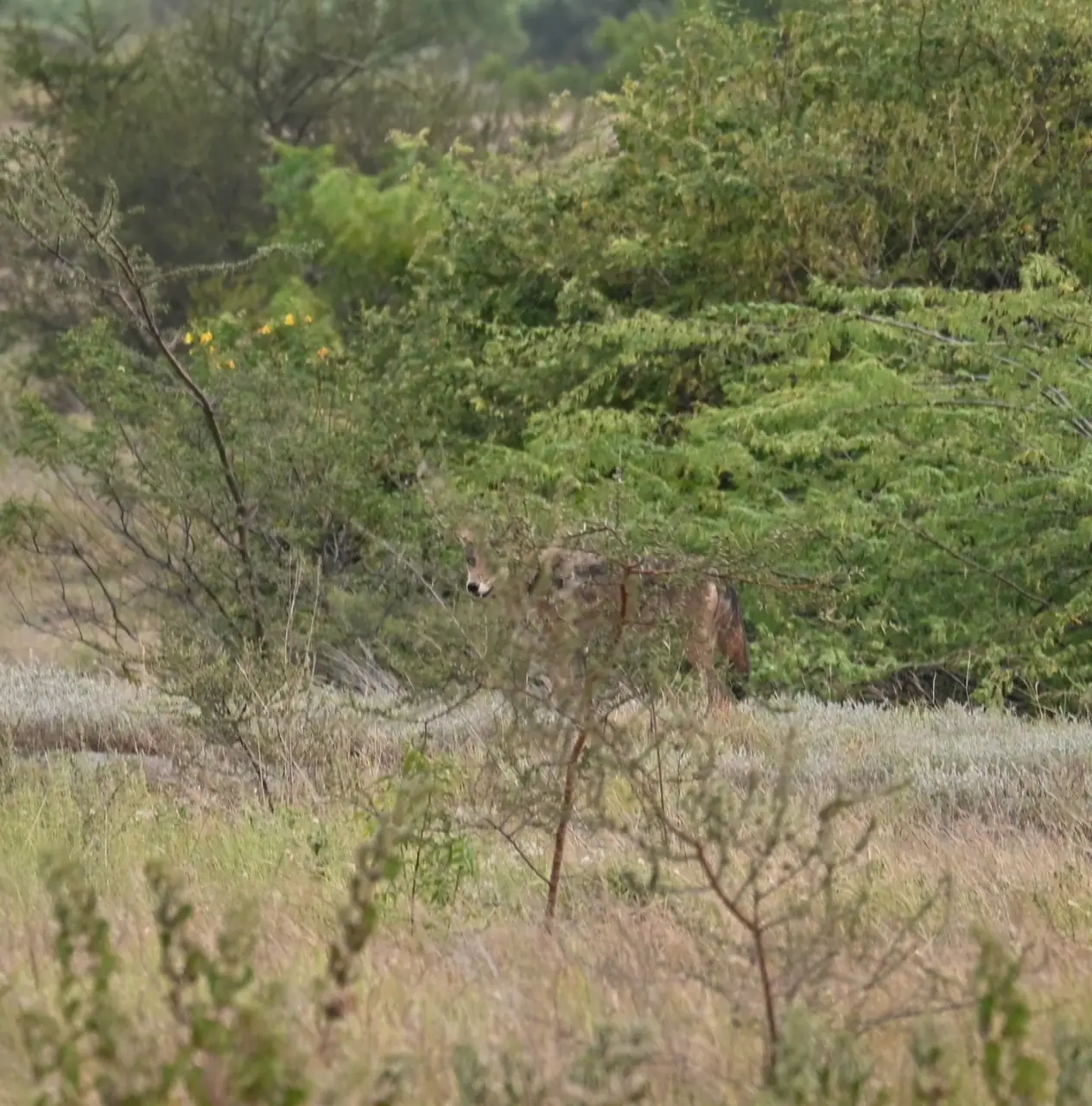
What an Indian wolf looks like
An Indian wolf has long legs, a narrow body and a grey-brown coat with darker hairs along the back. Its muzzle is pale and its ears are large. It looks a little like a big, lean village dog, but it moves with a smooth, steady walk and holds its tail low.
Where Indian wolves live
Indian wolves live in peninsular India, in dry grasslands, open scrub and farmland. In Maharashtra, the grasslands around Pune, Ahilyanagar and Solapur are good wolf country, and Kadbanwadi near Bhigwan is one of these places.
What Indian wolves eat
They hunt hares, rodents and young deer and antelope such as chinkara and blackbuck. They also eat birds and insects. Wolves often hunt at dawn and dusk, when the day is cool.
Family life in a pack
Indian wolves live in small packs, usually a breeding pair with their young. The pair dig a den in the ground, often in a gentle slope, and raise their pups there. The whole family helps to feed and guard the pups.
Tips for seeing an Indian wolf
- Visit open grasslands such as Kadbanwadi in the early morning or the last hour of light.
- Scan the edges of bushes and low ridges slowly.
- Stay in your vehicle and keep quiet.
- Carry a long lens, because wolves keep their distance.
Our wolf was the last sighting of a wonderful evening at Kadbanwadi. Read the full story in our Bhigwan trip story, and see the chinkara that share the same grassland.
Indian wolf or jackal?
The golden jackal shares the same grassland. A wolf is larger and taller, with longer legs, a broader head and a grizzled grey-brown coat. A jackal is smaller and more golden, with a slimmer muzzle. Size is the easiest clue when both animals are in view.
Why grasslands matter to wolves
Open grasslands give wolves room to hunt and safe slopes for dens. Places like Kadbanwadi, protected for chinkara, also give wolves a home. Every visitor who pays the entry fee helps support this protection.
Our sighting
We met our wolf at 6.29 pm, at the very end of the evening session. It stood half hidden behind thin bushes, looked at us calmly for a few moments, and slipped away into the scrub. The light was low, so we used a slow shutter speed and kept the camera very steady.
Best time of year
Wolves are seen all year. Pups are raised in the months after the monsoon, and the dry months from November to March often give clearer views across short grass.
Photography tips
- Be ready before the light goes, with a high ISO already set.
- Brace the camera on a window frame or bean bag.
- Take a few frames and then simply watch; these moments are short.
How to reach Bhigwan and Kadbanwadi
Bhigwan is on the Pune–Solapur highway (NH65), about 105 km from Pune. The nearest airport is Pune, and Bhigwan has its own railway station (BGVN), with Daund Junction about 26 km away for more trains. State Transport buses from Pune to Solapur stop at Bhigwan. Kadbanwadi is a short drive away, and most homestays in Kumbhargaon arrange transport and local guides.
Frequently asked questions
Are there wolves in Maharashtra?
Yes. Indian wolves live in the grasslands and scrub of Maharashtra, including the area around Bhigwan and Kadbanwadi.
How big is an Indian wolf?
It is about the size of a large dog, with long legs and a slim body, smaller than the wolves of colder countries.
When is the best time to see an Indian wolf?
Early morning and the last hour before dark, when wolves are most active.