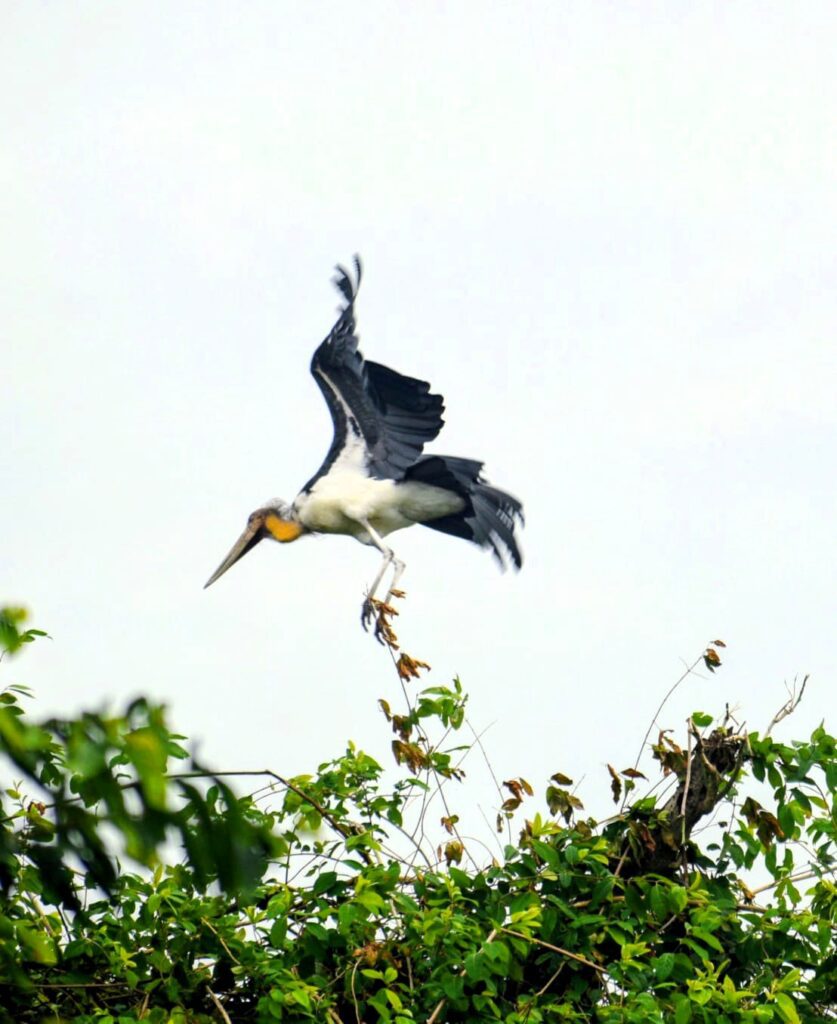
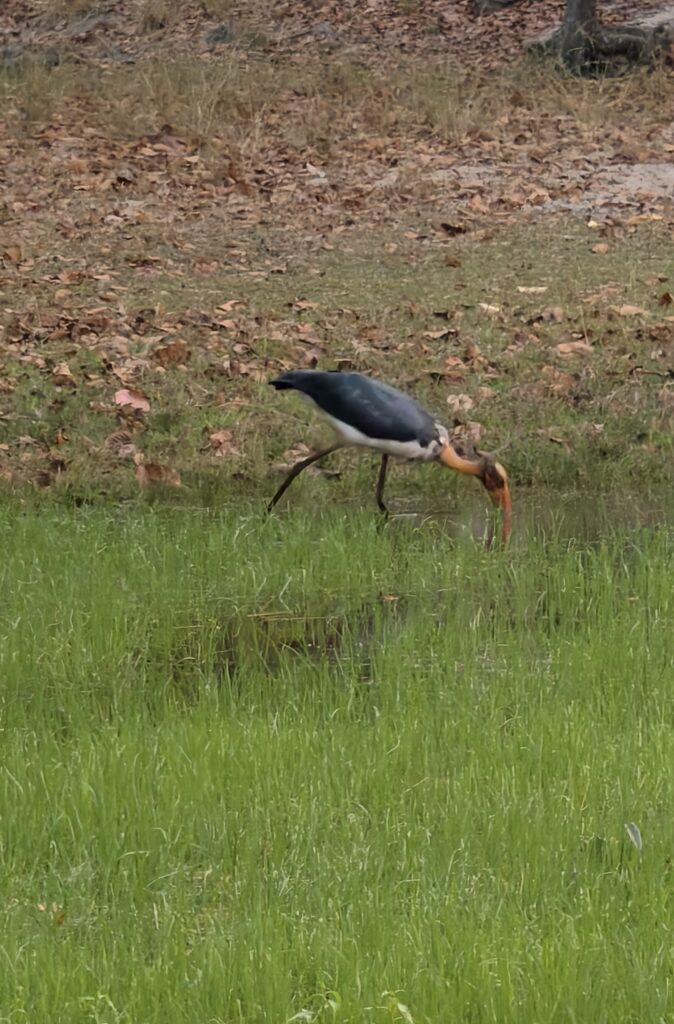
The Lesser Adjutant Stork (Leptoptilos javanicus) is one of the most striking and rarely spotted storks of South and Southeast Asia. Known for its bare yellow-orange neck and heavy bill, this bird is both fascinating and imposing. Spotting it at Bandhavgarh National Park is a treat for bird enthusiasts.
Appearance & Identification
- Tall, large-bodied stork with a bare, rugged neck.
- Massive wedge-shaped bill built for catching prey.
- Dark upperparts and pale underparts.
- Unlike its cousin, the Greater Adjutant, it appears slightly slimmer and less bulky.
Behavior in Bandhavgarh
The Lesser Adjutant is usually solitary and shy. In Bandhavgarh, it is often found near grasslands and shallow water pools, foraging for:
- Fish
- Frogs
- Small reptiles
- Carrion
This makes it an important scavenger in the ecosystem.
Habitat & Range
- Prefers swamps, wetlands, marshes, and riverbanks.
- Found in pockets across India, Nepal, Bangladesh, Myanmar, Thailand, and Cambodia.
- In India, sightings are rare, making Bandhavgarh a noteworthy location.
Conservation Status
The species is listed as Vulnerable by the IUCN. Major threats include:
- Wetland destruction
- Hunting and poaching
- Disturbance from human activity
Protecting areas like Bandhavgarh is crucial for the survival of this rare stork.
Fun Facts
- The name “Adjutant” comes from its stiff, military-like walk.
- Lesser Adjutants are quieter than most storks, often seen foraging in silence.
- They are vital scavengers, helping keep wetland ecosystems clean.
Conclusion
The Lesser Adjutant Stork at Bandhavgarh is a rare sighting that highlights the park’s rich biodiversity. Its presence is not just a joy for birdwatchers but also a reminder of the importance of conserving India’s wetlands for future generations. The Lesser Adjutant Stork stands as a symbol of rich biodiversity and the urgent need to protect India’s wetlands.”
Why the head is bare
A Lesser Adjutant has a bald, yellowish, wrinkled head and neck, and it is not an accident of ageing. It is equipment.
Storks in this group feed at carcasses as well as in wetlands, pushing head and neck into places that a feathered head would leave permanently fouled. Bare skin is easier to keep clean and dries quickly. Vultures solved the same problem the same way.
Identifying it
- Size: very large, standing around 110 to 120 cm.
- Head: bare, dull yellow to orange, sparsely downy. No dangling neck pouch.
- Bill: long, heavy, wedge-shaped, pale.
- Plumage: dark glossy upperparts, clean white belly and undertail.
- In flight: neck retracted like a heron, not extended like most storks.
Lesser Adjutant vs Greater Adjutant
These two are genuinely confusable and it matters, because the Greater Adjutant is one of the rarest storks in the world.
- Greater Adjutant: has a large pendulous pouch hanging from the front of the neck. Bigger, heavier, and now largely restricted to Assam and a small population in Cambodia.
- Lesser Adjutant: no pouch. More widely distributed, though still declining.
If there is no pouch, it is a Lesser. That single feature settles almost every case.
Conservation status
The Lesser Adjutant is listed as Vulnerable. The pressures are habitat loss — wetland drainage, the felling of the large trees it nests in — and disturbance at nesting colonies.
It needs undisturbed tall trees for nesting and shallow wetlands for feeding, and both are exactly what development removes first. A reserve like Bandhavgarh matters to this species precisely because it protects both together.
Where to look at Bandhavgarh
Marshy ground, the edges of waterbodies, wet grassland and flooded depressions. It often feeds alone or in twos rather than in the flocks openbills form.
Look for a very large, dark, upright bird standing motionless at the edge of water. Adjutants are patient and undemonstrative, which is partly why visitors overlook them.
Photographing it
- Give it space in the frame. A tightly cropped adjutant loses the sense of scale that makes it impressive.
- Expose for the white belly, which will blow out against dark plumage if you are careless.
- Wait for flight. The retracted neck and enormous wingspan make a much stronger image than a standing bird.
- Photograph the head detail if you get close enough — that bare wrinkled skin is the identifying feature.
Frequently asked questions
Why is it called an adjutant?
From its stiff, measured walk, which reminded British observers of a military adjutant on parade.
How do I tell Lesser from Greater Adjutant?
The Greater has a large pendulous neck pouch. The Lesser does not.
Is the Lesser Adjutant endangered?
It is classed as Vulnerable, with numbers declining through wetland loss and disturbance at nesting sites.
Why is its head bare?
Because it feeds at carcasses as well as in wetlands. Bare skin stays cleaner and dries faster than feathers.
Related: Bird Photography for Beginners, Bird Watching at Bandhavgarh, Lesser Adjutant at Tadoba: feeding and behaviour, Woolly-necked Stork, Red-wattled Lapwing and Bandhavgarh Safari Guide.
More Photographs from Our Trips