
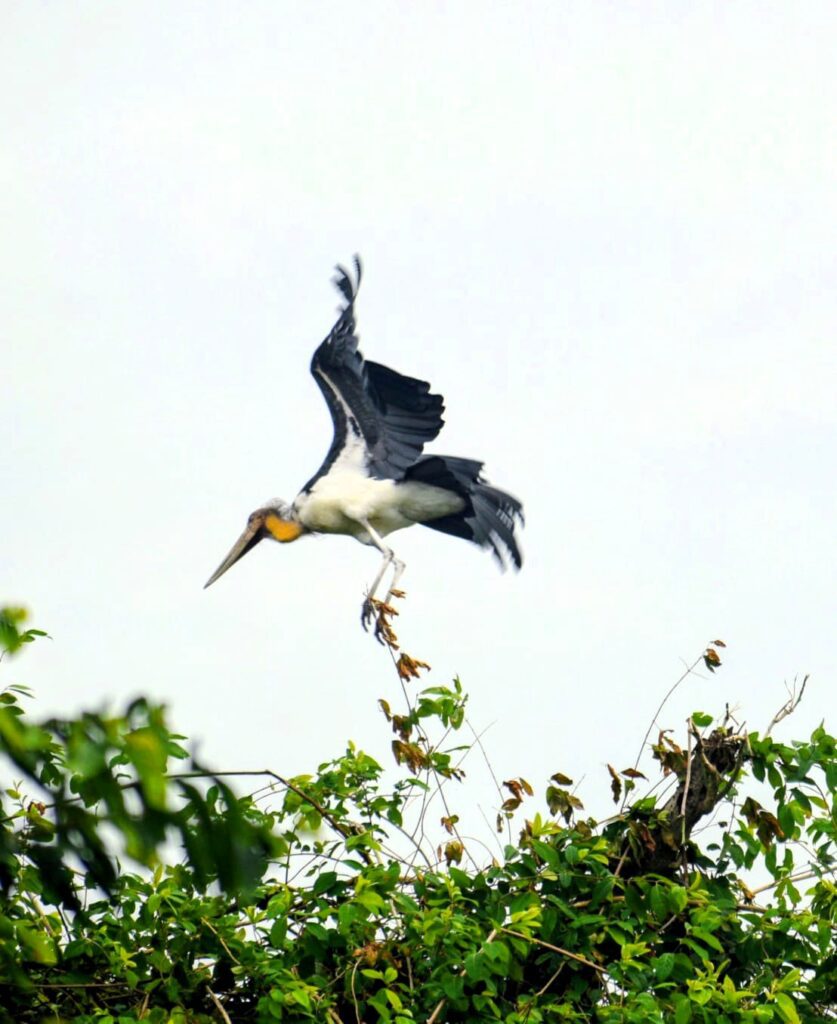
Lesser Adjutant Stork mid-flight, just as it lifts from a green canopy
Introduction
Among the wetlands and forests of Tadoba, the Lesser Adjutant Stork stands out as one of the most unique and rare birds. With its bare yellow throat pouch, large bill, and massive wings, this stork looks almost prehistoric. Spotting it in flight is a real treat for birdwatchers.
Description of the Photo
The Lesser Adjutant Stork mid-flight, just as it lifts from a green canopy. Its wings are stretched wide, showing the strong black feathers, while the yellow throat pouch is clearly visible.
- Head & Neck: Bare skin, dull grey with a hanging yellow throat pouch.
- Body: Black wings and back, with a contrasting white belly.
- Bill: Heavy, strong, slightly upturned.
- Size: Large, standing over 1 meter tall, wingspan up to 2.5 meters.
Habitat & Behavior
- Found in wetlands, riverbanks, and marshy forests.
- Diet includes fish, frogs, reptiles, carrion, and small mammals.
- Walks stiffly, like a soldier — the reason for its name “adjutant.”
- Usually seen alone or in pairs, unlike other storks that gather in groups.
Fun Facts
- Plays a key role in cleaning the ecosystem by eating carrion.
- Listed as Vulnerable by the IUCN due to habitat loss and poaching.
- Its prehistoric look often surprises first-time birdwatchers.
- Lesser seen compared to the Greater Adjutant, which is even rarer.
Why You’ll Love Seeing It in Tadoba
The Lesser Adjutant Stork isn’t about beauty but about rarity and power. Watching its massive wings spread across Tadoba’s skies makes you feel like you’re looking back into the age of dinosaurs.
An opportunist, not a specialist
Most large wading birds are committed to one feeding strategy. The Lesser Adjutant is not, and that flexibility is the most interesting thing about it.
It takes fish, frogs, reptiles including snakes, large insects, crabs, rodents and nestling birds. It will also feed at carcasses alongside vultures, and it visits rubbish tips in some parts of its range.
This breadth is why it survives in landscapes that have lost their more specialised wetland birds.
How it hunts
Slowly. It walks through shallow water and wet grass with a deliberate, stiff-legged stride, watching the ground ahead, and strikes downward with that heavy wedge of a bill.
The bill is not built for the delicate probing a stork like the openbill does. It is a blunt instrument for seizing and crushing, which is what allows the adjutant to take prey as large as a snake or a rat.
Riding thermals
Adjutants are heavy birds and flapping is expensive, so they use rising warm air the way raptors and vultures do.
Through the middle of the morning, as the ground heats, you may see them circling upward on motionless wings, gaining height without a wingbeat, then gliding away across country. It is an efficient way for a large bird to travel between feeding grounds.
This is also why sightings often cluster around late morning rather than dawn — the thermals have to build first.
Nesting
They nest in tall trees, often in small loose colonies and sometimes alongside other large waterbirds. The nest is a broad platform of sticks, reused and added to over years.
Because they need large mature trees near wetland, a single felled nesting tree can remove breeding capacity from an entire area. This is one of the main reasons the species is declining.
Where to look at Tadoba
Tadoba lake, Telia lake, marshy edges and flooded grassland. Also worth scanning the sky in mid-morning for a large soaring bird with a retracted neck — that neck posture separates it instantly from an eagle at distance.
Photographing behaviour
- Wait for the strike. A standing adjutant is a static subject. The downward stab is the picture.
- Watch mid-morning skies for soaring birds. Adjutants on a thermal against cloud are a genuinely uncommon image.
- Use scale. An adjutant beside egrets or openbills shows just how large it is.
- Keep well back from nest trees. Disturbance at colonies is a documented cause of decline.
Frequently asked questions
What does the Lesser Adjutant eat?
Fish, frogs, snakes and other reptiles, large insects, crabs, rodents and nestlings. It also scavenges at carcasses.
Do adjutants soar?
Yes, on thermals, gaining height without flapping before gliding to another feeding area.
Where do they nest?
In tall trees near wetlands, often in small loose colonies. Nests are reused over years.
How is it different from other storks at Tadoba?
It is much larger than the Asian Openbill, has a bare head, and flies with the neck retracted rather than extended.
Related: Lesser Adjutant: identification and conservation, Asian Openbill Stork at Tadoba and Birds of Tadoba National Park.
