
The Indian gaur (Bos gaurus), often called the Indian bison, is the largest wild cattle in the world. With its dark muscular body, curved horns, high shoulder ridge and white “socks”, it is one of the most impressive animals in India’s forests, and one we have watched many times on safari in Tadoba and Bandhavgarh. This guide covers its size and weight, how to identify it, where it lives, how it behaves, and how to watch it safely.
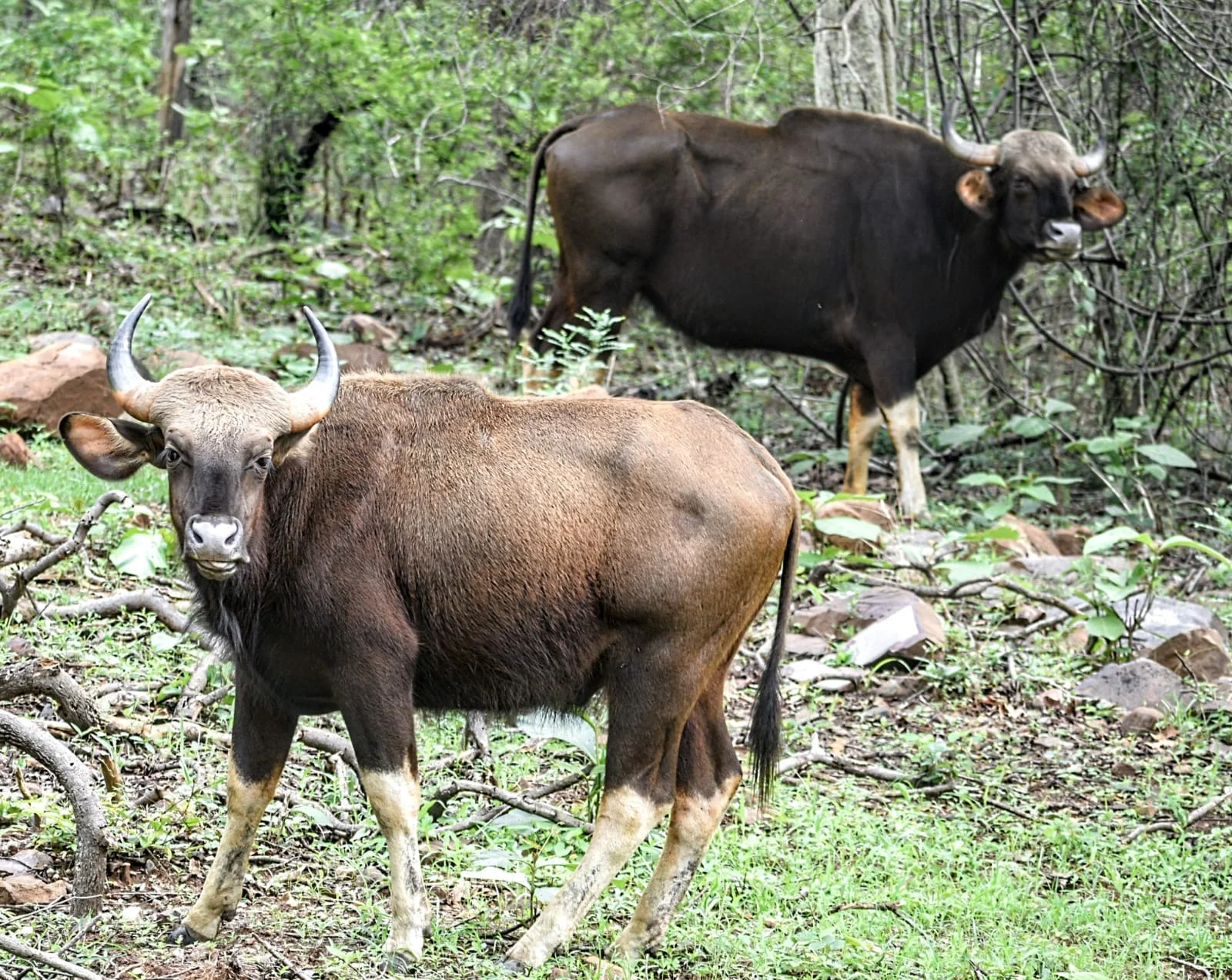
What Our Gaur Photographs Show
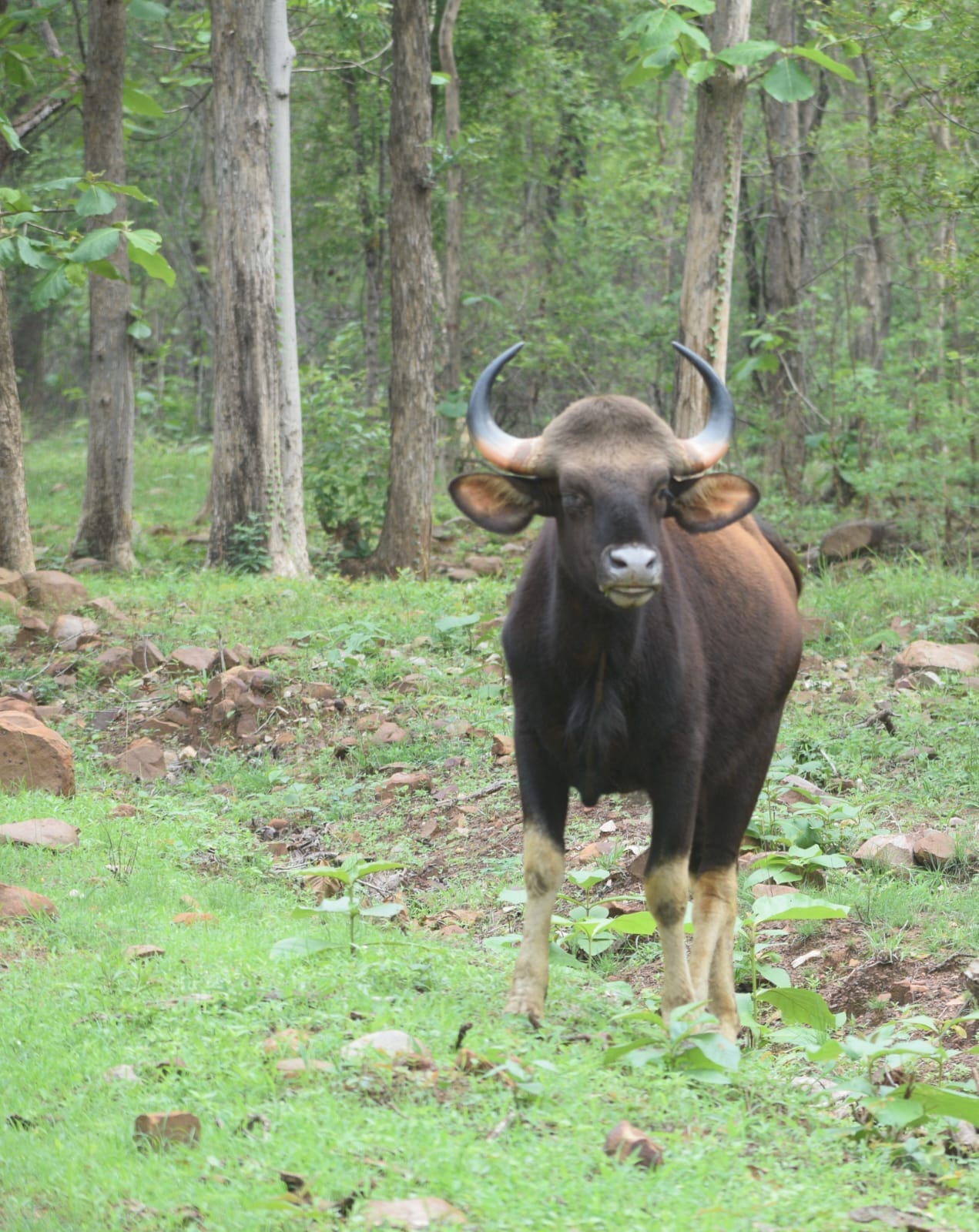
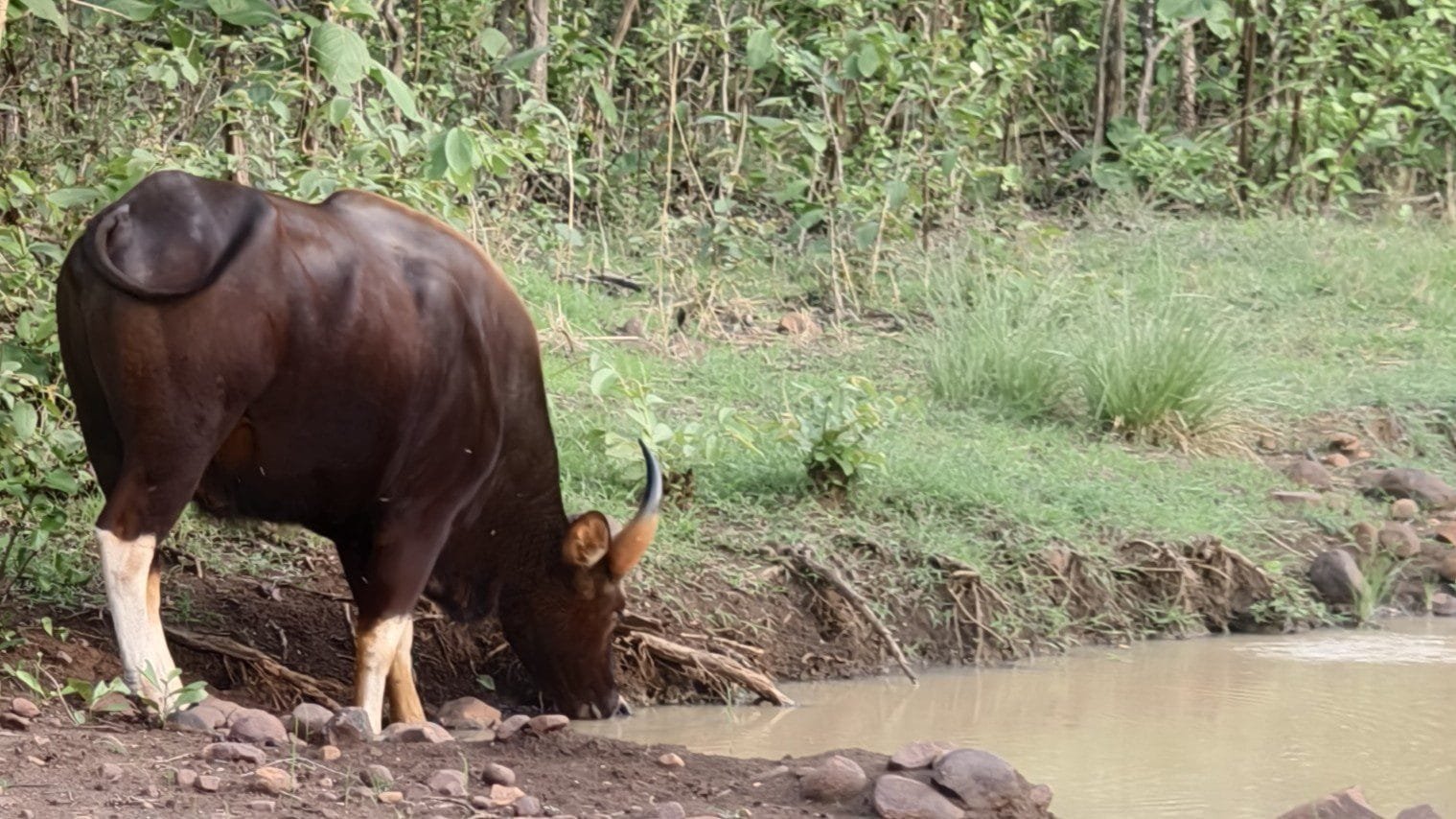
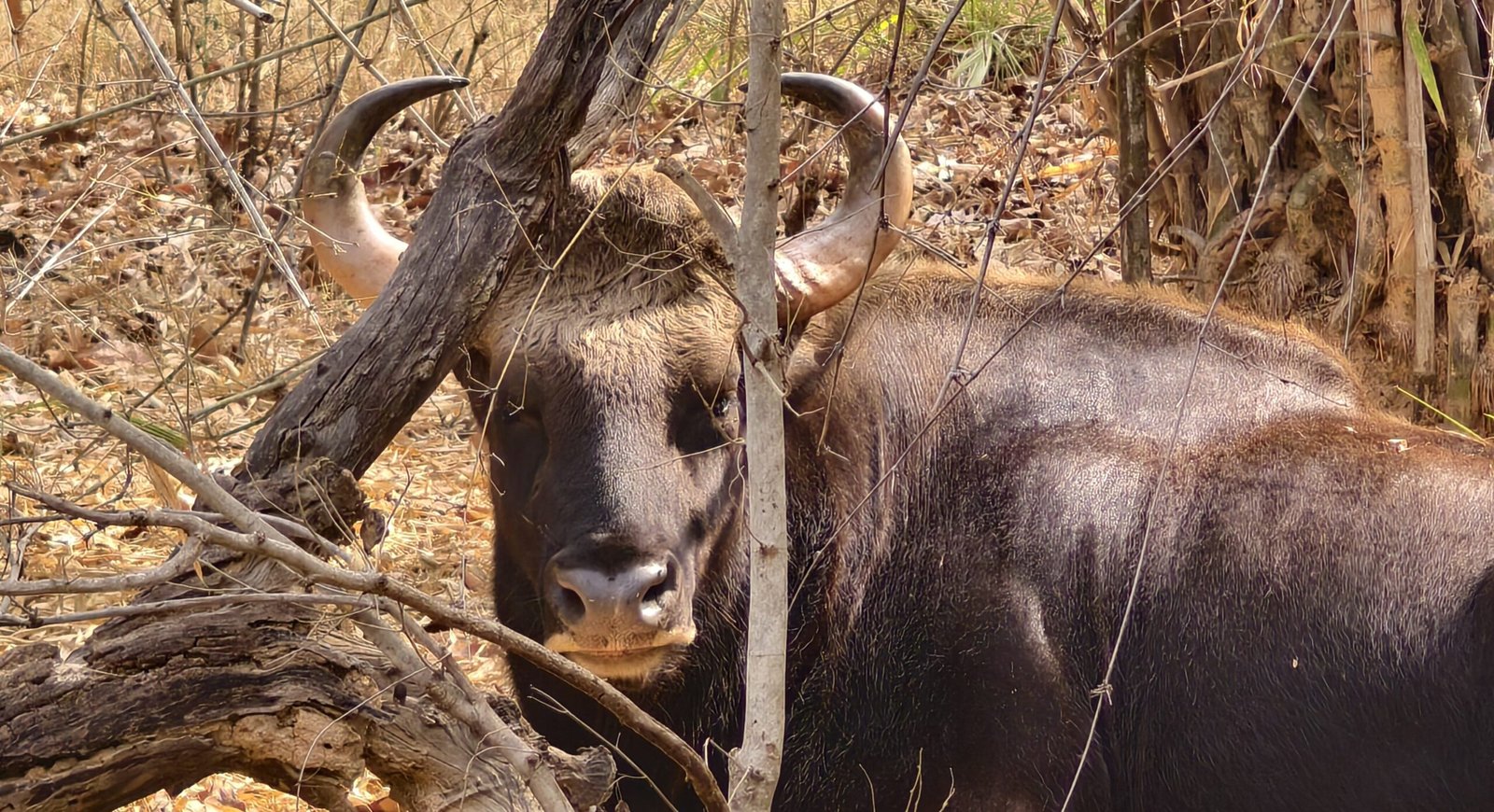
These photographs are from our safaris in Tadoba and Bandhavgarh, not stock images. The first frame shows two gaur in a Tadoba forest clearing. Another image farther down this page shows a gaur drinking at a Tadoba waterhole, while our Bandhavgarh photograph shows a bull among dry branches. Together they show how different the setting can look even when the animal is unmistakable. They are records of those trips, not a promise of a sighting on every safari.
If you spot a large dark animal at a distance, look for the gaur’s high shoulder ridge, pale lower legs and curved horns before deciding what it is. Keep your distance and follow your safari guide’s instructions. For the story behind our Bandhavgarh photographs, read our Indian gaur field notes from Bandhavgarh.
Indian Gaur Facts at a Glance
| Feature | Information |
|---|---|
| Scientific name | Bos gaurus |
| Common names | Indian gaur, gaur, Indian bison |
| Family | Bovidae (cattle family) |
| Diet | Herbivore: grass, leaves, bamboo, shoots, fruit |
| Male weight | Commonly about 600–1,000 kg; big bulls can be heavier |
| Female weight | Commonly about 440–700 kg |
| Shoulder height | About 1.5–2.2 metres |
| Habitat | Forests with grassy clearings and water |
| Status | Vulnerable (IUCN) |
| Key field mark | White or pale lower legs |
What Is a Gaur?
The gaur is a wild ox native to South and South-East Asia. It belongs to the genus Bos, the same group as domestic cattle. The name “Indian bison” is widely used but not accurate: true bison belong to a different genus and live in North America and Europe. India has no wild bison; the animal people call one is the gaur.
How Big Is an Indian Gaur?
Size depends on age, sex and region. Mature bulls commonly weigh 600 to 1,000 kg and can stand close to two metres at the shoulder, taller than most people. Cows are smaller and lighter brown. Seen beside a safari jeep, an adult’s shoulder is roughly level with the top of the vehicle.
How to Identify an Indian Gaur
- White lower legs: the clearest field mark, like white stockings, visible even in poor light.
- Shoulder ridge: a high muscular hump over the shoulders, strongest in adult bulls.
- Dark coat: bulls are dark brown to almost black; cows and young are lighter brown; calves are reddish.
- Broad forehead: often paler, sometimes greyish, between the horns.
- Curved horns: both sexes have horns that curve out and then up, with dark tips.
Gaur, Bison or Buffalo?
| Feature | Indian gaur | Bison | Wild water buffalo |
|---|---|---|---|
| Group | Bos | Bison | Bubalus |
| Shape | Tall, high shoulder ridge | Heavy, big hump, shaggy | Broad, huge swept-back horns |
| Lower legs | White or pale | Dark | Dark |
| Habitat | Forest with clearings | Grassland, open woodland | Wetland, floodplain |
| Wild in India? | Yes | No | Yes |
Where Is the Gaur Found in India?
India has most of the world’s wild gaur. They live in hilly forest with grass and water, mostly inside national parks and tiger reserves, and avoid open plains and deserts, so they are not found in Rajasthan, Gujarat or most of the Gangetic plain.
- Western Ghats: the biggest, easiest-to-see herds, in Karnataka, Kerala, Tamil Nadu and Goa.
- Central India: Madhya Pradesh, Maharashtra and Chhattisgarh.
- East and Northeast: Odisha, Jharkhand, Assam and Arunachal Pradesh, in smaller, shyer herds.
Best Parks to See Gaur
- Nagarhole and Bandipur (Karnataka) and Mudumalai (Tamil Nadu): large herds, often near roads and water.
- Periyar (Kerala): gaur on the grassy hills around the lake.
- Kanha and Pench (Madhya Pradesh): regular sightings in meadows and bamboo.
- Tadoba (Maharashtra): we have seen gaur here many times, especially near water in summer.
- Bandhavgarh (Madhya Pradesh): gaur were brought back here in 2011–12 and the herd has grown.
- Bhagwan Mahavir Wildlife Sanctuary (Goa).
Which State Animal Is the Gaur?
The gaur is the state animal of Goa, where it is locally called gava, and of Bihar.
When to See Gaur
Early morning and late evening, when they feed. In central India, March to June is best, when animals gather near water and the forest is open. Look for a huge dark animal with white socks.
What Does the Gaur Eat?
Gaur both graze and browse: grass, leaves, bamboo, young shoots, bark and fruit, changing with the season. They feed mostly in the cool early morning and evening and rest in shade at midday. Water is essential, so in summer they visit waterholes regularly.
Behaviour and Herd Life
Cows and calves live in herds, usually led by an older cow. Adult bulls spend much of the year alone or in small groups and join herds to breed; a big bull standing alone is normal, not lost. Gaur communicate with posture, smell and calls, and an alarmed animal gives a loud snort or whistle. When threatened, a herd bunches together with calves in the middle.
Tiger vs Gaur
In Tadoba and Bandhavgarh gaur are an important prey for tigers, but tigers mostly take calves, young animals or lone gaur. A healthy adult bull, weighing a tonne and armed with horns, is a serious risk even for a tiger, and herds have been known to drive off tigers and dhole packs.
Are Gaur Dangerous?
Gaur usually avoid people, but they are very powerful wild animals. A surprised bull, a mother with a calf or an animal that feels cornered can charge.
- Stay inside the safari vehicle.
- Keep a respectful distance and never block a gaur’s path.
- Do not shout, make sudden moves or feed them.
- Follow your guide’s instructions.
- Outside protected areas, move away calmly and inform the forest department.
More: Is the Indian Gaur Dangerous?
Conservation Status
The gaur is listed as Vulnerable on the IUCN Red List. Its main threats are habitat loss and fragmentation, hunting, diseases spread from domestic cattle and conflict at forest edges. Protecting forests and the corridors between them helps gaur and every other animal that shares their home.
Photographing Gaur on Safari
- Expose for the animal, not the bright background; dark gaur in shade are easy to underexpose.
- Watch the highlights on the forehead and white legs.
- Focus on the eye and use continuous autofocus when it moves.
- Include some forest to show scale, and capture behaviour, not just portraits.
- Never ask the driver to get dangerously close.
Frequently Asked Questions
What is the scientific name of the Indian gaur?
Bos gaurus.
Is the Indian gaur the same as the Indian bison?
Yes, it is the same animal, but “bison” is a misleading name. The gaur is wild cattle, not a true bison.
How much does an Indian gaur weigh?
Adult bulls commonly weigh about 600–1,000 kg; cows about 440–700 kg.
Why is the gaur called the forest bull or forest cow?
Because it is wild cattle that lives in forest. Local names often mean “wild ox”; in Goa and Maharashtra it is called gava.
Is the gaur a buffalo?
No. Wild buffalo have huge swept-back horns and dark legs and live in wetlands. The gaur has white socks, a shoulder ridge and lives in forest.
Where can I see gaur in India?
Tadoba, Bandhavgarh, Kanha, Pench, Nagarhole, Bandipur, Mudumalai and Periyar are all good places.
Read next: Tadoba Safari Guide · Bandhavgarh Safari Guide