
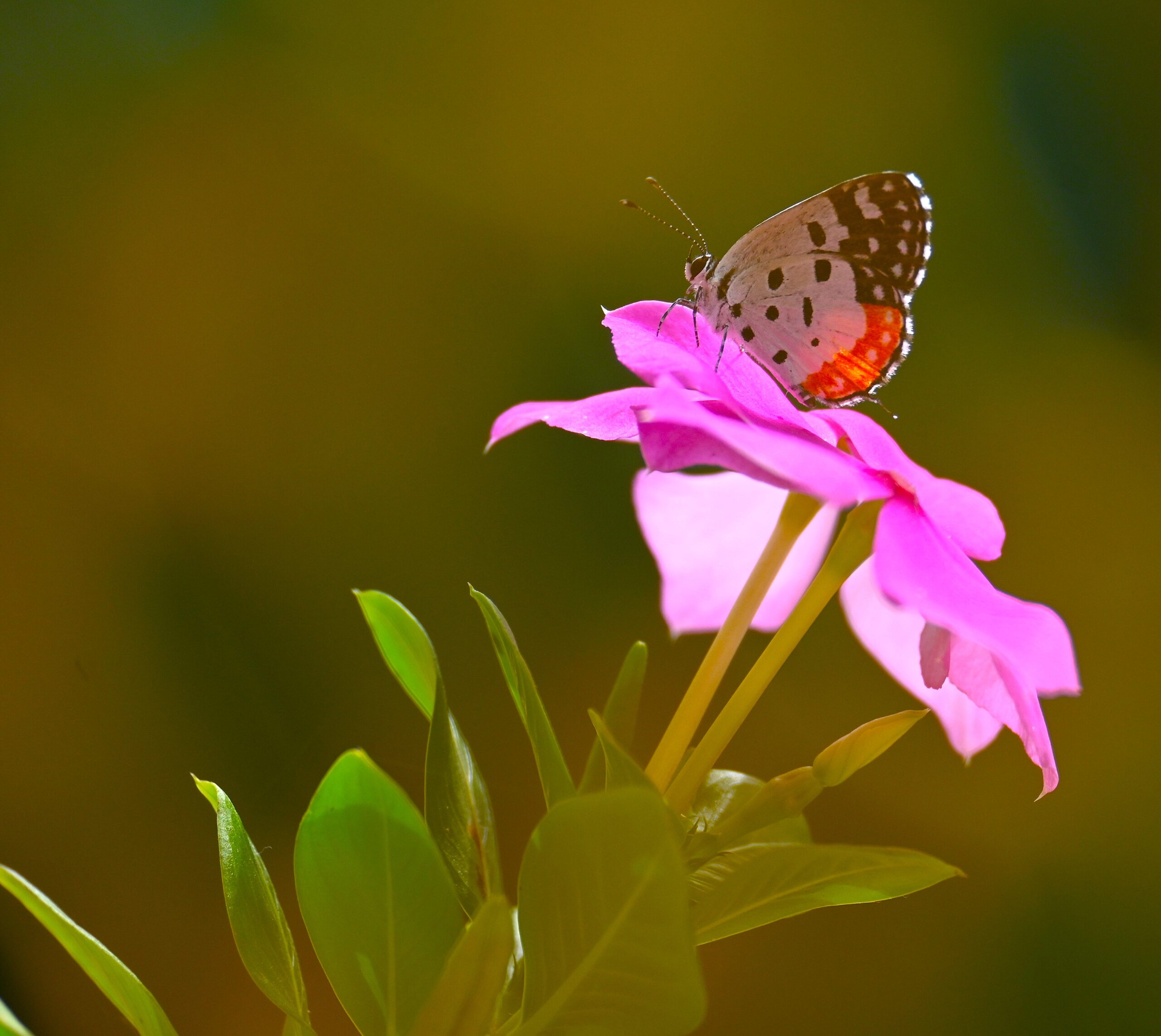
The Red Pierrot (Talicada nyseus) And The flower is Madagascar Periwinkle (Catharanthus roseus)

Madagascar Periwinkle

Butterfly

The butterfly Red Pierrot (Talicada nyseus).

  • Distinctive features: Black upper wings, orange-red patch on the hindwing underside, white spots with black markings.
  • Common in: India, Sri Lanka, Nepal.
  • Behavior: Often rests on the underside of leaves, flies low, and is associated with succulents like Kalanchoe.

🌸 Plant

The flower is Madagascar Periwinkle (Catharanthus roseus).

  • Features: Bright pink/purple flowers with five petals.
  • Uses: Widely grown ornamental, medicinal properties (used in cancer drugs like Vincristine and Vinblastine).

🌟

  1. “The Tiny Rebel: Meet the Red Pierrot Butterfly”
    • Why it’s called a ‘rebel’ in nature (unusual habits like sitting under leaves).
  2. “From Garden Beauty to Life-Saving Medicine: The Story of Madagascar Periwinkle”
    • Journey from ornamental flower to pharmaceutical hero.
    • Fun fact: This humble garden flower gave us cancer-fighting drugs.
    • Easy tips to grow it in pots and gardens.
  3. “Butterflies and Blooms: A Perfect Love Story”
    • Relationship between butterflies and flowering plants.
    • How Red Pierrot depends on plants like Kalanchoe and enjoys nectar from periwinkles.
    • Why planting periwinkle attracts more butterflies.
  4. “5 Fun Facts about Red Pierrot Butterfly You Didn’t Know”
    • It hides under leaves at night.
    • Despite its small size, it has a striking warning coloration.
    • Its caterpillars bore into succulent leaves.
    • Found commonly even in cities.
    • Symbol of transformation and endurance.
  5. “Pink Charm: The Cultural and Medicinal Journey of Periwinkle”
    • Used in Ayurveda and traditional medicine.
    • Symbolism of pink flowers in love and peace.
    • Its modern-day pharmaceutical significance.

A caterpillar that lives inside a leaf

The Red Pierrot is a small butterfly with an unusually specific life. Its caterpillar does not sit on a leaf and eat it from the outside. It burrows in and lives between the two surfaces, mining the tissue from within.

The foodplant is almost always Kalanchoe — the thick, fleshy-leaved succulent grown in pots across India and often naturalised on walls and rocky ground.

A leaf with pale, irregular, translucent blotches spreading through it has a Red Pierrot caterpillar inside. Hold it to the light and you can sometimes see the larva as a dark shape moving within.

Why the succulent matters

A thick fleshy leaf is what makes this possible. Most leaves are too thin to live inside; a Kalanchoe leaf is deep enough to house a caterpillar, keeps it hidden from predators and parasitic wasps, and keeps it from drying out.

It is also why this butterfly turns up so readily in gardens and on balconies. The foodplant is an ornamental. Plant Kalanchoe in an Indian city and Red Pierrots will find it.

Recognising the adult

  • Small, with a wingspan of roughly 3 to 4 cm.
  • Upperside: black with a broad orange-red patch on the hindwing.
  • Underside: white, heavily spotted with black, with orange along the hindwing margin.
  • Tails: fine hair-like tails on the hindwing, often moved gently while at rest.

The false head

Those little tails, combined with the orange spotting at the base of them, form a false head at the wrong end of the butterfly.

At rest the butterfly rubs the hindwings together so the tails move like antennae. A bird or lizard striking at what it reads as the head takes a piece of hindwing instead, and the butterfly escapes with a notch out of it but alive.

This is why so many pierrots and blues in a garden have small symmetrical bites out of their hindwings. Each is a failed predation attempt.

Finding and photographing them

  • Look for the foodplant first. Find Kalanchoe and you will find the butterfly, or at least the mined leaves.
  • Check the leaves for mines even if no adult is flying. It is proof of breeding.
  • Photograph the underside. Pierrots usually rest with wings closed, and the spotted underside with the false head is the more interesting view.
  • Go early. They are slower before the day warms and let you approach far closer.
  • Watch the tails. Catching the wing-rubbing motion tells the mimicry story.

Frequently asked questions

What does the Red Pierrot caterpillar eat?

It mines the inside of Kalanchoe leaves, feeding on the tissue between the leaf surfaces.

How do I know if a plant has them?

Look for pale translucent blotches spreading through the fleshy leaves. That is the mine.

Why does it have tails on its wings?

They form a false head. Predators strike at the wrong end, and the butterfly escapes with wing damage rather than being killed.

How can I attract Red Pierrots?

Grow Kalanchoe. It is the larval foodplant and the butterfly finds it readily, even in cities.


Related: Plain Tiger Butterfly, Atlas Moth and Daisies and their insect visitors.

Scroll to Top