
The Atlas moth is one of the largest moths in the world. It has a wingspan of around 24 cm, which is wider than most people expect a moth to be. We found this one on a mesh door at night near Vanoshi, Sindhudurg, during the monsoon.
Tap the photo to view it full size.
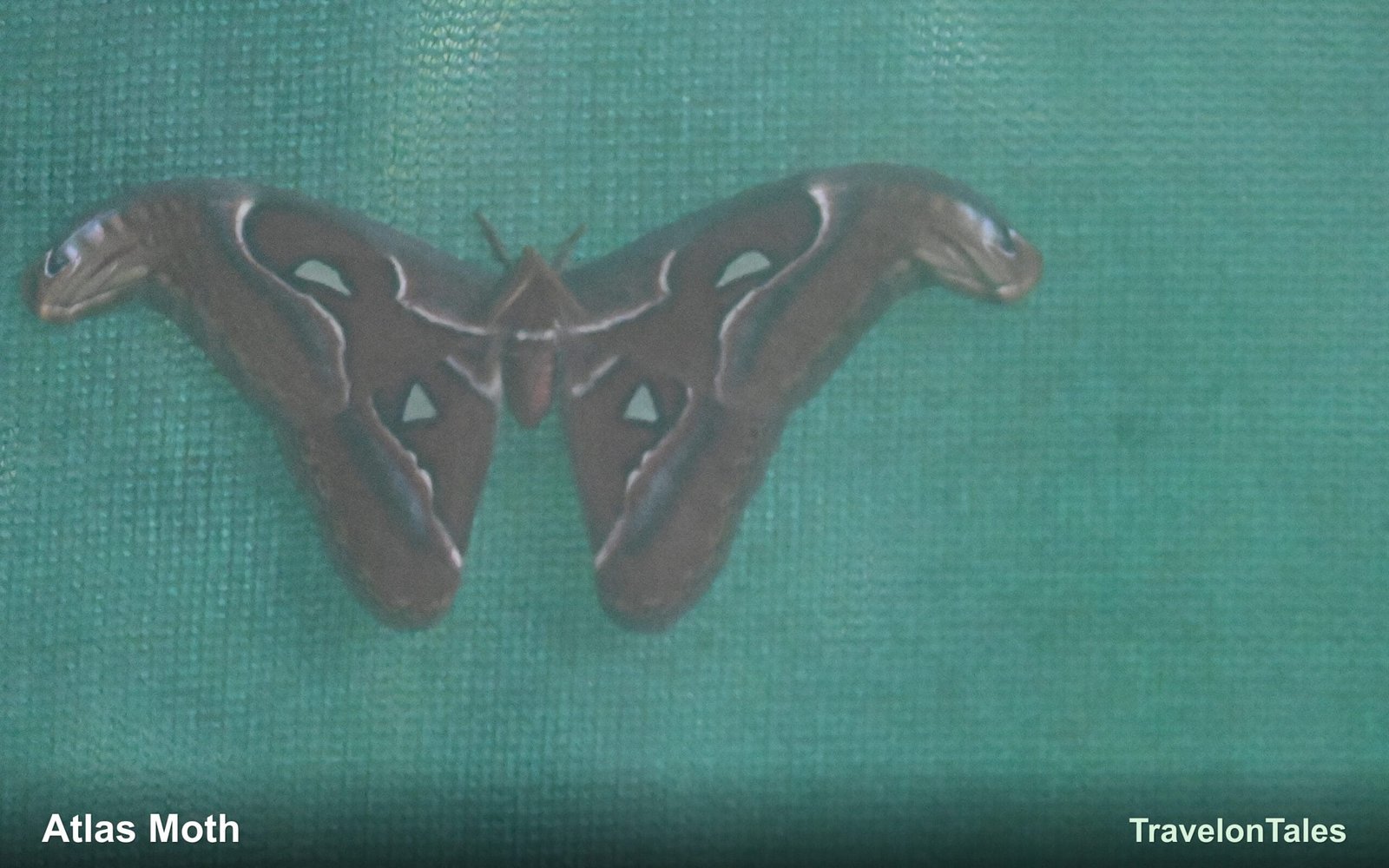
How big is an Atlas moth?
The wingspan is usually 20 to 24 cm and the wing surface area is among the largest of any insect. Females are bigger than males.
It is often called the largest moth in the world. By wing area that is close to true, though the Hercules moth and the white witch have claims on wingspan too.
The snake head on the wingtips
Look at the tip of each forewing. The shape and markings look like the head of a snake, complete with an eye and a curved snout.
When the moth is disturbed it can drop and flap slowly, and the moving wingtip is thought to imitate a snake head well enough to make a bird think twice. Whether or not it fools every predator, the resemblance is striking once you have seen it.
The moth that cannot eat
This is the fact that surprises most people. An adult Atlas moth has no working mouthparts. It cannot feed at all.
It emerges with all the energy it will ever have, stored as fat from its caterpillar stage. It lives roughly one to two weeks, mates, lays eggs and dies. Everything the adult does runs on fuel the caterpillar collected.
How it finds a mate
The female sits still and releases a scent. The male has large feathery antennae that can detect that scent from a considerable distance downwind, and he flies to her.
Because neither can feed, and the adult life is short, this has to work quickly. The huge antennae on the male are the whole strategy.
Where and when to see one
Atlas moths live in the forests of South and Southeast Asia. In India they are found in the Western Ghats, the Northeast and other forested regions.
The monsoon is a good time in the Western Ghats. They are night fliers and they come to lights, so the most common way to see one is exactly how we did: on a wall, a window or a mesh door at a forest homestay after dark.

Photography tips
- Do not handle it. The wing scales rub off on your fingers and do not grow back. Photograph it where it sits.
- Shoot flat on. A moth on a wall or mesh is a flat subject. Keep the sensor parallel to it so the whole wing is sharp.
- Include something for scale if you can do it without touching the moth. Otherwise the size does not read in the photograph.
- Use soft light. Direct flash flattens the wing pattern and burns out the pale windows.
- Turn the light off afterwards. A moth stuck at a lamp all night is exposed to predators at dawn.
Frequently asked questions
Is the Atlas moth the largest moth in the world?
By wing surface area it is usually given the title. By wingspan the Hercules moth and the white witch are comparable.
Do Atlas moths bite or sting?
No. The adult has no functional mouth at all and cannot bite. It is completely harmless.
How long does an Atlas moth live?
The adult lives about one to two weeks. It does not feed during that time.
Why do the wingtips look like snakes?
It is thought to be defensive mimicry. A predator seeing what looks like a snake head is more likely to leave the moth alone.
Where can I see one in India?
Forested areas of the Western Ghats and the Northeast. They come to lights at night, so forest homestays and lodges are the usual place people find them.
Related posts: Sindhudurg Monsoon Birding Guide, Oriental Dwarf Kingfisher in Sindhudurg and Plain Tiger Butterfly.