
Most of us say “peacock” for every one of these birds. But the peacock is only the male. The female is a peahen. And the bird as a whole is called the Indian peafowl (Pavo cristatus). It is a small thing. But once you know it, you will notice every time someone gets it wrong.
This is a plain guide to the Indian peafowl. How to tell the male from the female, what that famous “tail” really is, why it falls off every year, how the dance works, and why safari guides listen to peafowl when they are looking for a tiger. The photos are from Bandhavgarh and Jawai.
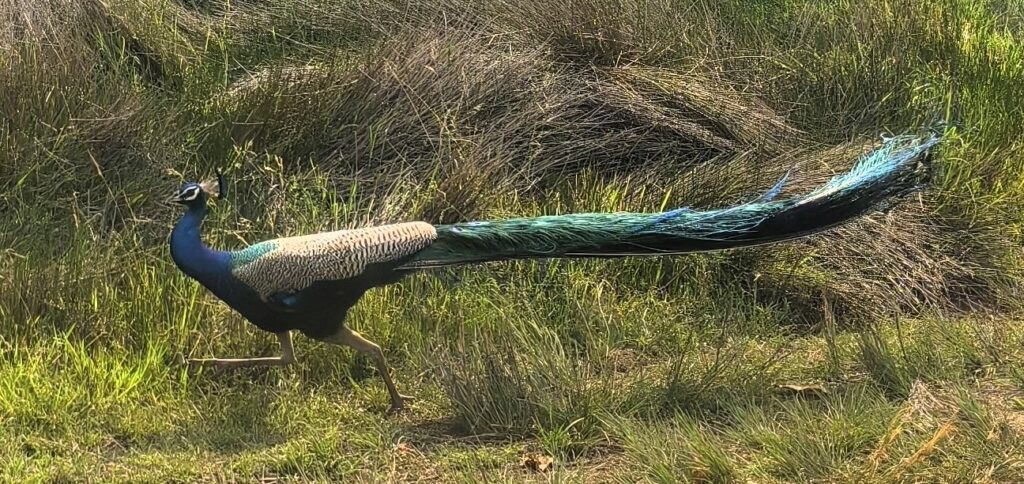
The words, explained
| Word | What it means |
|---|---|
| Peafowl | The species. It means both males and females. |
| Peacock | The male. |
| Peahen | The female. |
| Peachick | A young bird. |
How to tell a peacock from a peahen
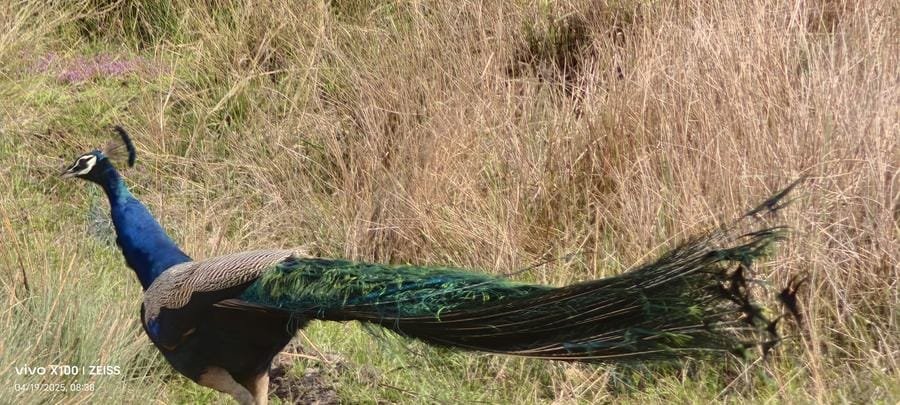
- The train. Only the male has the long train with the eye-spots. He raises it and fans it when he displays.
- The colour. The male has a shining blue neck and breast, and a fanned crest on his head. The female is brown, with a white face and a neck that shines green.
- The size. The male looks bigger, mostly because of the train.
- The behaviour. The male displays and calls loudly. The female feeds quietly and watches him.
The tail that is not a tail
This surprises almost everyone. The long, beautiful feathers behind a peacock are not his tail. They are called the train. The train grows from his back, above the real tail. It is made of about 200 long feathers, and roughly 150 of them have the “eyes” on them.
The real tail is short, stiff and brown, and it sits hidden underneath. Its job is to prop the train up when he fans it. The train itself can be longer than the bird’s own body, close to two metres.
He loses it every year
Here is something even stranger. The whole train falls off after the breeding season, and it grows back before the next one. So a peacock in August can look like a big, plain, ordinary bird. You might not even notice him.
There is a good reason for this. Growing and carrying two metres of feathers, and still escaping predators, is hard. A male who can do it is showing that he is healthy and strong. The train is an honest sign.
Young males take time too. A young male looks like a female at first. Slowly he gets blue on his neck. The full train takes about three years to come.
How the dance works
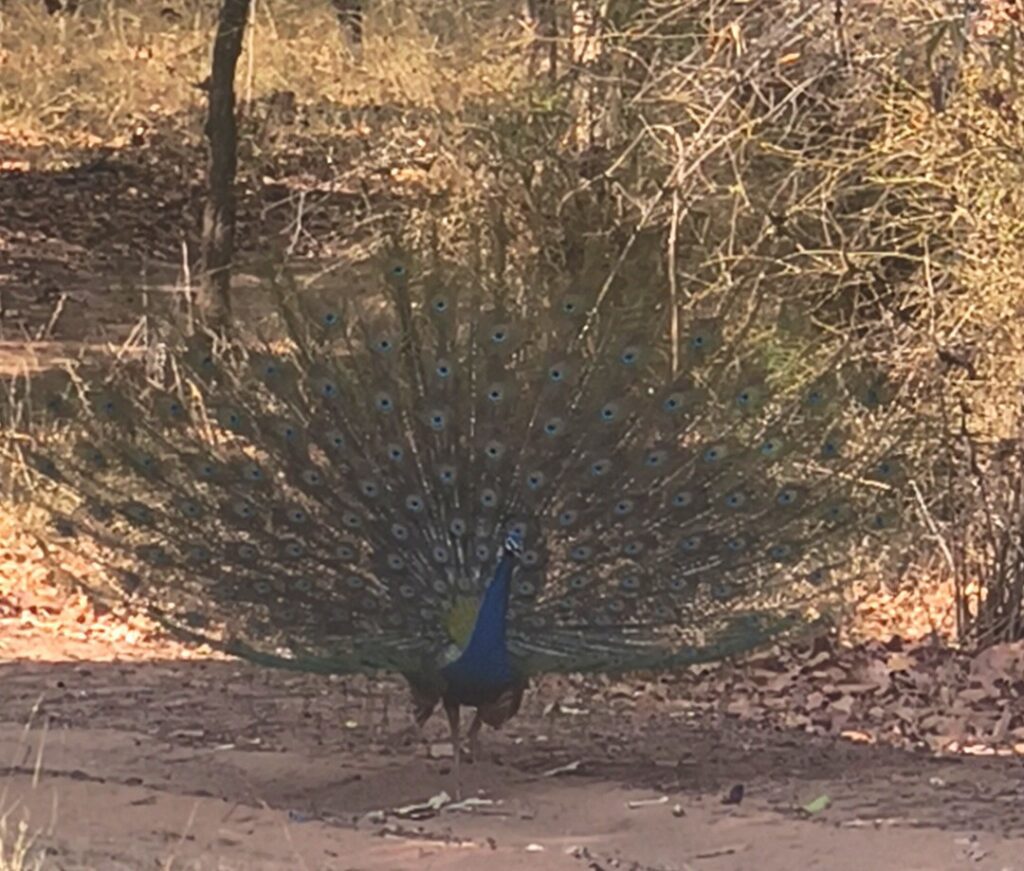
The peacock’s display is not just a fan opening. There is a sequence, and once you know it, you can tell which stage he is at.
- The raise. He lifts the train and spreads it.
- The shiver. He shakes the train very fast. This makes a dry rattling sound you can hear when you are close.
- The turn. Every so often he turns his back and shows the plain brown back of the fan. It looks like a mistake, but it is deliberate, and it is part of the show.
- The rush. If the peahen stays, he may run a few steps toward her with the train still up.
The shaking also makes a sound we cannot hear. It is called infrasound, which is below the range of human ears. Peahens can detect it. So the peacock is talking on a channel we are deaf to. A recording of the dance misses part of what is happening.
Studies suggest the peahens look at the eye-spots, how many there are and how good they look. They also look at how strongly the male shakes. Carrying and shaking a train this long takes a lot of energy. A male who can do it well is saying something true about himself.
The call is a safari signal
Peafowl are loud. Their call sounds like “may-awe”, and they use it when they see a predator, and before rain. On a safari, the guides listen to them along with chital and langur calls when they are tracking a tiger or a leopard. If a peacock keeps calling from one spot, it is worth stopping. I wrote about this in Bird Watching at Bandhavgarh and Tiger Photography in India.
When and where to watch them
The display season runs mostly with the approach of the monsoon, and into it. The best hours are early in the morning and late in the afternoon. Look in open ground beside forest, at the edge of villages and in clearings inside reserves. Peacocks display where there is space and an audience, so a spot that works once will often work again.
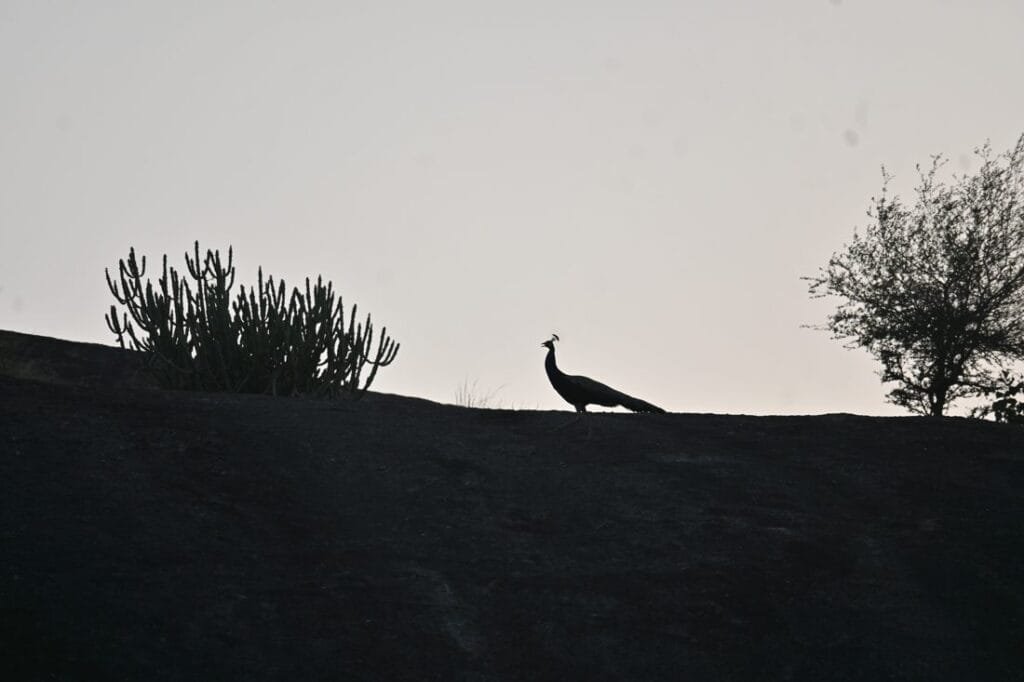
Peafowl live all over India. We have seen them in tiger reserves like Bandhavgarh and in rocky country like Jawai. They are easy to see, and a good bird to practise on if you are learning bird photography.
What they eat
Peafowl are not fussy. In the wild they look for seeds, insects and small reptiles in open forest, grassland and farm land. They also eat snakes. That makes them useful for the forest, because they help keep the numbers of insects and snakes in balance.
Photographing a peacock
- Do not chase the fan. A displaying male is unpredictable. If you walk toward him, he stops. Pick a spot and wait.
- Shoot the shiver. A slightly slower shutter turns the shaking into soft movement. It shows what is happening much better than a still fan.
- Shoot from behind sometimes. A backlit fan from the back is a picture most people never take.
- Use soft light. Harsh sun kills the blue and green shine. Overcast skies bring it out.
- Add the peahen if you can. A male alone is a picture. A male showing off to a female who does not care is a story.
Why is it the national bird?
The Indian peafowl was named the national bird of India in 1963. It was chosen because it lives across the whole country, and because it has been part of Indian art, myth and religion for a very long time.
More on the Indian peafowl
Our full species guide is The Indian Peafowl (Pavo cristatus), and a forest note from Bandhavgarh is Peacock in Bandhavgarh Forest.
Questions people ask
Is a peacock male or female?
Male. The female is a peahen.
Is the peacock’s train its tail?
No. The train is made of long feathers that grow from the back, over the real tail. The real tail is short, stiff and brown, and it sits underneath.
Do peacocks lose their feathers?
Yes. The whole train falls off after the breeding season and grows back before the next one.
Why does a peacock shake its feathers?
It is part of the courtship. The shaking also makes infrasound that peahens can detect.
Why do peacocks call before rain?
They call at many things, including weather and predators. The link with rain is real, but the call is not only for rain.
How long does it take for a young male to get a full train?
About three years.
Related: Safari Alarm Calls: How Guides Find Tigers by Listening