
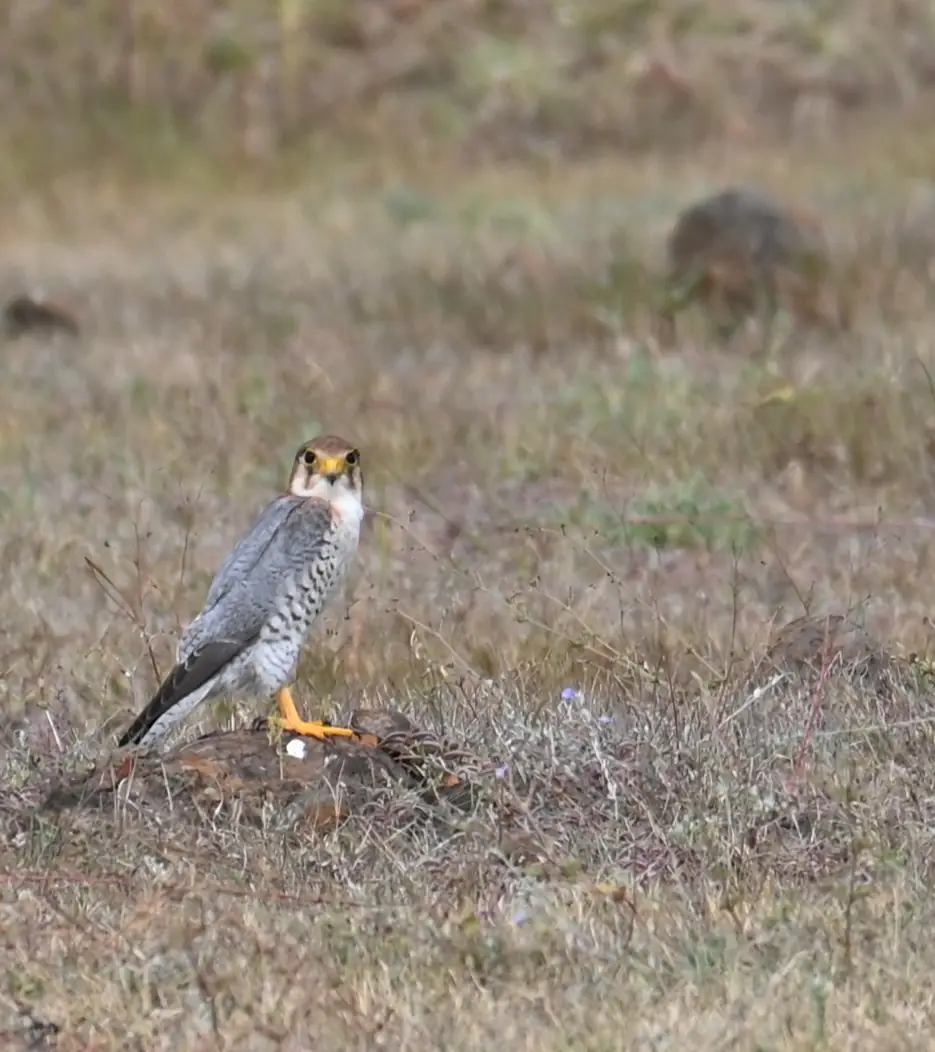
The Red-necked Falcon is a small, fast falcon of open country. On a grassland morning near Bhigwan, one stood on a mound in the grass and looked straight into our camera.
How to recognise a Red-necked Falcon
- A rusty chestnut crown and back of the neck.
- Blue-grey back and wings.
- White underparts with fine dark bars.
- Bright yellow skin around the eye, at the base of the bill and on the legs.
How it hunts
This falcon hunts mainly small birds. It flies low and very fast, often with its partner, and the pair work together to chase their prey. It also takes bats, lizards and large insects.
Where it lives
Red-necked Falcons live in open country with scattered trees, palms, farmland and grassland, across much of India. They often perch on a tall tree or a pole and watch the ground.
Tips for photographing it
- Look in open country with lone trees or palms.
- Mornings are best, when the birds are hunting.
- Keep your distance and let the bird settle.
Read about the rest of that morning in our Bhigwan trip story.
Red-necked Falcon or Amur Falcon?
The Amur Falcon passes through India on migration. Its female has a grey crown and orange-red skin around the eye. The Red-necked Falcon has a rusty chestnut crown and bright yellow skin around the eye and on the legs, which makes it easy to tell apart.
Life as a pair
Red-necked Falcons often live in pairs all year. They nest high in tall trees, especially palms, often in an old crow’s nest. The pair hunt together: one flushes the small birds, and the other makes the catch.
Our sighting
We met our falcon at about 9.35 in the morning on the grassland near Bhigwan. It stood on a small mound in the dry grass, turned its head and looked straight at us for several frames before flying off low across the grass.
What it shows about a grassland
A hunting falcon is a sign of a healthy grassland, full of small birds and insects. The grasslands around Bhigwan support larks, pipits, quails, sandgrouse and many more, which makes them excellent falcon country.
Best time of year
These falcons are resident and seen all year. Clear winter mornings give the best light; the green months after the monsoon add colour to the background.
How to reach Bhigwan and Kadbanwadi
Bhigwan is on the Pune–Solapur highway (NH65), about 105 km from Pune. The nearest airport is Pune, and Bhigwan has its own railway station (BGVN), with Daund Junction about 26 km away for more trains. State Transport buses from Pune to Solapur stop at Bhigwan. Kadbanwadi is a short drive away, and most homestays in Kumbhargaon arrange transport and local guides.
Frequently asked questions
Is the Red-necked Falcon found in India?
Yes. It is found across much of India in open country with scattered trees.
What does the Red-necked Falcon eat?
Mostly small birds, which it catches in fast, low flight, often hunting with its partner.
Why is it called red-necked?
Because of the rusty chestnut colour on its crown and the back of its neck.