
Ask ten people in India what an Indian bison is and most will point to the same animal: a huge, dark animal with big horns standing in the forest. That animal is the gaur. And here is the funny part. It is not a bison at all.
This page is a simple guide to the gaur. What it is, how big it gets, how to tell it from a buffalo, and where we have seen it. I have photographed gaur in three parks, and each time it has made me stop and stare.
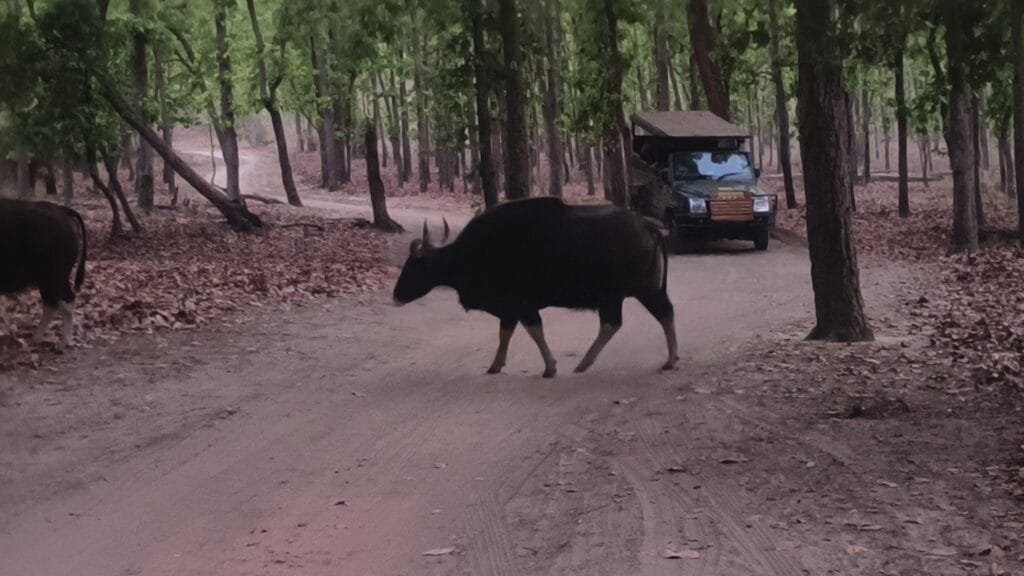
So what is a gaur?
The gaur (Bos gaurus) is the largest wild cattle species on earth. Not just in India. In the whole world. It lives in the forests of South and Southeast Asia. It belongs to the same family as the cows and bulls we see on our streets, only it is much, much bigger.
People call it the Indian bison, or the wild Indian bison. That name is wrong, but it stuck. A true bison belongs to a different group and lives in North America and Europe. No true bison has ever lived in India.
Gaur at a glance
| Indian gaur | |
|---|---|
| Scientific name | Bos gaurus |
| Other names | Indian bison, wild Indian bison, gaur |
| Weight | About 650 to 1,500 kg. Big bulls are often over a tonne |
| Height at the shoulder | About 1.7 to 2.2 metres |
| Colour | Dark brown to almost black, with white lower legs |
| What it eats | Grass, leaves, bark and fruit |
| Conservation status | Vulnerable (IUCN) |
| State animal of | Goa and Bihar |
If a large dark animal has white feet, it is a gaur.
The white legs trick
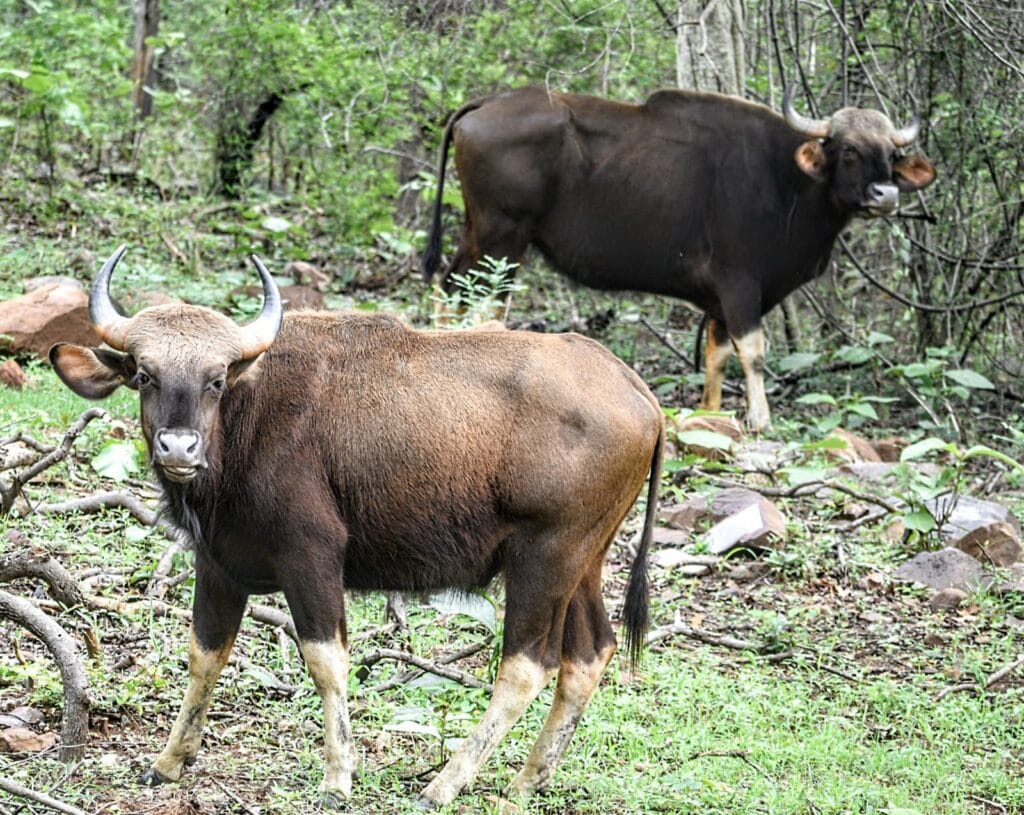
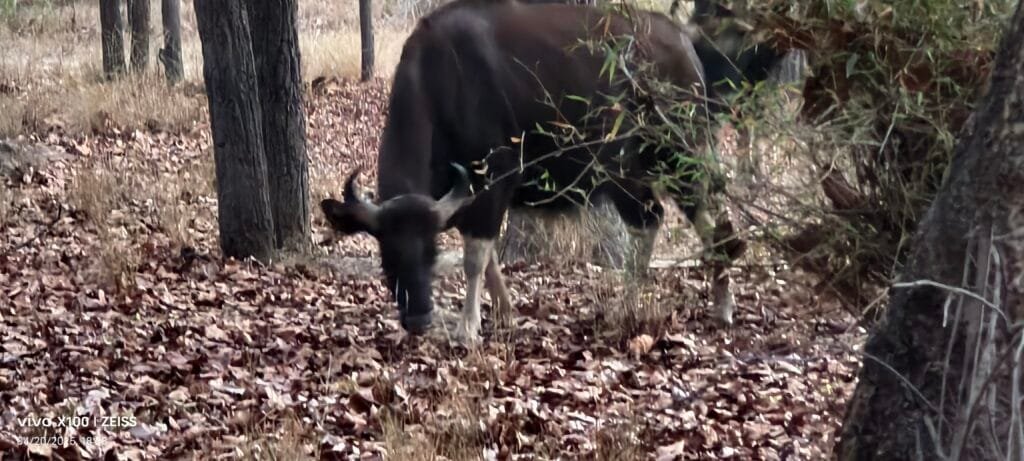
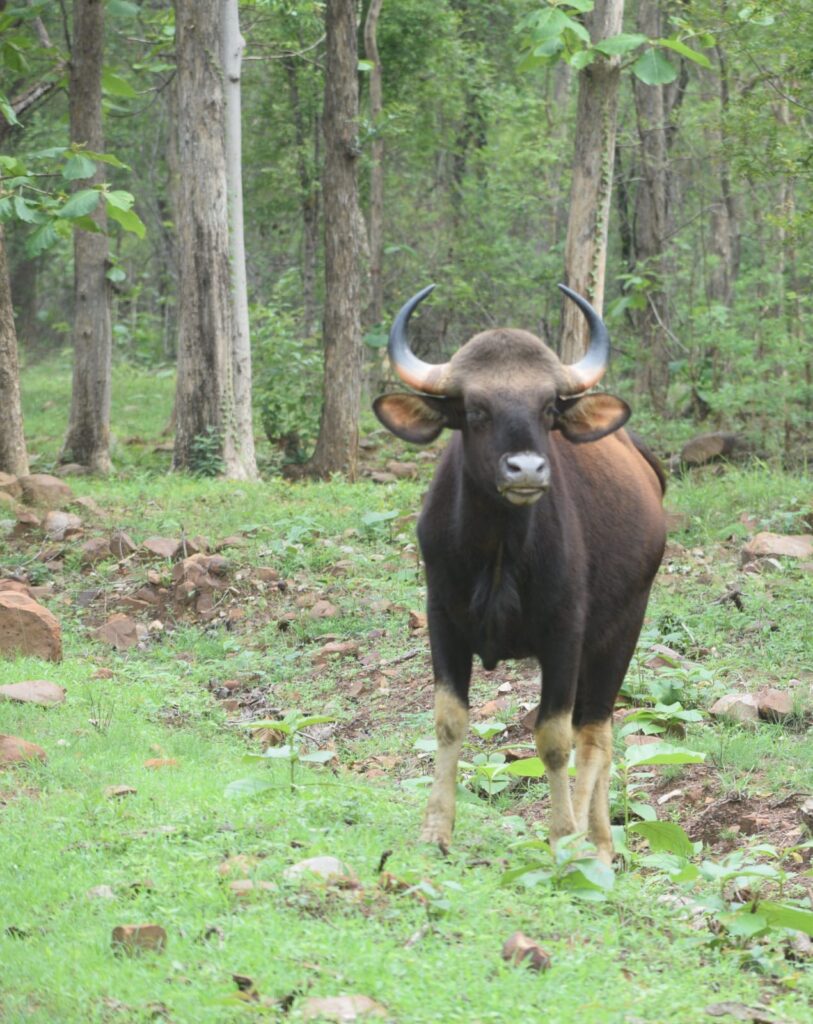
Think of every big dark animal in an Indian forest. Sambar, sloth bear, wild boar, buffalo. All of them have dark legs. The gaur is the odd one out. From the knee down, its legs are white or cream, like it is wearing socks.
This is the best way to know a gaur, even from far away or in bad light. You do not need to see the horns or the hump. Look at the legs.
Gaur, bison or buffalo?
Three big, dark, horned animals. People mix them up all the time. Here is the simple difference.
| Indian gaur | Bison | Buffalo | |
|---|---|---|---|
| Where it lives | India and Southeast Asia | North America and Europe | Asia and Africa |
| Habitat | Dense forest | Open grassland | Wetlands and grassland |
| Legs | White below the knee | Dark all the way | Dark all the way |
| Family group | Bos (cattle) | Bison | Bubalus or Syncerus |
The easy rule: if it is in an Indian forest and has white legs, it is a gaur.
How to spot a gaur in the field
- Look at the legs first. White socks on a dark body.
- Look at the forehead. There is a pale ridge between the horns. It is called the boss.
- Look at the horns. They curve up and in. They are pale at the base and black at the tip.
- Look at the back. There is a muscular ridge over the shoulders. It is bigger in bulls.
Where we have seen gaur
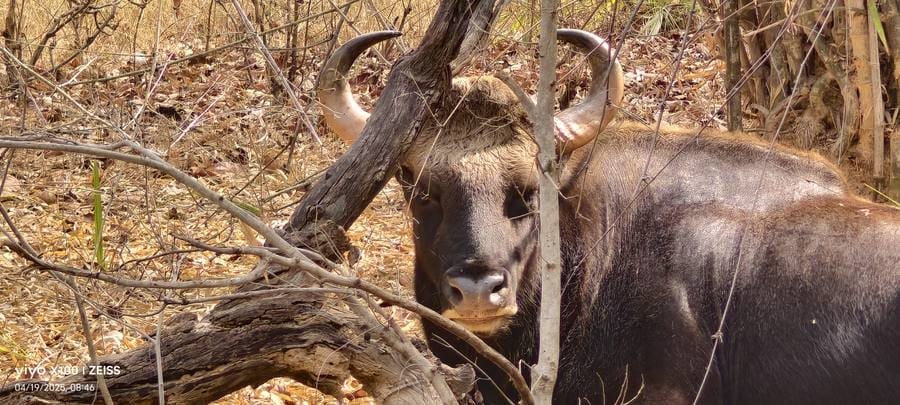
We have photographed gaur at Tadoba, at Bandhavgarh and at Panna. In all three parks, gaur live in forest and hill country, often near water.
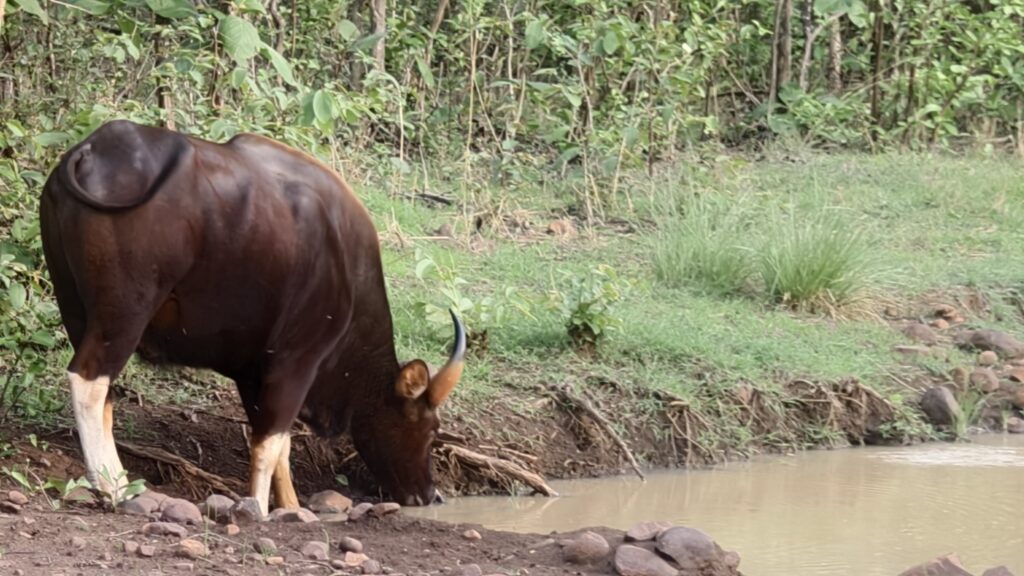
At Bandhavgarh we found a bull in the Tala Zone in the April heat. He was standing still about twenty metres from the track. At Tadoba, we saw two together in a green clearing. And at a forest pond, we watched a gaur drinking.
What a gaur does all day
Not much, and that is part of its charm. A gaur eats grass, leaves, bark and fruit. It moves in herds, led by a strong cow or a big bull. It rests in the shade in the heat of the day. In the cool of the morning and evening, it grazes.
Gaur are shy. They avoid people if they can. When they meet a jeep, they usually look at it for a few seconds and then carry on.
Are gaur dangerous?
They can be, but only in certain situations. If a gaur is surprised, hurt, protecting a calf, or met on foot, it may defend itself. On a safari, from a vehicle, the risk is low. We wrote a full page on this called Is the Indian Gaur Dangerous?.
Photographing a gaur
A gaur is a great subject for a beginner. It is big, it stays still and it is easy to find in the right park. Here is what we have learned.
- Expose for the dark body. A dark animal in a green forest can look like a black shape. Raise your exposure a little so you can see the eyes.
- Wait for the head to lift. Eyes visible makes a much stronger picture.
- Keep the white legs in the frame. They tell the viewer what the animal is.
- Use the jeep as your hide. Stay inside and use a long lens.
- Check the background. A messy branch behind the head will ruin a good frame.
For more ideas, read Tiger Photography in India.
More gaur stories from this site
- Indian Gaur: weight, size, habitat and facts
- The Indian Gaur: the gentle giant of India’s forests
- Indian Gaur: nature’s titan of Indian forests
- Indian Gaur at Bandhavgarh: field notes
- Is the Indian Gaur Dangerous?
Questions people ask
Is the Indian gaur the same as the Indian bison?
Yes, people use both names for the same animal. But the gaur is not a true bison. It belongs to the cattle family.
What is the scientific name of the gaur?
Bos gaurus.
How big is an Indian gaur?
Bulls can weigh over a tonne and stand about 1.7 to 2.2 metres tall at the shoulder.
What does a gaur eat?
Grass, leaves, bark and fruit. It is a plant eater.
How can I tell a gaur from a buffalo?
Look at the legs. A gaur has white lower legs. A buffalo has dark legs all the way down.
Where can I see gaur in India?
In forest parks such as Tadoba, Bandhavgarh and Panna. You may see them near waterholes in the morning and evening.