
We left Mumbai in the dark and drove into weather. Somewhere past Chiplun the rain stopped being something the wipers dealt with and became the whole windscreen. By the time we turned off for Vanoshi it had been raining, without any real pause, for about nine hours.
Two days. That was all we had. People plan a week for this and we had two days, in the middle of the monsoon, for a bird the size of a matchbox.
The forest wakes you up
You do not need an alarm. The tin roof does it. Rain on tin is not a gentle sound, and underneath it there are frogs that have been going all night, and somewhere in the trees something calling that I never did identify.
Outside it was still properly dark. Not the blue that comes before sunrise — dark. Our guide was already on the path with a torch pointed at the ground, waiting, entirely unbothered, in a shirt that was going to be soaked within the hour.
We went down to the stream.
Mostly you just stand there

Here is the thing nobody tells you about photographing an Oriental Dwarf Kingfisher in the monsoon. You do not look for it. You go and stand near a particular perch that somebody who knows the forest has chosen, and then you stop moving, and then you wait a very long time.
It rained the whole time. Not dramatically. Just steadily, the way it does there, so that after twenty minutes water has found the gap at your collar and after forty you have stopped thinking about it.
Leeches came up the boots. You flick them off and they come back. After a while you stop doing even that.
And then it is simply there
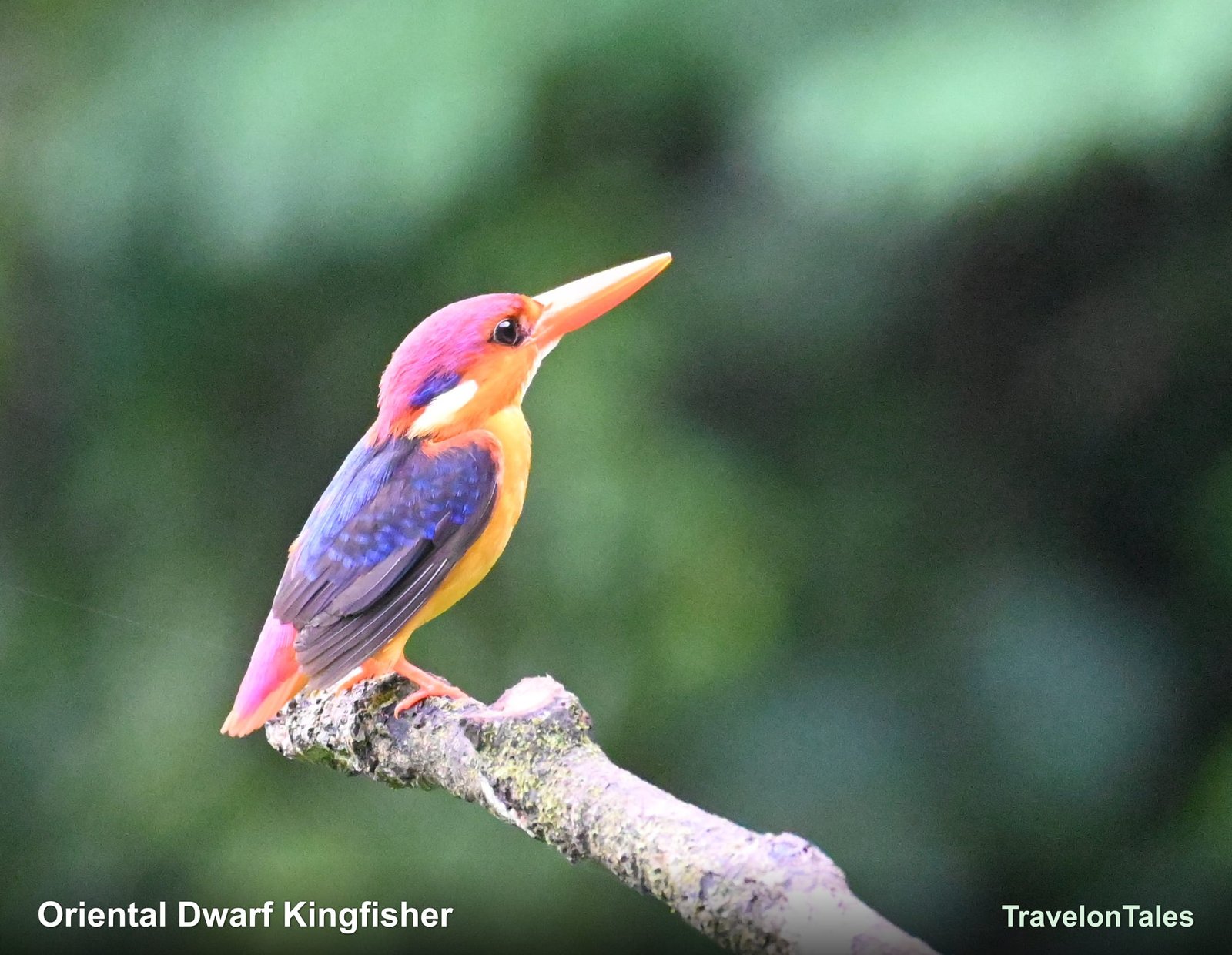
It arrived without any warning at all.
One second there was a wet branch over a stream. The next there was this absurd small thing sitting on it, orange and lilac and impossible, looking somewhere else entirely. I did not see it fly in. It was simply there, the way a thought arrives.
I did not take a photograph for the first few seconds, which I regret and also do not.
Then everybody remembered themselves and there was that soft mechanical noise of four people shooting at 1/200th and ISO 6400 in light that did not deserve the name. It sat there for less than a minute. Then it dropped, took something out of the water, and was gone.
Nine hours of driving and two hours of standing in the rain, for less than a minute of bird. I would do it again tomorrow.
What we walked past twice

Our guide took us a little further along and pointed at the bank.
That was a nest tunnel, and I had walked past it twice that morning without seeing anything at all. This is the part of the trip I still think about — not the bird, but how much of that forest was invisible to me and completely obvious to someone who had spent years in it. Without them we would have seen a fraction of what we saw. Possibly none of it.
The middle of the day
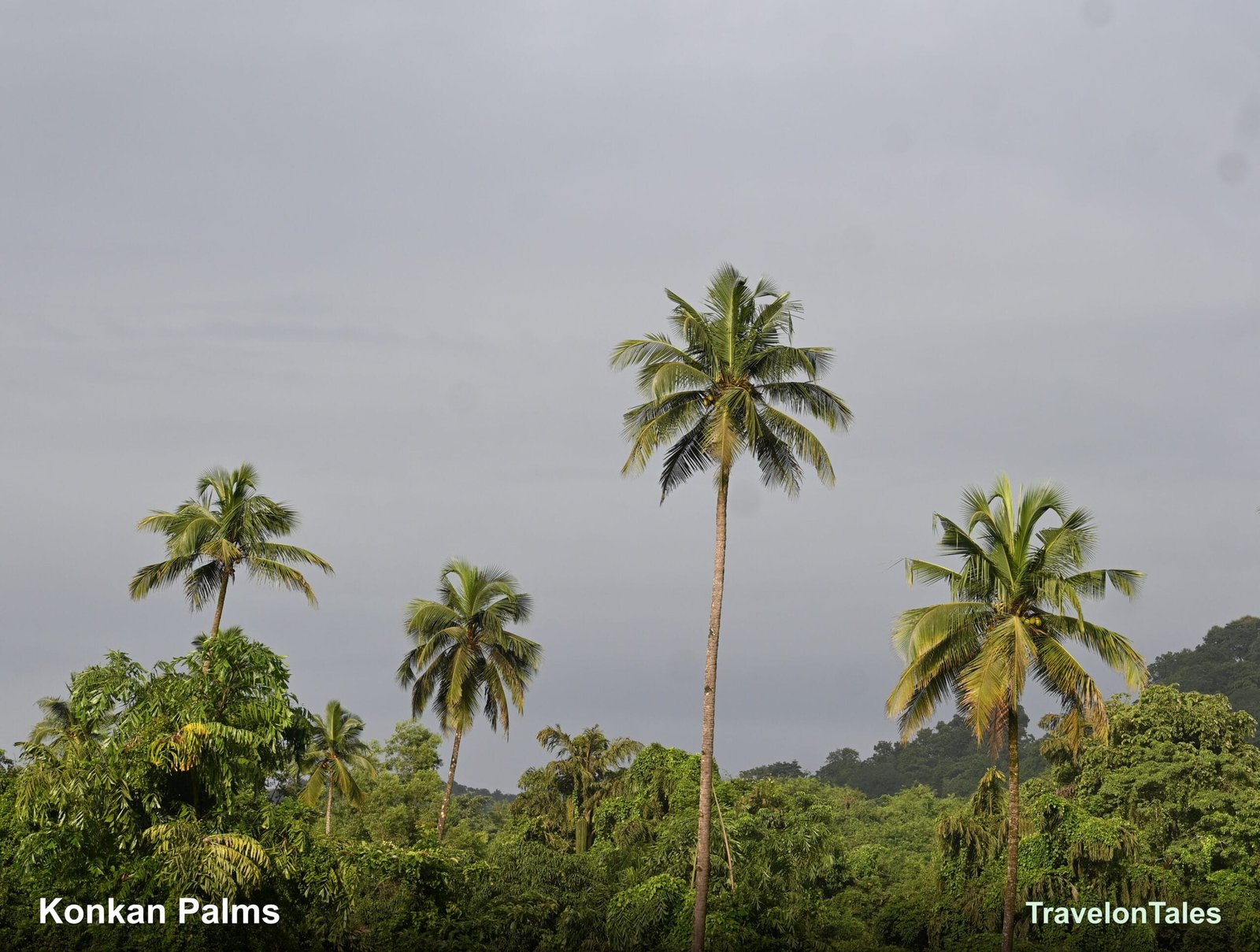
Very little happens in the middle of a monsoon day, whatever the brochures suggest. It rained hard. We sat under a roof with lenses and lens cloths and that gritty feeling of salt and sweat and rain, drinking tea, waiting for the afternoon.
Everything we owned was damp. Not wet — damp, which is worse, because it never dries. The camera bags smelt of wet nylon for a week after we got home.
When the rain eased we went straight back out, which is the whole argument for staying inside the forest instead of an hour away from it. No packing, no driving. Boots on, gone. A Blue-eared Kingfisher on the second stream, darker and deeper than the dwarf and somehow more serious about itself. A Malabar Grey Hornbill crossed a gap in the canopy doing the flap-flap-glide thing they do, calling like something being strangled.
What the lights bring in
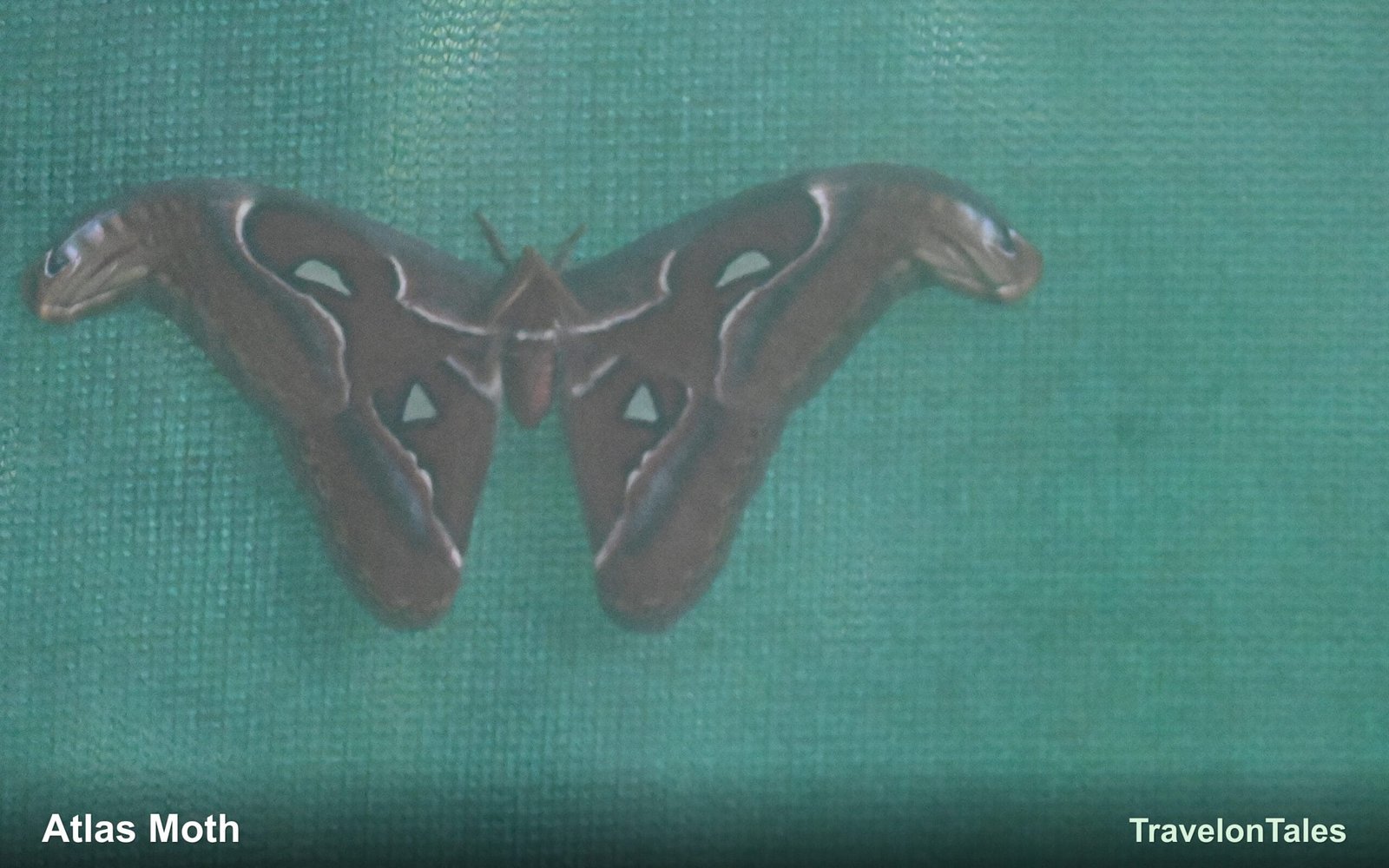
The lights on the property pull in insects, and the insects pull in everything else. There was an Atlas moth on the mesh door, sitting absolutely still, with those snake-head wingtips that look designed by somebody trying to frighten you.
The swallows had the lamp above the walkway. Two of them, every single evening, in the same spot, ignoring us completely. I have written about those swallows elsewhere, because they turned out to be the birds I photographed most on the whole trip and they never moved more than ten feet from the building.
The frogs started at dusk and did not stop.
The owl

A Brown Wood Owl, twenty feet up, in shade so deep the camera could not find anything to lock onto. Absolutely motionless.
Our guide put the torch beam on the ground near the base of the tree and then just pointed up, and it took me a full thirty seconds to resolve a bird out of what I was certain was bark.
It opened its eyes, looked at us with an expression of total contempt, and closed them again.
The one we did not get
An Indian Pitta called. We never saw it.
It called from a slope for about twenty minutes, that two-note whistle, shifting position slightly each time, and we stood in wet undergrowth turning our heads like idiots while it declined to show itself.
That is the honest ledger. The kingfisher, yes. The owl, yes. The pitta, no. And in between all of it, a great deal of standing still.
Driving home

We left at midday in more rain, past rivers that were brown and much too full, past laterite cuttings bleeding red water onto the road, past a man cycling with an umbrella in one hand and doing it far better than seemed possible.
The thing I did not expect about monsoon birding is how much of it is discomfort, and how completely that vanishes from the photographs. You see the frame of the kingfisher on the wet branch. You do not see the two hours before it, the leeches, the fogged viewfinder, or the shot lost because water landed on the front element at the exact moment the bird turned.
And then it lands, and the arithmetic stops making sense in the best possible way.
Two days, and barely a minute of the thing we came for. Worth every hour of it.
If you are planning something similar, the full Sindhudurg monsoon birding guide has the practical side of it — when to come, what it costs, what else is around — and the field guide to the birds of Sindhudurg covers the species properly, which this account deliberately does not.
A note on names: we identify these birds ourselves and we do not always get it right. If you think we have called one wrongly here, tell us — we are still learning this, and we would rather fix a name than leave it standing.